
NB: This is a revised version of TechTips #2 with the addition of further details on how the issue of hand capacitance has been resolved.
The problem: Hand capacitance makes it difficult to accurately adjust the GTU.
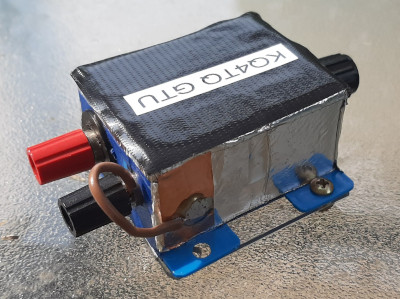
The fix: Upon examination of my own GTU it was discovered that the layout had become too complex and the plastic enclosure provided no shield against capacitance between my hand and the RF circuitry. The solution is actually very simple; either re-assemble the GTU inside a metal enclosure, or provide some means of shielding the circuitry from hand capacitance. Since I didn’t have a suitable metal enclosure I elected to do the latter. The entire plastic enclosure was covered with aluminum duct tape. As an additional precaution, the duct tape was electrically connected to the ground binding post to ensure it remains at ground potential.
Did it work? Yes, I am pleased to report that this fix has entirely eliminated the problem. Here is a photo of the shielded GTU (KQ4TQ single inductance version):
The following is the pre-amble to the first version of TechTips #2 (now deleted to avoid confusion).
This is the second in an occasional series of short posts that zero in on details of a specific technical topic in relation to projects here on this blog, which some readers may find helpful.
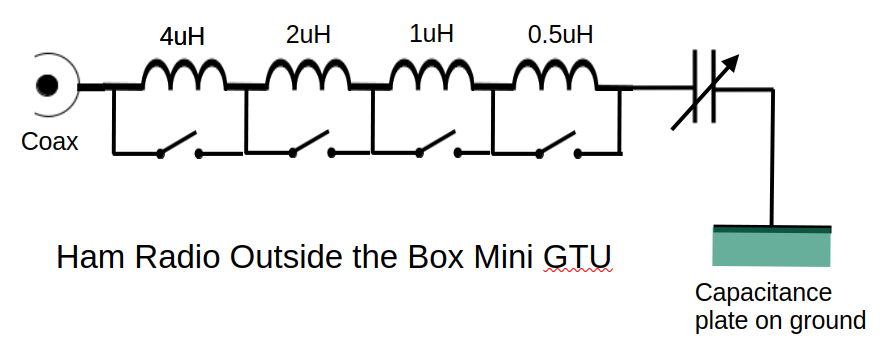
A few weeks Ham Radio Outside the Box published a description of a “Mini Ground Tuning Unit (GTU)”. The schematic for that device is reproduced below. The design was then simplified with input from HROTB-Labs collaborator Tim KQ4TQ. Tim proposed a single inductance with a value of 3 microhenries (and generously donated a prototype he had built).
I built the revised GTU and performed many experiments in HROTB-Labs outdoor test facility (actually, my backyard). Various types of ground planes were tried, from G4AKC’s capacitance plate at the base of his pedestrian mobile radio trolley, to Faraday cloth (“magic carpet”), to ground radials.
My least favorite was the Faraday cloth. The one I used was about 1 square meter in area. I acknowledge the input of Paul VE3PVB who emphasized the need to maximize the area of the Faraday cloth to improve its efficiency. Two things about Faraday cloth are worth noting: first it has a shiny surface which can be distractingly reflective in bright sunshine. Second, it is often referred to as “magic carpet” – a very appropriate term since it has a tendency to fly in even a mild wind. Matt finish paint and a bag of rocks fixes both issues.
I settled on a set of 8 short radials (each 7 feet, or 2 meters long) and they work well. A single long radial wire might be more convenient for rapid deployment in the field. Along with the Ground Tuning Unit (GTU) and a resonant vertical radiating element, a very acceptable SWR is obtained without the use of a tuner.

Help support HamRadioOutsidetheBox
No “tip-jar”, “buy me a coffee”, Patreon, or Amazon links here. I enjoy my hobby and I enjoy writing about it. If you would like to support this blog please follow/subscribe using the link at the bottom of my home page, or like, comment (links at the bottom of each post), repost or share links to my posts on social media. If you would like to email me directly you will find my email address on my QRZ.com page. Thank you!
The following copyright notice applies to all content on this blog.

This work is licensed under a Creative Commons Attribution-NonCommercial-NoDerivatives 4.0 International License.
Discover more from Ham Radio Outside the Box
Subscribe to get the latest posts sent to your email.
 Ham Radio Outside the Box