
About a year ago I mentioned an antenna devised by Peter Waters G3OJV that used a 13 feet (4 m) vertical wire to create a multiband antenna. I used Peter’s idea to create “A Simple, Low Profile, Multiband Antenna for POTA“. The antenna was designed to work on 20m, 17m, 15m, 12m and 10m with the aid of a tuner. But, I discovered a small problem on the 17m band. If we do the elementary calculation for the length of a quarter-wave radiator at the bottom end of the band (18.068 MHz) we find that it works out to be 12.95 ft – just a whisker short of the 13 ft recommended by G3OJV. So why is that a problem?
The problem arises because the antenna uses a 4:1 unun at the feedpoint. Since the 13 ft length is already almost resonant on 17 meters, the 4:1 unun makes the job of the tuner much harder. That did indeed prove to be the case when I tested my derivative in the field. So, I made a small change when designing the new 5B6L antenna – I increased the length to 14 feet (4.2672 meters) – well … not quite true, but that is the underlying principal behind the linear-loaded equivalent.
Here are the calculated lengths of a quarter-wave radiator at the mid-point of each of the five bands of interest:
| 20m: 16.6 feet | 17m: 12.92 feet | 15m: 11 feet | 12m: 9.39 feet | 10m: 8.11 feet |
A 14ft radiator slips nicely in between the 20m and 17m quarter wavelengths and becomes a “random length” on all 5 bands. Nice. But this is a linear-loaded antenna made from ladder line. Linear-loading shortens the required length by around 30%. Fourteen feet, shortened by 30% works out to 9.8 feet (~3 meters). After field adjustments I settled on a length of 9.75 ft (a little less than 3 meters).
Lose the radials!
I wanted this antenna to be what could be loosely described as a random length dipole – two equal lengths of ladder line (each shorted at one end) so that was how it was constructed. Now we have the benefit of versatility. It could be erected as a traditional dipole although with two very short arms it would be tricky to get it up in the air. It could also be erected as a vertical dipole on a support pole about 7 meters (23 feet) tall like my Spiderbeam. But that would make it difficult to orient the coax feedline so that it comes away from the antenna at 90 degrees, as is required to prevent the feedline picking up some of the radiated signal. Perhaps a sloper would work; now that is a very viable solution.
How ‘Bout a Lazy-L?
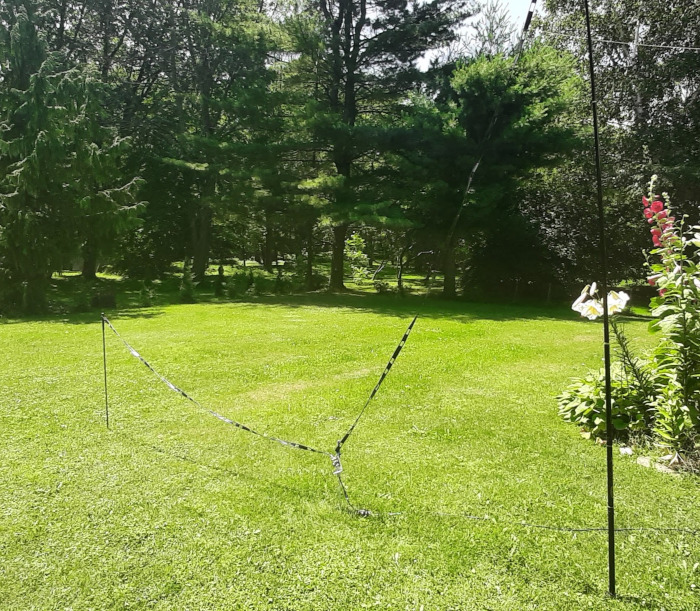
One of the YouTube channels I follow is “Jim’s Cool Stuff“. In one of his videos Jim suggested using a “Lazy-L” orientation of a vertical simple wire radiator and single raised radial wire. Why? The purpose is to increase the take-off angle. A vertical antenna usually has a very low take-off angle which is great for chasing DX, but what about shorter-range contacts? From my location in Southern Ontario, Canada it is only a short hop down to the north-eastern states in the USA. The US northeast has a very large concentration of amateur radio operators many of which participate in popular activities like POTA. A vertical antenna is likely to send my signal whistling over their heads, or at the very least, be received at a reduced level.
A Lazy-L configuration optimizes radiation to favor short to mid-range contacts by raising the take-off angle to achieve much shorter hops. Does it work? Yes indeed, during test operations I have been able to make contacts, just over the shallow puddle they call Lake Erie, into Pennsylvania, and across Lake Ontario into the state of New York, with quite respectable signal reports for my QRP CW signal.
But what about DX?
Stations on the west coast of the US or western Canada could be considered almost DX – each is thousands of kilometers away. No problem! I said this antenna has versatility. The Lazy-L configuration can be re-oriented to a straightforward regular vertical with a raised counterpoise very easily. In fact the angle at which the radiating element leans can be adjusted to find an optimum at which near-DX and short hop stations all fall within its radiation pattern.
How to Build a 5B6L
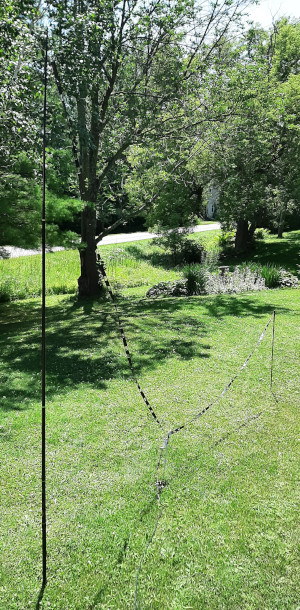
The following describes construction of a 5-Band, Linear-Loaded, Ladder Line antenna that can be operated on 20m, 17m, 15m, 12m and 10m with the use of a tuner. Materials needed are:
- Ladder Line. I recommend stranded conductors because this makes the ladder line more flexible than solid copper conductors. Use of the 5B6L as a field portable antenna may stress solid conductors and lead to failures.
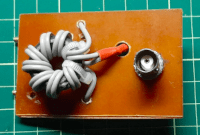
- a 4:1 unun. This item can be purchased or you can build your own using twin lead speaker wire (or similar) wound around a type-43 ferrite toroid
Instructions
- Cut two lengths of ladder line each 10 feet (3 meters) long. These may need to be trimmed during testing.
- Connect the two conductors of each piece of ladder line together at one end only.
- At the other end of each piece of ladder line, cut off the end of one of the conductors.
- Strip the insulation from the other conductor – this will be connected to the 4:1 unun.
- Connect each piece of ladder line to the unun.
Erection of the antenna
Attach a coax feedline to the 4:1 unun. A tuner may be inserted at this end if desired. For practical purposes, unless a very long coax is used, the SWR losses in the coax will not be significant so a tuner at the radio end can be used.
Set up your choice of pole, or other support, attach one end of the antenna to the top of the pole. The other end of the sloping radiating element (the feedpoint) should be supported on a short stick.
The other half of the antenna serves as a raised counterpoise and its far end can be supported by, for example, a trekking pole.
The slope angle can be adjusted by simply moving the counterpoise support sticks. See what works best for you. The whole antenna can be quite stealthy. I erected mine on only a 10 feet high pole. Efficiency may be improved by using a taller support but I prefer stealth when operating in public spaces. Tall antennas arouse suspicion!
The end is nigh!
A generous friend donated a lot of ladder line some time ago and I have used all but a few feet of it. Maybe it’s time to experiment with something different. So my next project – take a deep breath – is something I have been writing about in unflattering terms recently – a short, base loaded whip! What? Have I been enjoying too much Scottish champagne? Well, I thought it would be an interesting challenge to see how efficient I could make a short-ish whip antenna with a base-loading coil. A prototype has been constructed and has made contacts in backyard tests (with my helping fingers tapping on the key ). When the design has been completed you will be able to read about here on Ham Radio Outside the Box. Stay tuned.

Help support HamRadioOutsidetheBox
No “tip-jar”, “buy me a coffee”, Patreon, or Amazon links here. I enjoy my hobby and I enjoy writing about it. If you would like to support this blog please follow/subscribe using the link at the bottom of my home page, or like, comment (links at the bottom of each post), repost or share links to my posts on social media. If you would like to email me directly you will find my email address on my QRZ.com page. Thank you!
The following copyright notice applies to all content on this blog.

This work is licensed under a Creative Commons Attribution-NonCommercial-NoDerivatives 4.0 International License.
Discover more from Ham Radio Outside the Box
Subscribe to get the latest posts sent to your email.

