
TechTips are occasional brief posts describing easy ways to do difficult things.
What is a balun?
The simplest definition is “a device for connecting a balanced line to an unbalanced line.” Many hams use the term generically to refer to the device that goes in between the antenna wire and the coax. In some cases that would be true, but not always. There is also a similar device called an “Unun”. An Unun is a device for connecting two unbalanced lines.
In the case of an Unun, one of the two unbalanced lines is often the antenna itself while the other is a coax feedline.
BAL is an abbreviation of Balanced. UN is an abbreviation of Unbalanced. With that understanding it is easy to see the difference between a BAL-UN and an UN-UN.
Now what happens if the device also transforms the impedance between the two “lines”. Is it still a balun or unun? Some purists insist that the terms balun or unun refer strictly to the device’s primary function of connecting two “lines”. If the device also performs an impedance transformation (e.g. 4:1, 9:1, 49:1 etc) then it is an “impedance transformer“. I can understand that point of view but I prefer to take a more relaxed interpretation. If, for example, a device also happens to perform an impedance transformation between a balanced line (e.g. a dipole) and an unbalanced line it is still a “balun” – you could call it a “4:1 balun”. By comparison, a coffee maker with a built-in clock is still a coffee maker.
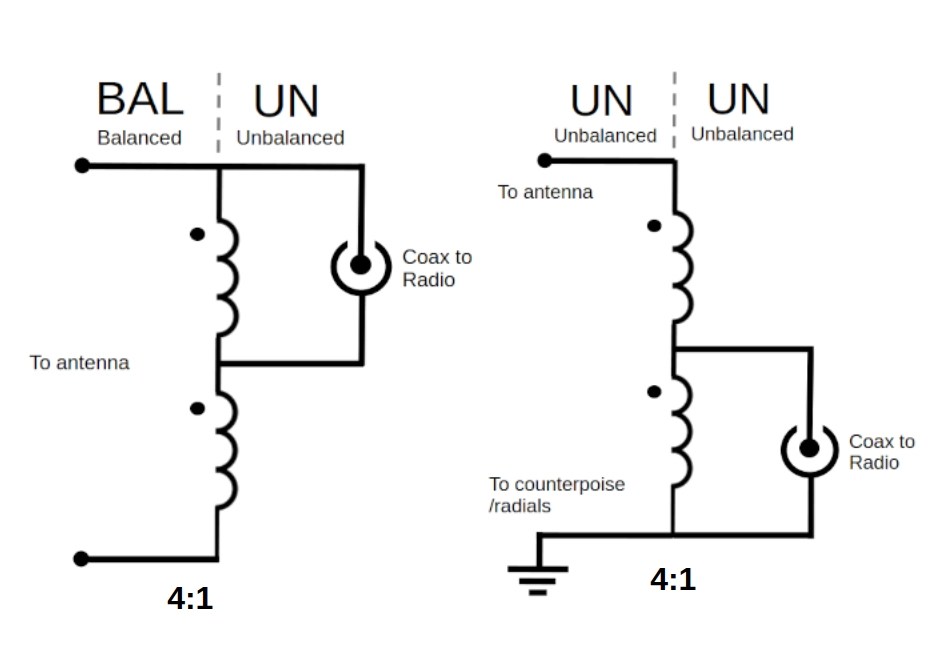
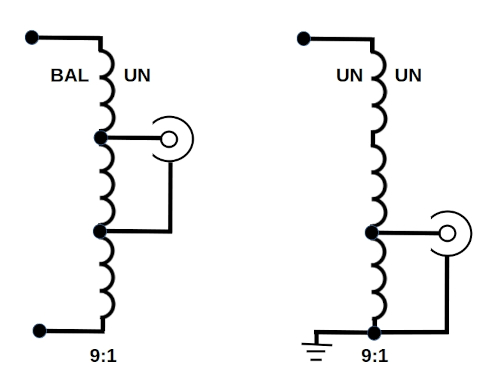
The schematics below show how to construct 4:1 and 9:1 baluns and ununs. The windings are “bifilar” for a 4:1 device and “trifilar” for a 9:1 device. The terms “bifilar” and “trifilar” refer to winding either two or three conductors together around the core. Thus one turn of the device will comprise two or three wires side-by-side.
Note that in the case of a 9:1 balun the primary is shown connected to the center of the three windings. It could be connected to any of the three. I drew it this way to clearly illustrate the balanced side of the device. The important difference between a balun and an unun is that, in the case of an unun, one end of one of the three bifilar windings is grounded. An unun could be made to function as a balun by not connecting that winding to ground as long as the coax braid is not grounded. A safer option would be to reverse the center and braid connections.
Eras and emissions excepted
Oh yes, I know the correct term is “errors and omissions excepted”, that’s just my tendency to frivolity when a topic gets a little heavy. I believe in the maxim “don’t take life too seriously; you’ll never get out of it alive”. But putting frivolity aside for a moment, if you disagree with my analysis please let me know in the comments. I am always grateful to receive and inwardly digest the wisdom of greater experts.

Help support HamRadioOutsidetheBox
No “tip-jar”, “buy me a coffee”, Patreon, or Amazon links here. I enjoy my hobby and I enjoy writing about it. If you would like to support this blog please follow/subscribe using the link at the bottom of my home page, or like, comment (links at the bottom of each post), repost or share links to my posts on social media. If you would like to email me directly you will find my email address on my QRZ.com page. Thank you!
The following copyright notice applies to all content on this blog.

This work is licensed under a Creative Commons Attribution-NonCommercial-NoDerivatives 4.0 International License.
Discover more from Ham Radio Outside the Box
Subscribe to get the latest posts sent to your email.


Now then John, the more articles presenting a simple explanation like
yours the better. One must ask why you didn’t include a schematic of a
1:1 balun to complete the picture?
There will always be those who believe neither a balun nor an unun is
ever needed. We have one such old-timer locally, he’s old enough to
know better but refuses to acknowledge the coax braid feeding his
center-fed single-band dipole is red-hot RF-wise, regardless of send or
receive, all the way to the inside of his shack.
But personal damage is one thing, it gets much worse when he teaches
noobs the ‘wisdom’ of his flawed beliefs, yet no one in the club dares
to speak up for fear of causing offence when a simple 1:1 balun would
fix his woes. Doest his behaviour sound somewhat akin to that of a
deluded priest?
73 de Stan
LikeLike