
Ham Radio Outside the Box has been re-examining the 3/8 wave vertical antenna with shortened raised radials that was first published here in 2024. She was called “Long Tall Sally” (after the 1950s Little Richard song). Her vertical radiator wire was 25ft long and the two raised radial wires were each 5ft long. Apparently the design proved quite popular and has been copied recently on another site (with permission but, unfortunately, without attribution as required by our Creative Commons copyright).
Long Tall Sally was an improvement over a quarter wave vertical by raising the maximum current node higher away from the ground. It also had some issues. First, the feedpoint impedance was higher than for a quarter wave vertical and required a 4:1 impedance transformer to match the 50 ohm impedance of a transceiver. Then, the nominal 5 feet length of the radials required careful adjustment since even small changes in the length had a significant impact on the SWR. And finally, from my QTH in Owen Sound, Ontario, Canada, the signal take-off angle was too low for short-range contacts. My signal was hitting the ionosphere at too shallow an angle for strong signals to be refracted back down to the northeast USA where there is a high target concentration of hams.
Then there was considerable debate about what kind of classification best fit Long Tall Sally. Is she a Rybakov? Is she an Off-Center Fed Dipole? The easiest answer to both questions is “yes … probably”. Lazy Susan most closely resembles Greg KJ6ER’s Challenger. And the Challenger is an Off-Center Fed Dipole.
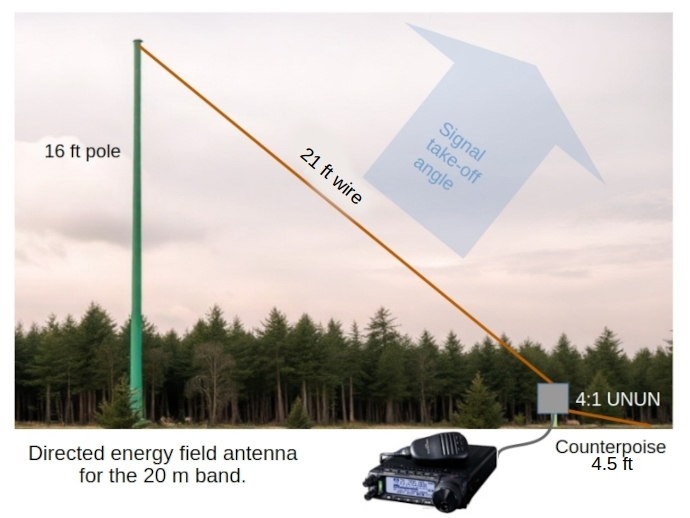
Maybe the same questions will be asked about the daughter of Long Tall Sally. I wasn’t sure whether to call this one “Laid Back Sally” or come up with a fresh name. I settled on “Lazy Susan” to reflect the fact that the antenna wire reclines (i.e. it is a sloper). Erecting a sloper results in a higher take-off angle and that gets its signal up to the ionosphere at a steeper angle. The refracted wave then hits the ground much closer to home than it would with a vertical antenna.
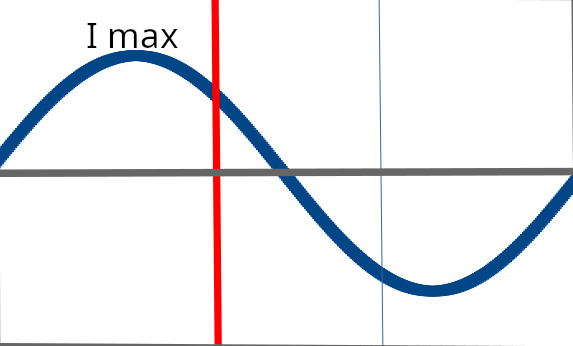
Lazy Susan retains some of the characteristics of Long Tall Sally. The radiating wire is slightly shorter at 21 versus 25 feet. A 25 ft radiator was found to be a little more difficult to match, but shortening it fixed that. By the way, there is nothing magical about a 3/8 wave radiating wire. The length can be adjusted as required, with corresponding adjustments to the counterpoise. A 3/8 wave wire just happens to keep the feedpoint close enough to a current maximum node to retain a usable impedance. A 21 ft wire is even closer to I-max.
Lazy Susan also needs a 4:1 impedance transformer. I suspect this component could be replaced with a more efficient L-match; I will try that if the impending cold, snowy Ontario winter weather holds off for long enough. Unlike Long Tall Sally, Lazy Susan’s counterpoise is a single wire draped on the ground from the short stake supporting the bottom end of the radiator. Some experimentation was required to get the length right. As a general rule, when using any antenna that has an elongated radiator and short counterpoise, the length of the counterpoise is quite critical. After some experimentation I ended up with a length of about four and a half feet most of which is on the ground.
I also experimented with using a Ground Tuning Unit (GTU). Tim KQ4TQ generously donated a GTU to Ham Radio Outside the Box. Using Tim’s GTU to “tune” the counterpoise allows a short random wire counterpoise to be used.
How does it perform?
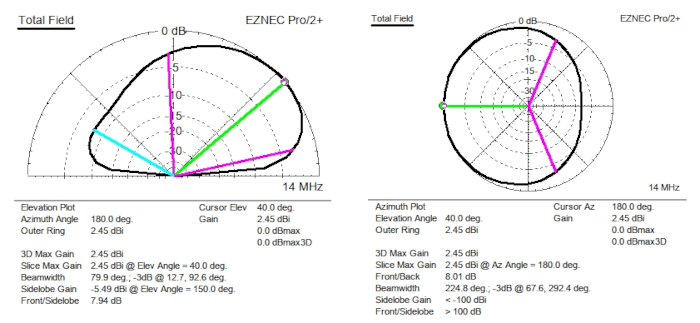
If we take a look at the elevation and azimuth plots from EZNEC in the diagram below, we can see that the signal is radiated at a take-off angle of 40 degrees. The -3dB points (half an S-unit at the receive end) cover elevation angles from DX to NVIS.
Now if we look at the azimuth plot we can see there is broad coverage over more than 180 degrees. That may not suit every operator. If your QTH is in the center of action you may prefer omnidirectional radiation. From my location there is little more than muskeg, wolves, bears and forest fires (sorry!) where a signal might land to my north, so if my antenna is oriented on a bearing of around 230 degrees (towards Texas) I can cover all of CONUS. In backyard trials I made QRP CW contacts with stations in Minnesota and Colorado.
Current Distribution
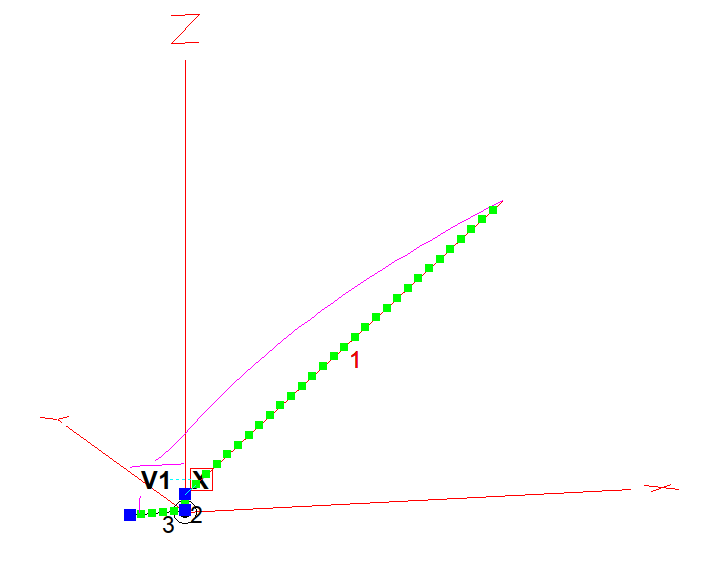
The distribution of current in Lazy Susan shows that almost the entire length of the radiating element is involved in radiation. Compare this with a quarter wave radiator for the 20 meter band where the current tapers to zero at the apex which is around 75% of Lazy Susan’s radiating element. It might reasonably be expected that Lazy Susan is more efficient than a quarter wave radiator for this reason. But, it must be noted that there is significant current in the counterpoise and this will result in some energy loss.
So, once again, what kind of antenna is Lazy Susan?
Is it a Rybakov? A Rybakov has a vertical radiating element of at least 25 feet worked against ground radials, so no, it’s too short.
Is it an Off-Center Fed Dipole? A dipole, wherever it is fed, is a half wavelength, or about 33 feet long on the 20 m band. If we include Lazy Susan’s counterpoise adjusted for detuning by ground contact, its overall length is still only around 26 feet. That equates to about 0.4 wavelengths. So, no again.
Okay, so it’s a sloping KJ6ER Challenger then? Greg KJ6ER writes that his Challenger design is an Off-Center Fed Dipole and I won’t challenge him on that. The Challenger is a very fine antenna; my monoband version works very well – although adjustment of the counterpoise is a little tricky. But Lazy Susan’s radiating element and its counterpoise are both shorter than those of the Challenger so, once again, no.
Ok wise guy, what is it then? If we compare Lazy Susan’s radiator length (21 feet) with a quarter wave on 20 meters (16.6 ft) we can see it is about 25% longer. The advantage of this is better current distribution over the lower quarter wave section of Lazy Susan’s radiator. The disadvantage is the need for a 4:1 impedance transformer. A low ratio impedance transformer is less lossy than higher ratio transformers, such as the popular 49:1, but if well constructed, should be quite efficient.
Why should I build this antenna?
If you share my love of experimenting with antennas, this one is well worth a try. When I go out to the field I always carry a simple dipole as a backup in case one of my experimental designs turns out to be a dud. Backyard trials lead me to believe Lazy Susan is not going to let me down. It occupies less ground space than a dipole and is less visually imposing. I prefer stealthy antennas and out-of-the-way operating spaces so I don’t have to pause a pile-up to explain what I am doing to people passing by. My next antenna project, for which I am assembling components, may not meet those criteria but will be very interesting nonetheless. Stay tuned.

Help support HamRadioOutsidetheBox
No “tip-jar”, “buy me a coffee”, Patreon, or Amazon links here. I enjoy my hobby and I enjoy writing about it. If you would like to support this blog please follow/subscribe using the link at the bottom of my home page, or like, comment (links at the bottom of each post), repost or share links to my posts on social media. If you would like to email me directly you will find my email address on my QRZ.com page. Thank you!
The following copyright notice applies to all content on this blog.

This work is licensed under a Creative Commons Attribution-NonCommercial-NoDerivatives 4.0 International License.
Discover more from Ham Radio Outside the Box
Subscribe to get the latest posts sent to your email.

