
TechTips are occasional brief posts describing easy ways to do difficult things.
Picture this scenario: a portable operator is setting up an antenna in a park on a nice sunny day in summer. The antenna requires one or more raised counterpoise wires. After raising the antenna, he walks to the far end of the counterpoise wire and plants a trekking pole into the nice, soft ground then attaches the wire to the top of the pole. Easy!
Now, let’s change the scenario. It is now winter, the ground is frozen hard and there are several inches of snow lying on top of a compressed layer of ice beneath the snow. The trekking pole easily penetrates the soft snow but cannot support the weight of the wire and falls down burying itself in the snow. Not so easy.
Let’s stay with summer and move the scene to a nice sandy beach on the shore of one of the Great Lakes. The sand is soft but attempting to penetrate it more than two or three inches is futile. Beneath the sand is a solid layer of rock. This scene is common in my home area where the ancient rock of the Niagara Escarpment reaches up into the 100 km long Bruce Peninsula dividing the main body of Lake Huron from Georgian Bay.
Or we could be setting up a portable station on the exposed bedrock of the Canadian Shield at Torrance Barrens, Ontario. These are all situations I have personally encountered in the area where I live and operate.
They say necessity is the mother of invention. I can’t claim to be the inventor of the technique I am going to describe but I have used it on multiple occasions while setting up my portable station in the diverse environment found in this part of Ontario.
Ontario Factoids: Ontario is big. According to Duck.ai, the driving distance from the Quebec border in the east to the Manitoba border in the west is "approximately" 3142.44 km.

Most people are unaware that while Ontario is a very long way from the Atlantic Ocean, it does have a sea coast on James Bay and Hudson Bay in the near Arctic. If you were able to drive from the province's southernmost mainland city of Windsor to Moosonee near the southern end of James Bay the journey would be "approximately" 1413.2 km.

By the way, Canada's southernmost point is Middle Island in Lake Erie, Ontario which is further south than the California border with Oregon. Middle Island is further south than about 30% of the lower 48 states of the US.
String theory has the solution
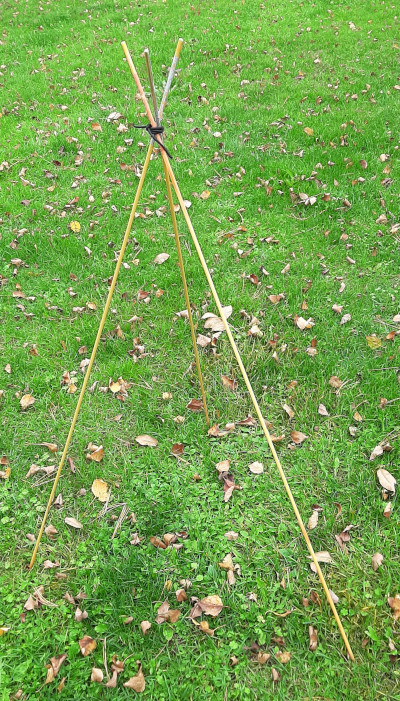
Take three fiberglass poles, or bamboo canes, or grab hardwood sticks lying on the ground and bind them together tightly a few inches from the top using thin bungee cord. The poles can be easily spaced out to form a tripod as can be seen in the picture below. The bungee cord will keep the poles together, but it will stretch sufficiently to allow the poles to form the tripod. Now the wire can be draped over the top of the tripod and attached to a counter weight to hold it place. For a counter weight you can use a water bottle or a bag of sand or snow.
NB: Only very wise men (and most women) can see the snow in the picture below.

Help support HamRadioOutsidetheBox
No “tip-jar”, “buy me a coffee”, Patreon, or Amazon links here. I enjoy my hobby and I enjoy writing about it. If you would like to support this blog please follow/subscribe using the link at the bottom of my home page, or like, comment (links at the bottom of each post), repost or share links to my posts on social media. If you would like to email me directly you will find my email address on my QRZ.com page. Thank you!
The following copyright notice applies to all content on this blog.

This work is licensed under a Creative Commons Attribution-NonCommercial-NoDerivatives 4.0 International License.
Discover more from Ham Radio Outside the Box
Subscribe to get the latest posts sent to your email.


An excellent idea John, thank you.
Worth every dime, thy tip-jar runneth over!
73 de Stan
LikeLike