
Back in the spring of 2024 Ham Radio Outside the Box introduced a very unusual field expedient portable antenna for 20m. It was dubbed “Long Tall Sally” because we took a standard quarter wave ground plane, stretched the vertical radiating element way out of resonance, then restored resonance by shortening the radials. This is what the antenna looks like when modeled on a computer:
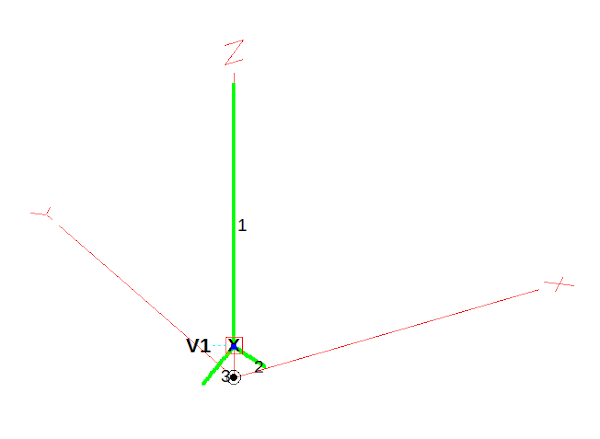
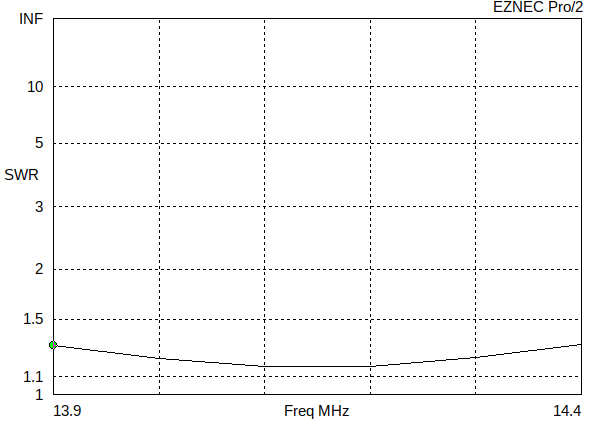
Modeling Long Tall Sally revealed that some of the wire dimensions are quite critical. This is often the case when wire lengths deviate from resonant values. With a little jigging here and poking there the modeled SWR was brought down to a level that eliminated the need for a tuner (i.e. under 2:1). Here are the calculated values of SWR:
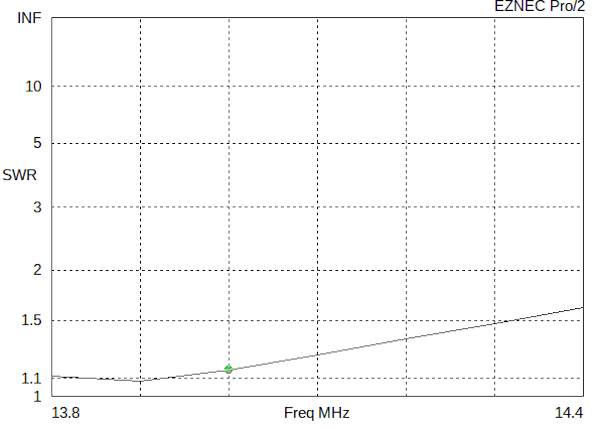
Note that there are just two raised radials. This is sufficient when the base of the antenna is elevated above ground. Ground-mounted quarter wave vertical antennas are quite popular but their maximum radiated energy is right at ground level. Unless they have an extensive radial system a lot of the RF will be absorbed by the surrounding ground and the heat will deceive local mammals into premature emergence from hibernation. Earthworms will be none too pleased either.
One of the benefits of Long Tall Sally is that the point of maximum radiation occurs further up the antenna so ground effects are significantly reduced and the antenna could be expected to exhibit greater efficiency than if the feedpoint is at ground level. Of course, simply raising a quarter wave antenna above ground will have the same effect, but Long Tall Sally also benefits from a smaller footprint on the ground. A small footprint is highly desirable when operating out in the field – especially in popular public spaces.
So how does Long Tall Sally actually work?
The simple answer is it works by electromagnetrickery, but to be honest I am not really sure. My first guess was that Long Tall Sally is an Off-Center Fed Dipole (OCFD) so let’s pursue that avenue. The clues are certainly there. The overall length (radiator height plus radial length) approaches a half wavelength. The feedpoint impedance is 200 ohms and requires a 4:1 impedance transformer to present a safe SWR to a transceiver. If it looks like an OCFD, sounds like an OCFD and tunes like an OCFD – maybe it is an OCFD.
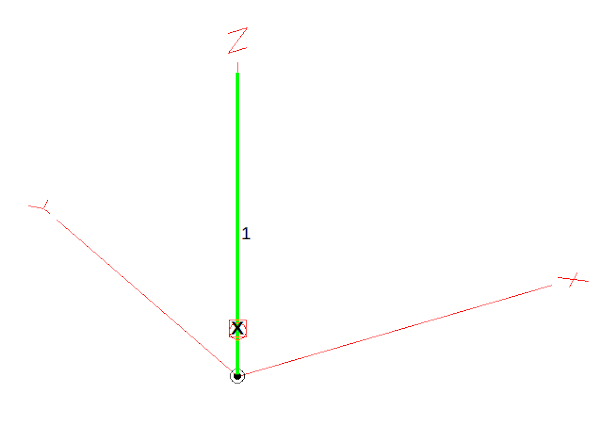
An OCFD antenna is usually erected horizontally, but there is no apparent reason why it shouldn’t be erected vertically. The current maximum (and hence point of maximum radiation) is well above ground so there should be no significant ground losses even with the short end just above the worms.
Uh-oh!
I modeled a vertically-oriented OCFD using my electronic abacus. After sliding thousands of electronic beads back and forth the abacus concluded the overall length of a 20m OCFD should be (drum roll please … ) 10m, or 33ft. Well, no surprise there, except that the overall length of Long Tall Sally’s wires was slightly shorter, around 9m, or 30ft.
Here is where the “electromagnetrickery” comes in. Long Tall Sally has not one, but two radials whereas a vertical OCFD has only one wire south of the feedpoint. Determining exactly how the second radial affects the overall length is tricky. Does the combined effect of two radials allow for a shorter overall length? Dunno, maybe I shouldn’t have quit working towards my master’s degree all those years ago.
Could the confusion be cleared by eliminating one of the two radials? No. The calculated SWR increased with only one radial. Maybe adding more radials would pimp its performance. Again, no. Adding two more radials worsened the SWR.
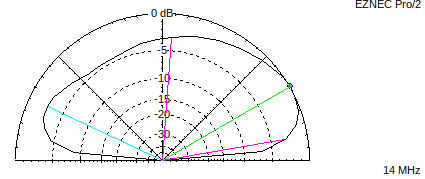
But back to the vertical OCFD. The radiation pattern is almost identical to that of Long Tall Sally. In 3 dimensions it is donut-shaped – omnidirectional with a nice low take-off angle. Here is the 2-dimensional representation:
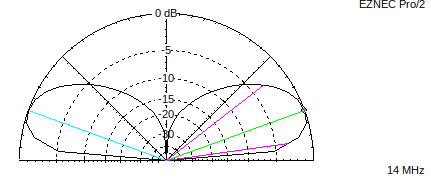
The common radiation pattern is another clue that Long Tall Sally is really an Off-Center Fed Dipole in disguise.
I have built a Long Tall Sally antenna, and even activated a park for POTA with it. She is a difficult lady to control though. In a previous post I wrote about a problem I discovered when erecting her on the Canadian shore of Lake Huron. At the park I was activating there was 100 miles of water between the Province of Ontario and the State of Michigan on the other side of the lake. The wind coming off the lake blew Long Tall Sally right off her pole and wrapped her wires around a tree. Incidentally, if I had driven a couple of hours south I could have driven over a bridge into Michigan!
I mentioned earlier in this post that it is often difficult to adjust the length of electrically short antenna elements. That is exactly the case with Long Tall Sally. I was unable to replicate the very low SWR predicted by the computer model. Instead of 1.1:1 the best I could get was 2.5:1. I still needed a “touch-up” tuner at the radio end of the coax. The radial lengths and height above ground are both very critical.
Lossy Coax Improves SWR!
I had measured the SWR at the radio end of a 25ft length of RG-58 coax. Of course, the coax affects the SWR. Received wisdom holds that lossy coax will improve the SWR seen by the radio (but it won’t improve the SWR of the antenna). My coax has a measured loss of 0.5dB (measured by my Rig Expert AA55 Zoom antenna analyzer). Just to check the effect of the coax, I performed an Open, Short, Load calibration at the radio end of the coax with my antenna analyzer to eliminate the coax and reveal the real SWR at the antenna feedpoint. There was some difference, a few decimal points higher SWR, but not significant.
So now I think we know the nature of the beast. Long Tall Sally is a very close cousin of a vertical Off-Center Fed Dipole. Long Tall Sally is a single band antenna, but an OCFD is a tunable multi-band antenna. Maybe that’s an idea worth exploring.
One small practical issue is that the longest pole I own is only 29ft high but a vertical OCFD for 20m (and up) is 33ft long. Maybe I could finagle a way of extending the pole, or maybe there is an even better idea. Suppose I erect the OCFD as a sloper?

Since I live in Canada, most of my contacts are to the south. To my north is muskeg, thousands of lakes, billions of trees and bears. If my OCFD is erected as a sloper the radiation pattern changes to favor one particular direction. If the chosen direction is south then more of my signal will be sent towards the thousands of hams in the US instead of up north to the bears.
Everyone’s a winner baby, that’s no lie
While I sip my Hot Chocolate this evening I’ll maybe start planning an addition to my antenna family – a sloper Off-Center Fed Dipole. No radials required, small footprint and multiple bands. That sounds like a winner! If it’s a success I’ll post about it here.
Help support HamRadioOutsidetheBox
No “tip-jar”, “buy me a coffee”, Patreon, or Amazon links here. I enjoy my hobby and I enjoy writing about it. If you would like to support this blog please follow/subscribe using the link at the bottom of my home page, or like, comment (links at the bottom of each post), repost or share links to my posts on social media. If you would like to email me directly you will find my email address on my QRZ.com page. Thank you!
The following copyright notice applies to all content on this blog.

This work is licensed under a Creative Commons Attribution-NonCommercial-NoDerivatives 4.0 International License.
Discover more from Ham Radio Outside the Box
Subscribe to get the latest posts sent to your email.
 Ham Radio Outside the Box
Two thoughts on your verticals: (1) You could put some sort of top loading at the top. A small aluminum dish from the local Chinese take-out restaurant would make the thing think it was longer. Then maybe your short pole would be long enough and you could still get resonance on 20 m. (2) You could feed it with open wire or ladder line, a 1:1 current balun at the transmitter end, and a good tuner such as the one in a KX2 or KX3. Then you could use it on lots of bands.
LikeLike
Interesting ideas, thanks.
LikeLike
Thank you. Interesting following you. Appreciate all the field and modeling work. Really interested in a sloper OCFD. Start with 20m (vs 40m) and work 10m and maybe 15m. Going to read this article again. Thanks. K2JJK
LikeLike
Thanks for the feedback. I built a sloper OCFD; it was all too easy to set up, wire lengths not critical and tuned easily on 20, 17, 15, 12 and 10m. I haven’t QSOd with it yet. Working on another rapid deployment backpack portable antenna for 40m and up.
LikeLike