
This is the first in an occasional series of short posts here on Ham Radio Outside the Box. The purpose of these TechTips is to share useful techniques I have learned over the years. I hope you will find them helpful.
TechTip#1 is an idea I picked up from a bushcraft video for creating a continuous loop of cordage. Of course, it is very easy to create a loop of cordage by simply tying the ends together with a knot. But that can be untidy and inconvenient, especially if the knot gets in the way of a neat join between two components of, for example, an antenna system.
How to use a continuous loop?
I use them a lot when erecting portable antennas. For example, if a cow hitch is formed at one end of the loop and a knot is tied at the end of a radial wire, the cow hitch can grip the wire end very securely – as long as tension is maintained in the loop. A second cow hitch can be formed at the other end of the loop to attach it to a tent stake. To release the wire simply pull out the tent stake, which relieves the tension and the wire is free.
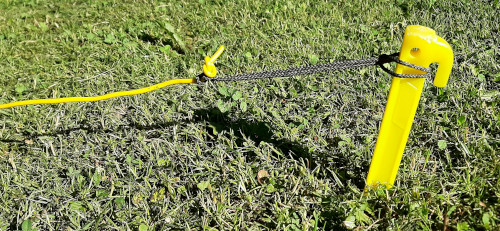
Creating a continuous loop is surprisingly easy to do in just 3 simple steps.
STEP 1
Cut a length of thin cordage about 18 inches (46 cm) long. I use Atwood 1/16 inch (1.6 mm) Utility Rope, but any similar cordage, such as Bank Line, will do.
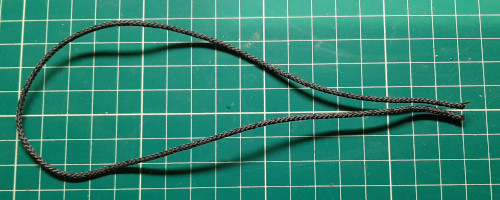
STEP 2
This is a very important step! Make sure both ends of the cordage are freshly cut, then melt the ends with a barbeque lighter, or similar. While the ends are still very hot press them gently together to form a bond. Be careful with this step because melted cordage can be quite painful if it gets on your hands. Being an amateur masochist I wait a couple of seconds then roll the join between two fingers to smooth the finished bond.
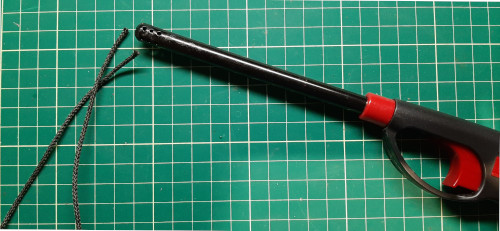
STEP 3
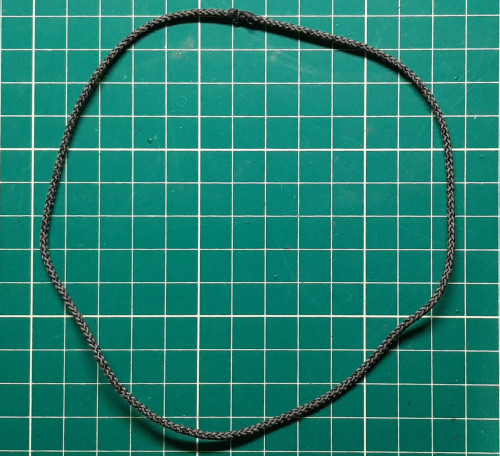
When the join has cooled – after just a few seconds – grab the loop either side of the join and pull like hell to test it. I was skeptical at first, but I can pull as hard as I like without breaking the bond. The Atwood cordage I use has a breaking strain of 110 lb (50 kg) and I suspect the join has the same strength.
If you have any similar amateur radio tips to share please send them to me via email, with photos if available and your tip will be featured here in a future Ham Radio Outside the Box TechTip.

Help support HamRadioOutsidetheBox
No “tip-jar”, “buy me a coffee”, Patreon, or Amazon links here. I enjoy my hobby and I enjoy writing about it. If you would like to support this blog please follow/subscribe using the link at the bottom of my home page, or like, comment (links at the bottom of each post), repost or share links to my posts on social media. If you would like to email me directly you will find my email address on my QRZ.com page. Thank you!
The following copyright notice applies to all content on this blog.

This work is licensed under a Creative Commons Attribution-NonCommercial-NoDerivatives 4.0 International License.
Discover more from Ham Radio Outside the Box
Subscribe to get the latest posts sent to your email.


Useful information and well written.
LikeLike
This is a great idea. For decades I’ve been using clips and carabiners of all kinds, tying knots in ropes and strings to fasten wires and baluns and all kinds of antenna related items to poles and pegs. A simple loop. Wow.
Thanks for this great idea. 73
Phil K7TTI
LikeLiked by 1 person