
My wife and I recently took a short early summer vacation in the Haliburton Highlands area of Ontario. The area is just south-west of Algonquin Park (Ontario’s first and by far the largest provincial park, most of which is accessible only by canoe with sometimes very long and challenging portages … and with a very large population of black bears and wolves).
I had hoped to be able to get a lot of radio time during the trip, but various obstacles, including a major solar storm, intervened to disrupt my plans. I did take one opportunity to put my mighty QMX QRP rig on the air, along with my full-wavelength, low apex, VP2E antenna built for 20m. Conditions were starting to deteriorate but I put a few CW QSOs in the log before shutting down the hilltop field station.
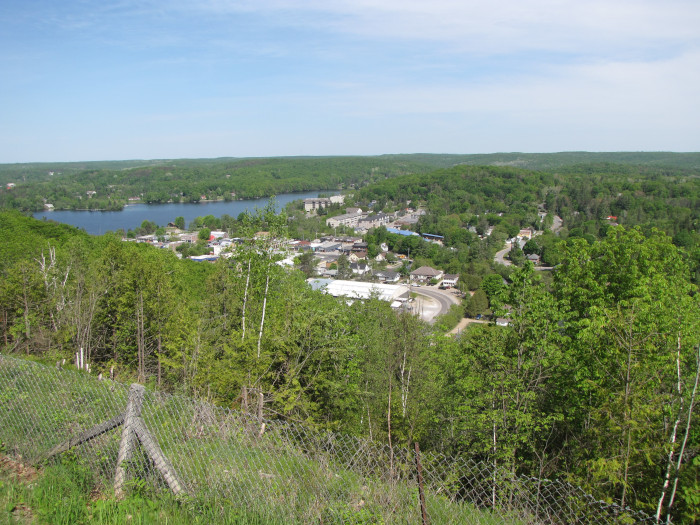
The QTH for the radio activity was a small park overlooking Haliburton Village. We had the park all to ourselves for most of our visit, which was a blessing since the VP2E occupies quite a large footprint. The propagation forecast did not look good because of an incoming Coronal Mass Ejection. A planned POTA activation the next day had to be canceled because the CME arrived and made QRP operation a little too challenging.
A learning opportunity
Even though poor propagation conditions limited actual time on the air, the activity did result in a couple of ideas for future radio road trips. First, I noticed I was getting better signal reports from stations thousands of kilometers away – generally to the west and south-west. Contacts along the upper eastern US seaboard were generally more difficult. This result suggests my signal may have had a lower take-off angle than modeling predicts. I have come up with a potential solution for this, thanks to the excellent website at portable-antennas.com. Details later in this post.
My wife and I stayed at a lakeside resort style hotel with more rules and restrictions than you could shake a stick at. Although ham radio was not mentioned specifically, I made the decision not to try to set up a 60ft long wire antenna in the limited space available between our room and the shore of picturesque Kashagawigamog Lake. Lesson learned: take an alternative compact antenna on the next road trip. That idea has stimulated a quest to find options for a low impact, discreet antenna that could be used in situations like this. Reader suggestions are welcome.
Who’s afraid of the big black wolf?
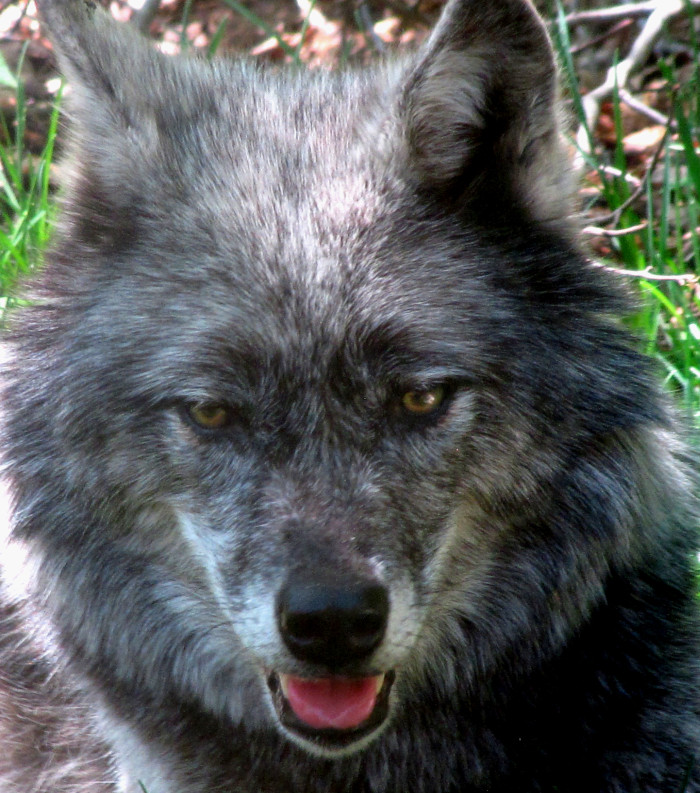
The bands may have been disappointing but our visit to the Haliburton Wolf Center certainly was not. A pack of five wolves is maintained inside a 7 acre enclosure. The wolves can be viewed through one-way glass to ensure they are not intimidated by the presence of humans. The wolves are not socialized and their environment is maintained as close to nature as possible. They are fed every 5-10 days with already dead animals such as beaver, tossed into their pen from a platform. Larger roadkill carcasses – such as moose – are lowered into the pen by crane.
It was very interesting to be able to view these magnificent animals from a safe location. I have camped in the backcountry of nearby Algonquin Park several times and (thankfully) never come into contact with any of the population of several hundred wolves. Algonquin Park is also home to several thousand black bears and, unfortunately, I did once experience a visit to my tiny lakeside campsite by a very large bear in the middle of the night.
Improvements to the VP2E antenna
My VP2E (Vertically Polarized 2-Element) antenna has given good service in many field operations, but over the years, fiddling with wire lengths to optimize SWR and changing the feed arrangement have resulted in a less than optimal configuration that needed correction. Fortunately the VP2E is very forgiving and despite my sometimes clumsy adjustments it just keeps on working.
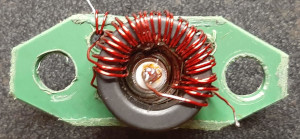
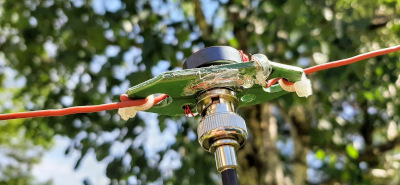
Followers of this blog may remember I recently installed an air wound Common Mode Current Choke (CMCC) at the VP2E feedpoint. I used this choke during the Haliburton road trip. It worked fine business but it is a little too bulky when packing out for field operations. When we returned from the trip I decided to replace it with another new CMCC. This one is 15 bifilar turns on a FT82-43 toroidal core. It is so compact that it mounts directly on the inelegant feedpoint insulator. Kudos for innovation, brickbats for style!
Another advantage of the new compact CMCC: it gives 33dB common mode current attenuation across the whole 20m band.
What other VP2E improvements?
Why is it that antenna designers assume everybody wants to work DX? I know many operators enjoy DXing, collecting countries and communicating with hams in the land of far-far-away. I usually have a different objective. Most of my field operating time is spent participating in activities like POTA and SOTA.
When I take a look at a map of, for example, POTA activators in North America, a clear picture emerges. What do I see? The vast majority of the activity is in the eastern part of the United States, and mostly in the northeast. It is disappointing to see that POTA operators in Canada are a rare breed!
And where is most of the POTA activity to be found? On the 20m band. The distance between my QTH in southern Ontario and North Carolina is about 750 miles (1200 km). If Florida is included (I often make contacts there too) the distance extends to around 1250 miles (2000 km). A side note: I once drove my family from Toronto to St Petersburg in Florida for a vacation. RF might take a few microseconds to complete the journey, but it took a heck of a lot longer to get there by road. I never repeated that drive; that’s what airplanes are for!
Now, if I want to target the US northeast, it is not the smartest plan to use an antenna designed for DX. It might be a better idea to use the 40m band instead, but that’s not usually where the activity is to be found. So 20m it is, and my antenna needs to have a higher take-off angle to avoid sending my signal sailing right over the heads of operators in my target area. But … not too high a take-off angle that my signal enters the NVIS zone. The ionosphere will not cooperate by refracting 20m signals back to the planet’s surface, the way it does for the lower bands. Instead, high angle signals on the higher bands tend to become outer space explorers.
Here is where portable-antennas.com becomes very useful. The site includes a design feature for the VP2E antenna with which we can experiment with the various dimensions of the antenna and determine the effect on its performance.
I selected a very low apex height of just over 3 meters which nicely matches the height of one of my fiberglass support poles.
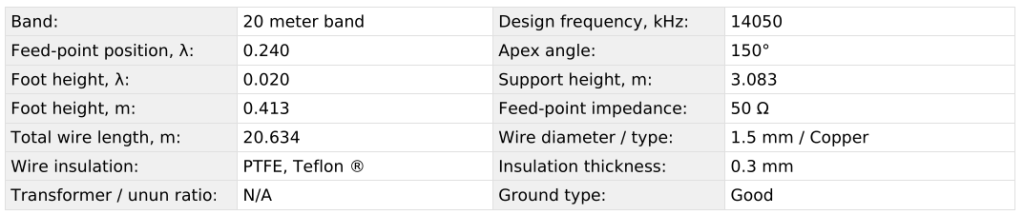
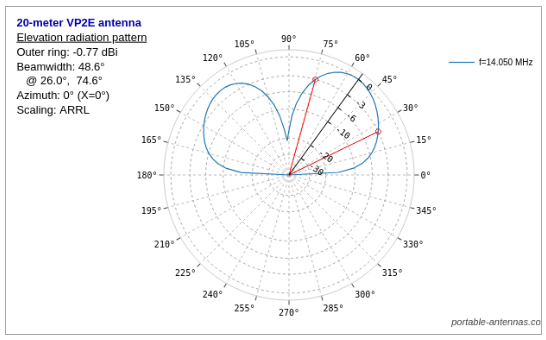
Looking at the elevation plot we can see the main lobe at a take-off angle of just over 50 degrees. The -3dB points include a useful component below 30 degrees, but part of the signal is poised to boldly go where where no man has gone before (although Spacex may change that before long). I specified a “good” ground type in my model because my home QTH is in between two huge lakes (Georgian Bay and Lake Huron) with plenty of surface water and high dissolved solids levels. As I travel to other areas where sandy soil or exposed bedrock are present, the antenna will inevitably behave differently. Hey, amateur radio is all about experimentation eh?
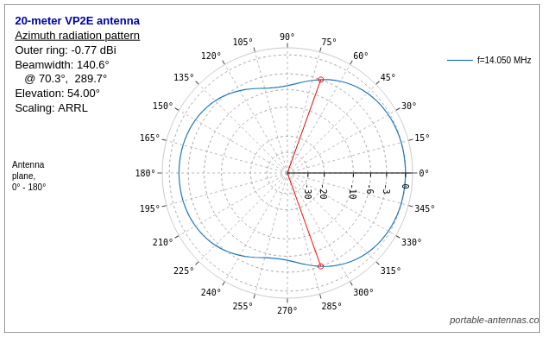
As the apex of the VP2E is lowered the model shows the antenna’s directionality improves. This could be a very useful feature. How many other simple wire antennas have the directional property of a beam antenna? Well, apart from the Grasswire (discussed several times in this blog) I can think of none.
I usually point my antennas at Texas and expect to cover the whole of CONUS. Now, while evaluating this new configuration of the VP2E, Washington D.C. may be a better target. I hope that last sentence won’t be misinterpreted by the security bots at the NSA!
The VP2E can be rotated very easily by simply picking up the wire ends and swinging them around. Maximum signal is radiated from “the long end” of the antenna (the VP2E is an off-center fed, full wave wire, so “the long end ” refers to the longest wire end away from the feedpoint).
Note: the VP2E with lower apex is an experiment. Experiments never fail; they only provide data for follow-on experiments with revised parameters. My 10ft pole has extensions for 13ft and 16ft that can be deployed if necessary.
What’s next John?
Now that summer is finally here (that brief period between snow storms here in Ontario) I will be spending more time in the great outdoors trying various antennas. That means Ham Radio Outside the Box will be publishing about every two weeks – unless there is something that needs to be urgently communicated to this blog’s burgeoning list of followers. In that vein, a sincere thank you to all the new followers who have signed up in recent weeks. I have some very interesting ideas to share over the coming weeks so please stay tuned.

Help support HamRadioOutsidetheBox
No “tip-jar”, “buy me a coffee”, Patreon, or Amazon links here. I enjoy my hobby and I enjoy writing about it. If you would like to support this blog please follow/subscribe using the link at the bottom of my home page, or like, comment (links at the bottom of each post), repost or share links to my posts on social media. If you would like to email me directly you will find my email address on my QRZ.com page. Thank you!
The following copyright notice applies to all content on this blog.

This work is licensed under a Creative Commons Attribution-NonCommercial-NoDerivatives 4.0 International License.
Discover more from Ham Radio Outside the Box
Subscribe to get the latest posts sent to your email.


Good article. I’ve been going back and forth between VP2E and the Delta Loop. I have a telescoping flagpole that I have been using to support one end of an EFHW. I love that little wire but I am going to re-locate it and I will now use the pole for some low-apex VP2E experimentation.
I am surrounded by pine trees on my property here in northern Idaho but I am undeterred!
73
Daryl/K6KRG
LikeLike
Hi Daryl, I have tried delta loops too but I found them to be a little trickier to erect (and get acceptable and stable SWR) than a VP2E. Although the VP2E has a long footprint on the ground it only requires a short pole which makes it fairly stealthy and suitable for rapid deployment along the side of a trail. Maybe its downside is its dependence on ground and, when operating portable, ground conditions can be highly variable.
LikeLike
What a FINE looking wolf John! Thanks. Thanks also for more info about the VP2E. I need to make one of these and aim it toward Owen Bay.
BTW, it might be a Real Good Thing to add a Search widget to the site. Don’t spend more than 5 minutes looking for one. That way, we could search and find “Grasswire.”
73 es BEST de N4REE, Bob
https://bob-easton.com/n4ree
LikeLike
Thanks for the search widget ldea Bob; I’ll check into it.
LikeLike
Search widget installed. Actually 2 widgets, one at the top of the sidebar and another beneath the comments at the bottom of each post. Let me know if that works OK for you Bob.
LikeLike
PERFECT. Thanks John. Easier to find the good stuff now. 🙂
LikeLiked by 1 person
Really enjoying your articles!
Thanks Tom
VE6TOM
LikeLiked by 1 person
Thank you Tom. I really appreciate that.
LikeLike
I find the VP2E antenna to be extremely thought provoking …. and frustrating. Much of my frustration is due to the antenna being unsuited to my back garden with various trees, fences and buildings in the way. At the prescribed 4.2m centre height it worked ….. but was totally out-performed by a centre-fed vertical dipole on DX ( and also by a 1/4 wave with just two radials/counterpoises with the base at c. 2m. ) Raising the centre of the VP2E to c. 8.5m improved matters appreciably but then the antenna was obviously not performing as designed. Has anyone modelled the VP2E performance at increased heights …… and/or with the first 1/4 wave section vertical with the remaining 3/4 wave in a sloping configuration ? An acquaintance in the US has commented that it makes a fair expedition antenna when mounted in plenty of open space.
LikeLike
John, here is an excellent resource for modeling the VP2E:
https://portable-antennas.com/vp2e.php
The VP2E is an off-center fed full wave dipole and modifying its dimensions and orientation should produce some interesting results.
LikeLike