
Not another “x-On The Air” program surely? Yes, that’s right, not another “x-On The Air program” at all. Instead this is a post about why I have come around to the way of thinking that simple dipoles may be the best antennas for portable field operations after all. I will present my case and let you be the judge.
I have spent a lot of time this summer, out in the backyard, monitoring portable field operators (typically POTA activators), working some but not hearing others at all. My home QTH is in grid square EN94MO which is in the Owen Sound, Ontario, Canada area.
Typically, I have no trouble working stations in Florida and Texas (two of my favorite states to visit, by the way) and often into the midwest. Stations closer to me in the northeast, for example New York and New England, are sometimes uncopyable. Most of the stations I want to work are in the northeast United States, a region with the greatest concentration of hams in the whole North American continent.
From my QTH, the US lies to the west across Lake Huron (a distance of around 100 miles, 160 km); to the south (130 miles, 210 km) at the Bluewater Bridge Crossing into Michigan, and 138 miles, 222 km) to the Rainbow Bridge crossing at Niagara Falls. All of these distances exceed the range of ground wave propagation. The alternatives are NVIS (Near Vertical Incidence Skywave) and Skywave.
Heavenly shades of night are falling, it’s 40 meters time
When selecting an antenna to reach a specific target area we must look carefully at two things, the radiation pattern of the antenna and the choice of band. Let’s look first at the band choices. Most of the POTA activity happens on 20 m by day and 40 m near dawn and twilight time. So let’s take a look at propagation on those two bands.
20 meter band propagation: A couple of hours after sunrise until a couple of hours before sunset are the best times to use 20 meters. Skywave propagation works best and the band favors a fairly low angle radiation pattern for long distance communication, but with a skip zone restricting communications over shorter distances. Higher radiation angles using an appropriate antenna can shorten the skip zone. At night, ionization of the F-layer by the Sun is no longer occurring and signals are refracted much less, leading to significantly weaker signals being propagated. NVIS does not work at mid-latitudes because signals are no longer refracted by the F2 layer, simply passing straight through and becoming lost in space (“Danger Will Robinson”).
40 meter band propagation: Propagation on 40 meters is almost the exact opposite of 20 meters. Long distance communication on 40 meters is impacted by D-layer absorption during the day. At night, the D-layer dissipates and signals are refracted by the combined F-layer, traveling long distances quite efficiently. During the day, NVIS is a viable propagation method since signals are still refracted by the F2-layer and strong propagation can occur within a few hundred kilometers of the transmitting station. It should be noted that NVIS propagation changes from season to season so the latest FoF2 (the maximum usable frequency for NVIS) should be observed.
* These notes on 20 m and 40 m propagation assume calm solar conditions. Our nearest star can be fickle and throw curveballs when we least expect them.
Now what about antennas?
Understanding propagation conditions leads to the possibility of being better informed when it comes to choosing an antenna. No single antenna is ideal for all bands and at all times of day or night. We make compromises, perhaps, but armed with a keen understanding of the science affecting our choices we certainly have a better chance of making the right decisions.
This amazing antenna works on all bands with fantastic gain!
There is one information source that is infamously unreliable – marketing claims by commercial antenna manufacturers. Marketing hyperbole has one purpose – to improve sales. Marketing language can be selected to create a favorable impression of a product without being wholesomely accurate. For example: “… has a gain of 10dB”. Sounds good doesn’t it? But a decibel is a ratio, so 10dB compared to what? An antenna that costs hundreds of dollars and claims great performance should be examined with a skeptical eye. Read the specifications carefully before buying.
This is straight up one of the most popular ham antennas
Straight up – as in vertical. Very popular for a good reason. Just plant a spike in the ground, extend the whip and lay out a few radials on the ground, then hit the air. I have used them – a lot, so let’s take a closer look.
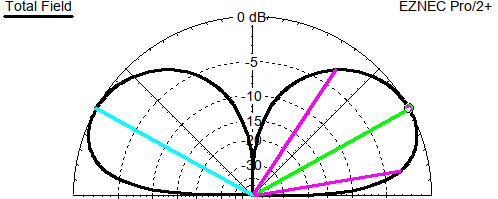
The radiation pattern looks fairly good, omnidirectional with an elevation around 25 degrees. No gain so the -3dB points for low angle DX and higher angle mid-range comms will be at half power.
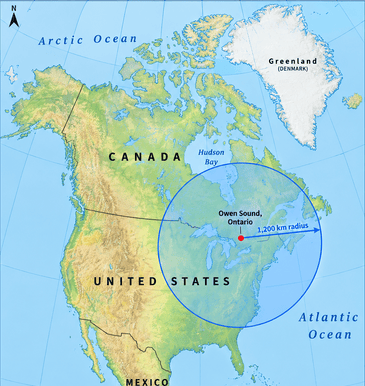
Our best signal will hit the F2 layer around 600 km away so the skip zone extends about 1200 km around the transmitter.
Communication within the skip zone is still possible if sufficient power is used, but, unless propagation conditions are very good and the antenna is a raised full-length whip with raised radials, QRP signals may be coming in on a whip and a prayer.
The accompanying map (generated by ChatGPT) shows a circle with a radius of 1200 km around my home QTH.
I am going to have difficulty receiving any station within this circle that is transmitting QRP using a quarter-wave, ground-mounted vertical antenna – or worse.
NB: The height of the F2 layer varies over a wide range of 220 – 880 km. Its peak electron density is in the range 250 – 400 km (source: Wikipedia). I used a figure of 300 km to calculate the skip zone and assumed the Earth is flat to simplify the trigonometry.
Well, the Earth is flat isn’t it?
Now I’m gonna level with you
“Level” as in horizontal – like a dipole. Well, not exactly in fact. A truly horizontal dipole needs three supports, so I use a shallow inverted-V dipole up around 7 meters (23 feet) at the apex when working the 20 meter band. The radiation pattern changes from the classic bidirectional pattern to a plum pudding shape as we can see from this image.
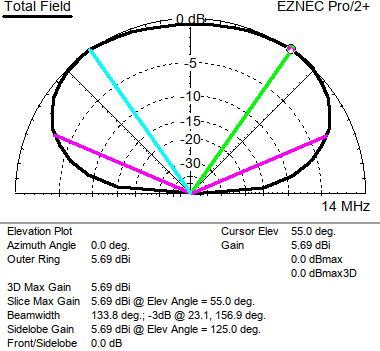
Maximum radiated power is at a relatively high elevation of 55 degrees – perfect for reaching mid-range locations. But there is another advantage. EZNEC predicts a gain of 5.69 dBi, so the -3 dB points still have a modest gain too!
In fact, modeling shows good signals can be radiated over a wide range of elevations.
DX is possible since very low angle radiated signals are still propagated more efficiently than with a vertical antenna.
Strong high angle signals are radiated for efficient NVIS propagation over short range.
In summary, modeling predicts an efficient radiation pattern favoring NVIS, mid-range and DX operations.
Critics may say …

Like I said earlier, I have used vertical antennas a lot – especially in public areas I am sharing with other people. They occupy a smaller footprint and can be relatively stealthy too. But, I suspect many hams are adopting fashionable short loaded whips with compromised counterpoise arrangements. Short loaded whips have a very low radiation resistance which reduces the effective radiated power.
“But I make QSOs with my wee willy whippie so you must be wrong.”
Well, there is no right and wrong here. Under the right conditions you can make QSOs on a wet noodle. Lots of factors affect whether we can do so. For example, terrain. High ground works better than the bottom of a valley. So, if you are working from down in a deep south “holler”, maybe consider hollerin’ louder. Ground conductivity helps a lot; signal reception is improved if both stations are located in high soil conductivity regions.
Stations located in areas with a high ham population clearly have an advantage over more remote areas.
Above all, choice of antenna is often the most critical deciding factor determining whether we make that QSO. I’ll give you an example. I enjoy a weekly rag chew with a friend about a hour’s drive away. His antenna is at DX height; mine is at NVIS height. His signal comes into my station at S9+ while mine reaches his station around S9. I transmit at 75 watts, my friend switches on his amp.
Let’s say you go out to the field to do a POTA activation with a short loaded whip sticking out from your BNC. Hunters come back to your CQs with booming signals. Wow, what a great antenna eh? Yes, but just maybe that great antenna was at the other end of the QSO, not your end.
One final thought: the relative gain between an efficient quarter-wave vertical and a dipole approaches one full S-unit – do we need to redefine what counts as QRP based on which antenna is chosen? And if you are using one of those new-fangled short whip things, should you still be able to claim to be QRP if you switch on a linear amp?
I rest my case; now it’s your turn. Let me know what you think in the comments.

Help support HamRadioOutsidetheBox
No “tip-jar”, “buy me a coffee”, Patreon, or Amazon links here. I enjoy my hobby and I enjoy writing about it. If you would like to support this blog please follow/subscribe using the link at the bottom of my home page, or like, comment (links at the bottom of each post), repost or share links to my posts on social media. If you would like to email me directly you will find my email address on my QRZ.com page. Thank you!
The following copyright notice applies to all content on this blog.

This work is licensed under a Creative Commons Attribution-NonCommercial-NoDerivatives 4.0 International License.
Discover more from Ham Radio Outside the Box
Subscribe to get the latest posts sent to your email.


I thoroughly appreciate your writing. I am learning a lot from what you write and look forward to getting the information.
As an older guy enjoying POTA by getting out to activate parks, I have reduced my “rig” to one bag and a vertical mounted on a Harbor Freight clamp that I attach to a picnic table or my luggage rack on the car. I make QSOs (QRP, highly compromised, I know), and I’m sure I frustrate hunters by showing up as an activator and not being able to hear them. This article tells me I could do better. Scratching my head now wondering how far I might go to improve.
LikeLiked by 1 person
Thanks for the feedback. Dipoles are very easy to build; for example, take a SO239 or BNC female connector and solder two 17 ft wires to it. Raise it on a painters pole, or similar, trim the wires for lowest SWR – works on 20 m. Give it a try.
LikeLike
Hi JohnToday’s was so interesting to me as I want to improve my situation here
LikeLike
Thanks for the comment. Glad you enjoy Ham Radio Outside the Box.
LikeLike
Right. I use a Buddipole dipole on my balcony in Nanaimo. It has two 22″ spreaders, two coils and two whips about 8′ long. The coils are tapped for 17m but I use my old MFJ 971 tuner from 6m to 20m. Right now (11:30am Pacific) PSKr is showing 34 reception reports between 2268km and 8419km. Nothing closer. This is typical and you can check VE7VIE almost any time, any day. In a few years (using FT8), I have WAS, WAC and 53 countries. So you are right. It is almost impossible for me to work anyone even in Vancouver or Victoria! BTW I am always QRP, barefoot KX3 at 10W. Radio is magic! 72, BarryVE7VIE
LikeLike
Thanks for commenting Barry. Sounds like you have a good setup on the island. A few years back my wife and I were planning to relocate to Qualicum Beach, then along came grandkids and everything changed!
LikeLike
John: Great post. I was strictly a portable dipole guy for quite a few years. If you have the room to string one up, you can’t go wrong. 73, Craig WB3GCK
LikeLike
Thanks Craig. I have been reading your own recent posts and noted your success with short whips and your KH1. I’ll be monitoring to see if I can catch you on the air sometime. We may be too close but its worth finding out if I can hear you.
LikeLike
Thank you John for another great article.
Having just started testing and using a SSB QMX I have quickly discovered I am getting better performance out of a simple SOTABeams 40/20 meter linked dipole than my OCF Dipole, EFHW or EFRW. While the end-fed antennas and the Off-Center fed dipole are more convenient to use and offer a greater selection of bands, here in ZL-land when QRP, 20 and 40 meters are predominantly the only bands I use.
On a summit though the End Fed is king only because it is simpler to get erected in small space’s in less than friendly conditions – high wind being our greatest enemy – but the height usually compensates for the lower efficiency.
Anyway, love the work you do and your articles. Always looking forward to seeing them arrive in my mailbox.
Cheers, Phil ZL3CC
LikeLike
Thanks Phil, glad you enjoy reading Ham Radio Outside the Box. I agree that end fed wires are easier to erect than regular dipoles but high ratio transformers can be lossy depending on how they are built. An EFHW with an L-match is probably the best alternative.
LikeLike
After decades of building all sorts of wire antennas and baluns. Then testing and tuning them, along with installing them in various configurations and heights I rarely have the same results twice. Here they work well, there they work so-so, and over yonder they are duds. Same with verticals. Now I just bring a wire antenna of some sort and a random wire as a vertical. But for some reason I keep building these things…maybe I need to find a hobby.
Nunca Digas Morir and 73
Phil K7TTI
LikeLike
Good story Phil. That kind of experience is what makes this hobby so engaging. We never stop learning!
LikeLike