
It’s not the smartest idea really is it? A quarter wavelength vertical whip for the 20 meter band should be around 5 meters (17ft) tall. Why build a vertically challenged whip that is less than a sixteenth of a wavelength long and expect it to work? And … with a QRP transceiver too!
Yes, indeed it’s not the smartest idea in the world, but Elecraft and others sell such an antenna and many hams use them. So is there another angle to this idea? Am I missing something? I watched another of G3OJV’s videos recently in which Peter Waters (of the UK’s Waters and Stanton amateur radio store) put a different perspective on the idea, so I decided to try it.
G3OJV’s idea is to force the counterpoise to do most of the radiating. Huh? If the counterpoise is raised above ground it will radiate – in fact, if the radiating element is only 48 inches (about 1.2 meters) tall, the counterpoise will do most of the radiating. I decided to model the idea using EZNEC to find out how to configure such an antenna so that it would actually have a chance of working. The model yielded some very interesting surprises.
But there’s a hidden gotcha!
The radiation pattern looks fantastic, and the gain is equally impressive at 4 dBi. It’s no wonder these little critters sell so well, but wait, let’s take a closer look. The NEC-2 engine I use for antenna modeling is notoriously unreliable for antennas that are close to the ground. I had set the Ground Type to Real | MININEC. Now suppose we take another look using Ground Type: Real | High Accuracy. Whoa, now we lose 6.4 dB; the actual gain figure is now predicted to be minus 2.4 dBi.

There are two ways to look at this result. First, the optimistic view: -2.4dB is less than half an S-unit at the receiving end – the receiving station probably won’t even notice the difference. Second, the pessimistic view: if our transmitter is pumping out a mighty five watts of RF, the amount of RF actually leaving the antenna drops to less than 3 watts (ignoring any losses in the feedline). On a good day when the propagation is favorable we are still going to make contacts. But, if the propagation is unfavorable, or we are trying to break a pile-up, our self-imposed handicap is going to be a problem. And, all of this assumes that NEC-2 is not being optimistic in its calculations.
But wait, there’s more bad news
I only modeled the far field propagation of an unloaded 48 inch whip worked against a 17 ft (5 m) single raised counterpoise. Of course, a base-loading coil is also required to match the impedance of the short whip. We’ll get back to that in a moment.
Let’s go ahead and waste more of our radiated power
Typically, very short whips are used for portable operations, and the temptation is to simply throw the counterpoise wire on the ground. Now EZNEC Pro/2+ set for high accuracy ground shows a gain of -3.31 dBi and our actual radiated power drops even further to a little over 2 watts. We are on our way to QRPp! (QRPp refers to radiated power of 1 watt or less). Remember, these little baby whips work best when we force the counterpoise to do most of the radiating. If we lay the counterpoise down on the ground the whole strategy is defeated (but the earthworms will be grateful for the warmth).
About that loading coil
The usual method of constructing a loading coil is to wind wire around an air-core former, or some other non-conducting material. Sometimes the wire used is copper, sometimes it is stainless steel. Now we have to take into account the DC resistance of the wire. Copper is good, silver or gold is better; stainless steel is ungood. You don’t need to be a rich ham to use silver or gold (although it might be a good hedge against inflation if you wind all your coils with solid gold wire); due to the skin effect gold-plated wire would work very well. Even copper-plated stainless steel would be better than unplated stainless steel.
The website 66pacific.com calculates that a loading coil of 9.1 microhenries is required to match a 48 inch whip at 14.150 MHz. That would require 30 turns on a 1 inch diameter air-core former. The length of wire required will be about 95 inches (2.4 m). The same coil can be wound around a powdered iron toroidal core with considerably less wire. Less wire means less resistance loss. Are we nit-picking here? Yes, the resistance losses are fairly small, but remember, we are already down to 2 watts out of our original 5 so every watt counts.
The long and winding coax that leads to your transceiver
Our best bet is to use a very short whip mounted directly on the antenna connector of our transceiver, otherwise coax loss can also become an issue. But make sure your antenna connector is mechanically capable of supporting the weight of a loading coil and whip. Some radios have a BNC antenna connector directly mounted on the transceiver’s circuit board which is an obvious weak point. Further stress is added if the counterpoise directly connects to the shell of the BNC.
I built a 48 inch whip antenna; how well did it work?
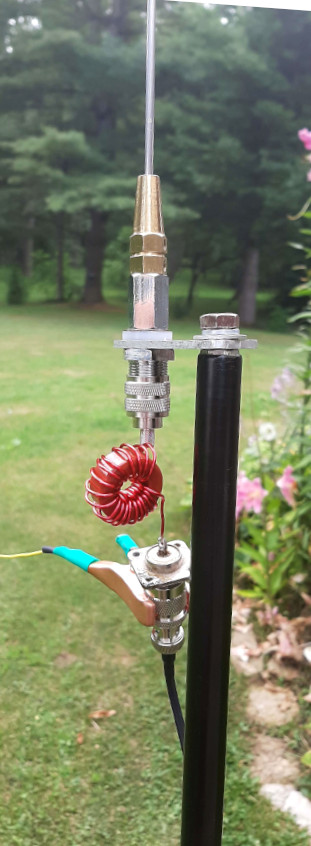
I own a collection of old ham stick antennas. Hamsticks have two parts, a helically wound loading coil section and a stainless steel whip. I grabbed one of the whips which happened to be the magic length of 48 inches and mounted it on a tripod with the feedpoint about 4 feet above ground. I then added a loading coil wound with 16 gauge enameled copper wire around a small type 2 toroidal core. My counterpoise was a single radial wire, 17 ft long sloping down from the feedpoint to a few inches above ground at the far end. EZNEC predicted that mounting the far end close to the ground improves the performance.
I fired RF at the antenna, through a few short feet of RG-58 coax, from my mighty mini QMX transceiver at nominally five watts and monitored the SWR on the QMX – all was good. Time to go hunting.
I considered it risky to attempt a POTA activation with an experimental antenna so the trial was to be a backyard hunting session. Well, knock me down with a feather, I actually made a contact with my microwhip. Propagation conditions that day were forecast to be good on 20m and I could hear several POTA stations on the air. I selected a station in Florida which is over 2000 km from my QTH in Ontario, Canada. I could hear the Florida station fairly well so, with a good deal of trepidation, I called him on CW with 5 watts into my test antenna. He came back to me right away, and after a couple of attempts to copy my callsign, we signed off and I put the contact in the log with his RST report to me of 229.
Wow, is this antenna a “keeper”?
No.
There is a popular expression in the QRP world: “QRP – when you want to send the very least”. My interpretation is: when you want to send the very least – get a 48 inch whip!
What is your experience?
If you are still wondering (really?) what my opinion of these vertically challenged antennas could possibly be, then let me say there are better options for ultra-portable lightweight antennas. Even a slightly longer whip would be better. I also built a version with a 9 ft whip – the extra length makes a lot of difference. Adding a top (capacitance) hat improves performance even further.
But, I am sure there are Ham Radio Outside the Box readers with entirely different experiences. For example, if you are an FT8 operator, the lower signal to noise performance – even over CW – may help to squeeze contacts out of a highly compromised antenna. SOTA operators working from the top of a mountain out in the Rockies may experience very short whips very differently. Perhaps if I were to take my 48 inch whip out to one of Ontario’s soaring peaks which sometimes scrape the clouds at 500 m (1640 ft) above sea level I might have a different experience. But then again I might go to the same high point with a real antenna!
Let me know what you think in the comments.

Help support HamRadioOutsidetheBox
No “tip-jar”, “buy me a coffee”, Patreon, or Amazon links here. I enjoy my hobby and I enjoy writing about it. If you would like to support this blog please follow/subscribe using the link at the bottom of my home page, or like, comment (links at the bottom of each post), repost or share links to my posts on social media. If you would like to email me directly you will find my email address on my QRZ.com page. Thank you!
The following copyright notice applies to all content on this blog.

This work is licensed under a Creative Commons Attribution-NonCommercial-NoDerivatives 4.0 International License.
Discover more from Ham Radio Outside the Box
Subscribe to get the latest posts sent to your email.


Hi John-
This is an anecdote rather than anything scientific, but here goes. It pretty much reinforces your conclusion about the 4-foot antennas.
I did a joint activation with a friend on a fabulous mountaintop location. He was using a 4-foot commercially available antenna and a full-length counterpoise on ground. He struggled for a half-hour to make a contact. It seemed the propagation Gods were against him that day.
I was set up on a nearby picnic table with my trademark inverted-Y antenna. I took a break; going on a walkabout to enjoy the scenery. He took over my antenna and had no trouble getting his POTA bag limit on 20M.
// There was a QST article many years ago about the so-called ‘Miracle Whip’- an even-shorter antenna, if I remember. It did work, but the miracle was in working anyone with it! A tradeoff of convenience vs. antenna efficiency perhaps taken too far. The antenna is still out there under a different name. I don’t have the inside scoop, but the folks who make Mayonnaise may have caught up with them.
73- Dave, K1SWL
LikeLike
Thanks Dave, I always read your feedback with great interest. Your anecdote matches the theory perfectly!
LikeLike
Interesting and thought provoking as usual. As regards conductivity, gold is usually over-rated – it’s advantage is that it doesn’t oxidise. On a relative scale of conductivity if we assume annealed copper to rate at 100 ( hard drawn is 89.5 ) gold comes in at 65. Silver is 106, pure aluminium ( rarely encountered ) is 59 – soft annealed aluminium alloy is 45-50 – and steel is a dire 3-15.
LikeLike
Thanks for the conductivity data. My reference to using Au was kinda tongue in cheek; I use copper.
LikeLike
I had assumed that your comments were ‘kinda tongue in cheek’ but I was pompous enough to pontificate anyway…… I also use copper however, in the distant past – and before I knew better – I once used silver-plated wire for a long wire antenna and soon found it offered no advantages whatsoever over the copper wire it ( briefly ) replaced.
LikeLike
Hi John, I am a new subscriber and want to tell you I thoroughly enjoy your articles. Thank you!
I am experimenting with an 89” carbon fiber whip and loading coil for QRP operation. The goal is getting my POTA load much lighter. I clamp the antenna on the luggage rack of the vehicle, put out two 17’ radials “draped” over the car and set up on a small portable table with my FX-4CR (QMX like) radio. I am making contacts, but if conditions are not good it can be a long haul to ten contacts. I envy and appreciate people like you who use software to “model” your antenna experiments. Someday I’ll learn how to do that. In the meantime, NanoVNA to set the coil and an ATU-10 tuner to get it done.
73
Tim
KI5OOS
LikeLike
Thanks for the feedback Tim. Sometimes POTA activations can be slow and other times you get a pile-up and wrap things up in 10 minutes. Don’t worry about it; just enjoy playing radio in the great outdoors. Try experimenting with bigger antennas, the difference can be amazing.
LikeLike
Morning John!
I experimented with short whips also and didn’t have much luck. Another thing I noticed is the bandwidth gets pretty narrow. Not magloop narrow, but it’s narrow.
Then I realized that in most cases, if I can put up a short whip, I can usually use a 17′ vertical in the same footprint with much better results.
Keep doing what you do, John! I appreciate it.
Rick N8TGQ
LikeLiked by 1 person
Thanks Rick!
LikeLike
I would recommend that every ham wanting to experiment with small antennas first read the chapter of Antenna Engineering Manual called “Small Antennas.” The book is NOT a ham radio manual, but a university-level book that you can get at your friendly technical college.
The upshot is that it is a physical impossibility to build an efficient antenna that fits within a sphere less than about 1/10 of a wavelength across. The reason is that there is a tradeoff between efficiency, bandwidth, and size that says “pick two out of the three.” There is a possibility to bury half of that big capacitive (or inductive) resonator in a ground plane, but all the current associated with its operation has to be accommodated by the groundplane. The more the structure is folded, the more resonant. Ground current grows, producing heat instead of radio waves.
The easiest way out of this corner is to make the structure reach up, but then you are back to your basic grounded quarter-wave whip, shortened by a coil and/or linear loading to say 1/8 wave minimum.
73 and keep having fun!
LikeLike
John, great post.
One way to muddy the water even further, with far better results, is to find a spot to operate from where the radial/CP can be dangled downwardly, like off a balcony, pedestrian overpass and the like.
I do this every time I can, then that radiating radial and the whip are cooperating to make a sort of vertical dipole.
And I agree that the 4 footers are problematic. I typically use a Grabil carbon fiber whip with a 30/40 meter adapter on my KX2 and find it to be much more effective in getting vertically polarized radiation to DX locations. See an example here. https://scottysfunkwerks.blogspot.com/2026/06/a-30-and-40-meter-kx2-adapter-for.html
Keep asking the tough questions!
72 Scott ka9p
LikeLike
Thanks Scott. I particularly like the vertical 4ft+counterpoise idea; I’ll have to explore that idea. I checked out your blog – very interesting content. Blogspot doesn’t have a subscribe option but I managed to subscribe anyway using RSS.
LikeLike
Hi John
I read this article a while ago but forgot to say something… fixing that now. Your type -2 material loading coil is LOSSY. It is indeed tempting to think that a shorter length of wire has less (DC) resistance so winding wire onto a toroid is the way to do it. But the toroid material itself also has loss. The higher the permeability, the worse the situation gets. I count 19 turns from your photo and put this in https://toroids.info/T50-2.php and can’t get 9.1 uH on any size -2 toroid let alone a small one. So I’m not sure what I did wrong. But you could go even further, use an FT50-43 ferrite toroid for example, and need only 4.5 turns… BUT – the loss will be even higher.
You get loss everywhere. Using a toroid, the loss increases with permeability. Using a wire, you have DC resistance. But the toroid losses will DOMINATE. You’d get better performance with an air-wound coil even though yes, it would use more wire. Whether or not you’d ever notice or be able to measure the slight difference, is another question 😉
73 Hans G0UPL
http://qrp-labs.com
LikeLike
Thanks Hans. I confess I didn’t do a lot of research before writing that article. I noticed the new Elecraft AH4 antenna uses type 6 cores for base loading and modelled my design on that. I used a type 2 core simply because I had more type 2s than type 6s in my component drawer. I measured the winding on the core I used in that article and it is a little over 5 uH. I started out by winding as many turns as would fit on the core, then measured the SWR of the antenna + counterpoise then reduced the number of turns until the SWR was acceptable. Perhaps the lower inductance than online calculators predicted was due to the counterpoise being forced to do most of the radiating.
LikeLike
Hi hi, just because Elecraft did it does not necessarily make it right 😉 Anyway the point of toroids is often also that they are highly repeatable and they shrink physical size. So that can also be an element of the tradeoffs in many applications, even if an air-wound inductor would technically provide a slightly higher performance.
I counted 19 turns in your photo. I couldn’t see any -2 material size in the https://toroids.info/ page that gave the correct inductance with 19 turns. In the end I ran the Mini Ring Core Calculator program and guess what, it has a weird toroid size T184 which isn’t listed on the toroids.info web page and that gives 19 turns for 9.1uH! Hi hi. So it IS possible.
Anyway in the end practical suck-it-and-see always beats theoretical models! So your approach was best. I was just curious.
73 Hans G0UPLhttp://qrp-labs.com
LikeLike