
In the last couple of posts I discussed my quest for a simple portable antenna that could be rapidly deployed in a very limited space, for example in a small clearing while hiking through the woods. Such an antenna would have to be a short, yet efficient, vertical that occupies a very small footprint on the ground.
The first successful candidate is a Linear-Loaded Monopole which meets all the design criteria and has performed surprisingly well in initial field tests. Ham Radio Outside the Box has received another suggestion from a reader who lives in the future (I’ll explain in an upcoming post) for a helical antenna. We’ll be hitting the outback (out in the backyard) to experiment with that idea very shortly.
Meanwhile, another design criterion is that a hiking antenna should occupy a very small footprint on the ground. My local woodlands sit atop the Niagara Escarpment and are often very rocky – sometimes with wide and dangerous cracks in the bedrock. There is often nowhere to set up ground radials and limited options for raised radials, so an alternative arrangement for “the other half” of a vertical quarter-wave antenna is necessary.
The solution that has been discussed here on Ham Radio Outside the Box is to use a Ground Tuning Unit (GTU) coupled to a small capacitive plate on the ground. There is some spooky physics associated with how a GTU works which we’ll discuss later in this post. But don’t let that discourage you; the science of physics is full of mind-mending spooky stuff.
Introducing the Mini GTU
I built a GTU some years ago which has seen a lot of use. Unfortunately it is rather big for carrying on a hike through the woods. I needed a small, lightweight version for this new use case. The Mini GTU is a simple device as can be seen from the wiring diagram here:
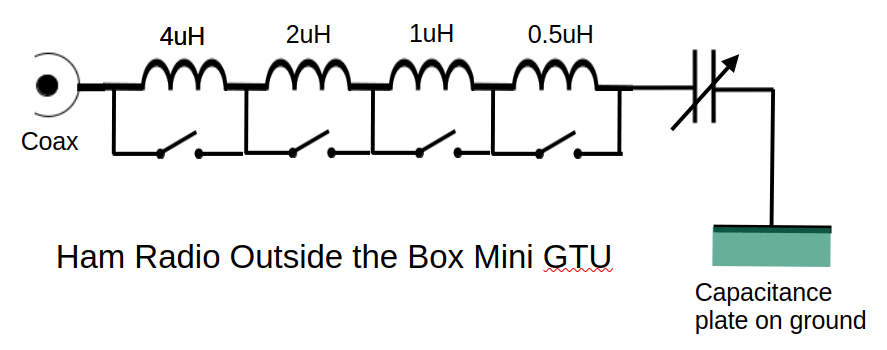
The device comprises four inductances – 4, 2, 1 and 0.5 microhenries. Each inductor has a SPST switch that can be used to short circuit it and thereby bypass it from the inductance selection. This arrangement allows binary selection of inductance from 0.5 to 7.5 microhenries in 0.5 microhenry increments. For this application it was considered unnecessary to increase the inductance any further, but more inductance could be added by doubling the value of each added inductor.
The Mini GTU is connected to the shield side of the coax that connects the antenna to the radio. This is exactly where you would normally connect radials. The other end of the Mini GTU connects to a capacitive plate laid directly on the ground.
What? No ground current meter?
A GTU usually has a ground current meter in series with the current path. That is achieved by adding a sampling circuit – a small toroidal core inductor with a single secondary turn, a diode rectifier and meter. Again, unnecessary in this application because as the current through the GTU increases, so does the current in the radiating part of the antenna. This is indicated by observing the SWR indicator on the radio.
Construction of the Mini GTU
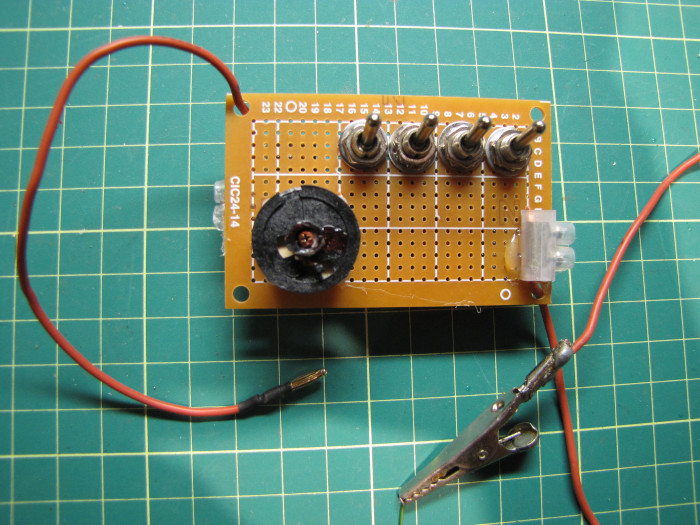
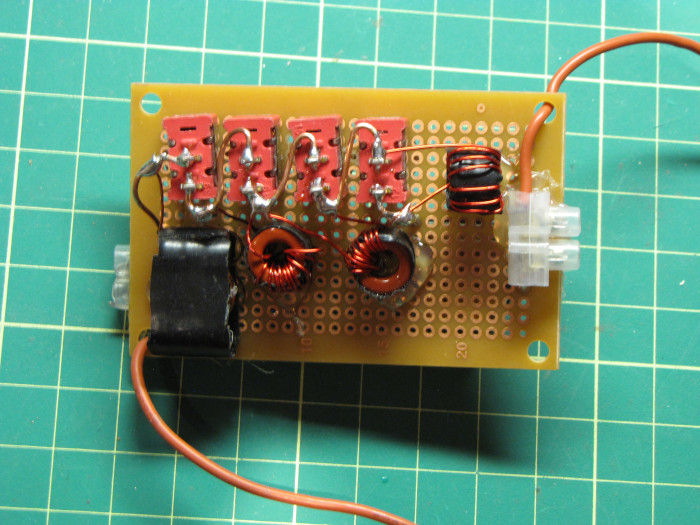
I built the device on a small piece of perfboard. The following two pictures show the layout of the components. As usual, my collection of T37-2 and T37-6 powdered iron cores were deployed. The smallest inductor (0.5uH) was wound on two stacked T37-6 cores. The 1uH and 2uH inductors were each wound on two stacked T37-2 cores. For the 4uH inductor I redeployed the six T37-2 binocular style cores I had used on the 2T2C inductor discussed in a recent post.
Why not just use one tapped inductor and a rotary switch?
That’s a good question. I could have wound a single 7.5 uH inductor with taps every 0.5 microhenries and used a rotary switch to select the appropriate inductance. But that would require good precision in locating the tap points since 0.5uH is a very small inductance that is more easily wound on a small core.
It is unnecessary to wind these smaller inductors to the precise values specified. Even using tiny T37 cores, a single turn can change the inductance quite a bit. I strove for a precision of about 10% which turned out to be very achievable.
About that capacitive plate on the ground …
Various different types of plate were tried. Pizza trays, hardware cloth and chicken wire all sorta worked. I wasn’t happy with any of them though. They are not very easily carried on a hike and one, the hardware cloth, had sharp cut steel wire edges that attacked me viciously when I handled it. A better solution had to be found.
Why don’t you come with me … on a magic carpet ride
I bought a piece of Faraday cloth to try out. This material is very light and easy to pack away in a backpack while hiking. Faraday cloth is sometimes referred to as “magic carpet” in ham radio circles and perhaps with good reason. It is made of several layers with interwoven dense conducting material. I purchased a piece of magic carpet from the “Brazilian River” company. It measures 39×43 inches (very nearly 1 square meter).
One square meter is a little larger than I had hoped for in this application so I folded it twice to created a nearly square smaller footprint. If that worked the plan was to cut the sheet into four pieces and use just a single piece for my hiking antenna. Did it work? With the smallest footprint and adjustment of the Mini GTU for best SWR indication on the radio an SWR of 1.68:1 was obtained. Not bad, in fact very usable, but could a bigger magic carpet go even better?
Second test: the magic carpet was folded in half. Now it was a rectangle and with the Mini GTU adjusted the best SWR dropped to 1.45:1. Obviously a trend had been established. Could the whole sheet of magic carpet top the trend?
Third test: now the whole square meter of Faraday cloth lay spread on the ground, secured from the wind with some rocks surreptitiously borrowed from my wife’s garden bed (thanks to all the ancient Norse gods she doesn’t read my blog). The SWR dropped again to 1.13:1. Jingolaba!
Conclusion: “magic carpet” seems to be best solution. If the available trail-side operating site is too small for the whole one square meter of cloth, it can be folded once or even twice while keeping the SWR well below 2:1.
Other hams have tried even larger sheets of Faraday cloth for a ground plane and achieved good results, but without a GTU. The advantage of the GTU is that only a very small capacitive ground plate is required to achieve the same or better results.
One more final note: antenna physicists will note I have been using SWR as a measurement of the effectiveness of the hiking antenna. Of course, lowest SWR does not imply resonance, but radios do not have any way of measuring and displaying complex impedance values and an antenna analyzer would add to the weight needed to be carried into the field when hiking.
Addendum: a bit of spooky physics to (explain?) how a GTU works
A quarter-wave vertical antenna radiates sinusoidal voltage and current waves into an imaginary medium called the “ether”. At the same time a mirror image of these waves is generated in the ground. These mirror image waves are as real as the “ether”. If we were to bury a current meter in the ground beneath the antenna would it record the mirror image? Unrenowned scientists like myself (I earned a bachelor’s degree in physics way back when) say no.
There are three reasons why not. First, and most obvious, we cannot read a meter buried in the ground. Second, no because the mirror image is virtual not real. And the third reason is really spooky. If you search on the Whirled Wild Web for the “double slit” experiment you will learn that spooky physics stuff only happens when scientists don’t try to monitor it. That experiment is one of the most mind-bending, unexplained phenomena that even amateur scientists can attempt to reproduce. So what happens to the real current flowing through the GTU? RF gotta go somewhere.
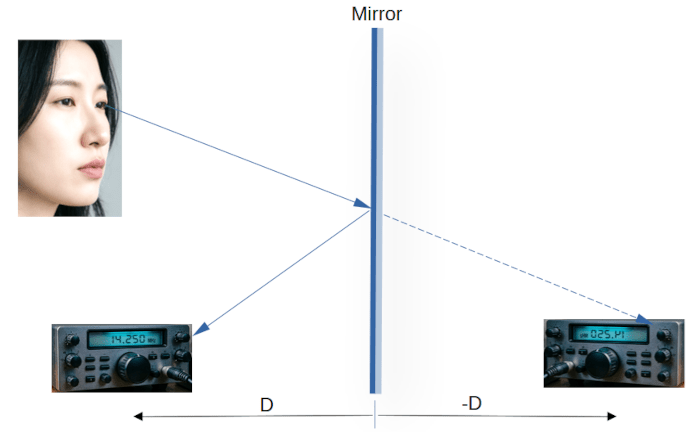
The concept of virtual images can be seen in this picture of looking at a transceiver in a mirror. If we trace the path of the light rays through the mirror we can see a mirror image of the transceiver at the same distance behind the mirror as the actual transceiver is in front of the mirror. Step behind the mirror and you won’t find the virtual mirror image. A fanciful thought emerges here. Maybe science will one day find a way to create that expensive radio you can’t afford using a virtual image held behind a mirror.
Physics can take spookiness to extremes. My own favorite is a topic called quantum entanglement. If really mind-bending science interests you, try typing that into your search engine. Even one of the greatest scientific minds of all time, Albert Einstein, called that “spooky action at a distance”.
Back to the future
My next project will be developing this week. I replied to the reader “from the future” and will be exploring his ideas in my backyard where intermittent snow cover is heralding the very slow birth of another spring season. Stayed tuned.

Help support HamRadioOutsidetheBox
No “tip-jar”, “buy me a coffee”, Patreon, or Amazon links here. I enjoy my hobby and I enjoy writing about it. If you would like to support this blog please follow/subscribe using the link at the bottom of my home page, or like, comment (links at the bottom of each post), repost or share links to my posts on social media. If you would like to email me directly you will find my email address on my QRZ.com page. Thank you!
The following copyright notice applies to all content on this blog.

This work is licensed under a Creative Commons Attribution-NonCommercial-NoDerivatives 4.0 International License.
Discover more from Ham Radio Outside the Box
Subscribe to get the latest posts sent to your email.
 Ham Radio Outside the Box
Hi John,
I’ve enjoyed the loaded vertical w/ground plate article so much I’ll have a go. Re weather, you might consider moving to West Ireland. High pressure finally moved in last week, ending the spell of daily rain we had since Christmas. Spring has burst out all over and the garden has burst out with colour. 73, Richard EI8JWB
LikeLike