
HamClock – or Open Ham Clock?
It was recently announced that the popular HamClock program will cease to function in June 2026 due to the death of its creator. HamClock has been running on an Inovato mini computer in my shack for a long time now. It has given instant access to a wealth of information important to the operation of my home shack. A rescue attempt has been announced that will restore access to the databases HamClock relies on to display its information. I hope that attempt is successful and will follow that project closely.
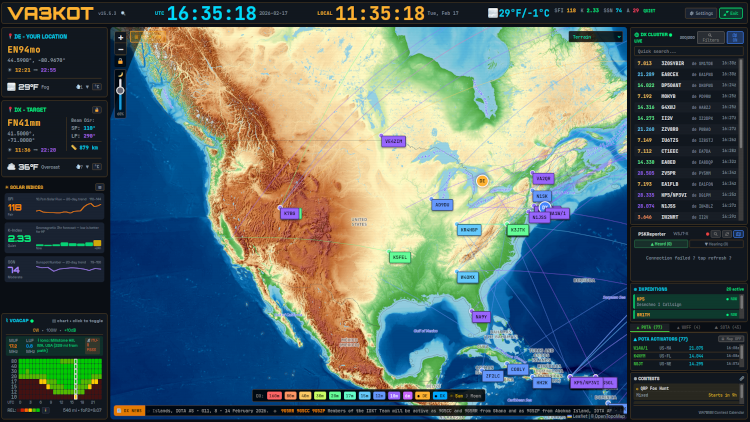
Meanwhile, there is now a competitor called Open Ham Clock. For the last few days I have been displaying both HamClock and Open Ham Clock on my shack computers and I have to say that I currently find the open version more useful and much more informative than the original. Both programs provide a VOACAP display that provides an instant view of band conditions for a selected “DX” location. In this context “DX” refers to any station or location selected by clicking on the map display, but not necessarily a long distance location.
Have you tried either program; if so what is your opinion? Let me know in the comments.
Life is tough and then it’s winter again
I am not a great fan of winter. I might think differently if I owned a snowmobile and could carry my portable radio gear for miles and miles along the extensive network of trails that cover the area where I live. Unfortunately I do not own such a vehicle and I’m a bit long in the tooth for snowshoeing through the woods wearing a backpack full of gear. Even if I did still have the stamina to get out into the back country in winter it would still be difficult to erect an antenna. Canada’s (literally) billions of evergreen trees have dense brush that catches the snow. Try to launch a wire up into the tree canopy and you can expect a small, cold avalanche to come tumbling down on top of your head. Guying a mast takes a lot of ingenuity because trying to drive stakes into the ground at this time of year requires something like a jack hammer – and that’s if you can even find the ground beneath a couple of feet of icy compressed snow.
But then, sometimes an idea occurs which is borderline genius but, at the same time, very simple. So when I wanted to take advantage of a recent day when the temperature managed to creep above freezing for the first time in weeks, this happened. I carried my Spiderbeam mast out onto my driveway looking for a way to secure it well enough to test an antenna idea. My driveway is regularly plowed and although I haven’t seen the concrete for months, the compressed layer of icy precipitation is sufficiently thin that my 4×4 truck can complete its passage between house and road without difficulty. But the rest of my suburban lot still carries the accumulated snowfall from weeks of winter weather. At the side of my driveway the snow is a couple of feet deep. Would it be firm enough to support my mast I wondered? I decided to find out. I pushed the mast down into the compressed snow and it felt firm enough. It penetrated 19 inches into the snow before meeting a firmer layer. A swift encouragement with my right foot inside a heavy snow boot sealed the hole at the top.
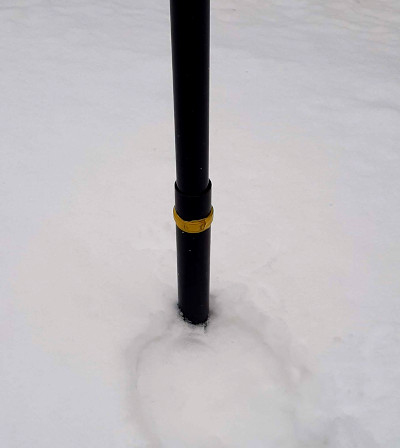
This particular mast is Spiderbeam’s 7 meter (23 feet) model. Would the snow holding less than 2 feet of mast at the bottom be sufficient to support the full extended length? Yes. Not only that but when I used it to support a 40m EFHW wire the mast bowed with the strain of the long wire, yet did not show any sign of dislodging from its nature-supplied support. Success! Maybe winter ain’t so bad after all!
The antenna was a half wavelength long on 40m, with links for 30m and 20m. It allows me to set up the antenna for operation on its fundamental frequency for the 20m, 30m and 40m bands without relying on harmonics, although it does also work on the 2nd harmonic of 40m (i.e. 20m) when operated at its full length. Note that the CW QRP calling frequencies of 7.030 and 14.060 are very conveniently precisely related.
I have used this wire many times for POTA activations but on this occasion I wanted to test the ability of my version of AA5TB’s parallel tuned circuit to find a match on each of the three bands (it did, easily). I also used the occasion to test my newly completed QRP L-match (with binary selectable inductances) to see if that would also find a match on the same three bands. It did, again easily. I’ll be writing more about that project in an upcoming post.
What happened?
I skipped a light Fandango when I received this week’s report from WordPress. Although I don’t fixate on Ham Radio Outside the Box’s visitor numbers, subscriber count etc, something unusual must have happened. In the last 7 days this humble little blog received 5,350 page views which is more than double the regular weekly number. Compared to major websites that statistic may be underwhelming, but for a tiny one person amateur radio hobby blog from the Great White North it’s an achievement. A big thanks to all Ham Radio Outside the Box subscribers and visitors; it is folks like you who make writing this blog so worthwhile.
I don’t want to belabor the point but this is a non-commercial site. Any links in the posts here are not “affiliate links”. I do not solicit or accept financial donations from any source. Amateur radio is my hobby, not a business. Participating in the hobby often costs money – particularly for experimenters like myself. The costs associated with maintaining a domain registration and site hosting fees are just part of the investment in a hobby that carries its own reward through the enjoyment and thrill of communicating with others by radio. We should keep in mind the definition of “Amateur service” from the FCC Part 97 rules (para 97.3, section 4). Note in particular the phrase “without pecuniary interest”.
Amateur service. A radiocommunication service for the purpose of self-training, intercommunication and technical investigations carried out by amateurs, that is, duly authorized persons interested in radio technique solely with a personal aim and without pecuniary interest.
Feedback
If you choose to leave a comment on any post on this blog, WordPress will ask you to set up an account. This has two benefits; it helps to prevent bots and other undesirable sources from flooding the site with spam. It also allows you to be notified of follow-up comments (e.g. my reply) when posted.
Some spam does still get through but is caught in the spam filter. Unfortunately some genuine comments also occasionally get trapped in the spam filter. If your comment does not appear within 24 hours please let me know by email.
If you prefer to use email to send feedback please ensure to include your callsign or “SWL” if you are not a ham. Many subscribers have cryptic IDs such as “pickledwalnut037az2”. You will be sure to get a reply if I know I am dealing with a real person. Thanks.

Help support HamRadioOutsidetheBox
No “tip-jar”, “buy me a coffee”, Patreon, or Amazon links here. I enjoy my hobby and I enjoy writing about it. If you would like to support this blog please follow/subscribe using the link at the bottom of my home page, or like, comment (links at the bottom of each post), repost or share links to my posts on social media. If you would like to email me directly you will find my email address on my QRZ.com page. Thank you!
The following copyright notice applies to all content on this blog.

This work is licensed under a Creative Commons Attribution-NonCommercial-NoDerivatives 4.0 International License.
Discover more from Ham Radio Outside the Box
Subscribe to get the latest posts sent to your email.


You’re a lot more adventurous than I John. I haven’t been to a park since November! The cold and I just don’t do well together anymore.
I do have an indoor antenna at my apartment so I’m still on the air. I don’t do any of the game radio stuff and all QRP, so it seems to get harder and harder to find other stations to work.
But Spring is right around the corner.
73 de Rick N8TGQ
LikeLike
Well Rick, I haven’t been to a park since November either. The parks around here are either closed, not plowed or only plowed as far as the parking lot. But I have gotten out to do some testing on my driveway.
LikeLike
Good morning John, I too have tried the other Hamclocks and the only part I have not seen reproduced is the way Elwood’s overlay of the propagation colours on the map. I was able to click on 20m and the map would transform with very definitive colours of green, yellow and red. Up to this point I have not seen the same reproduced. This was one rich feature of Elwoods HamClock I use all the time.
73,
Mike
VE9KK
LikeLike
Me too Mike! That is a valuable feature and maybe it will be implemented in future releases of Open Ham Clock. Meanwhile the same info (and more) is available directly from VOACAP.
LikeLike
Good stuff, John. I’m looking forward to seeing the L-match.
LikeLike
Craig, the L-match doesn’t incorporate any revolutionary new ideas. I just wanted to see if I could build one that would cover 20m, 30m and 40m using an EFHW. L-matches are claimed to be more efficient than wideband transformers so maybe more of our meager QRP signals will get radiated. I still have to try to improve on its rather coarse tuning but it is usable in its present form.
LikeLike
John:
HamClock and Open Ham Clock are wonderful gifts to the amateur radio community. I find HamClock a lot easier on the eyes. – de KO4DKI
LikeLike
I agree with that! I have Open Ham Clock running on quite a large monitor, but even so some of the panels are hard to see because of the tiny font. I believe there is a way to remove panels we don’t need to see, and maybe resize others. The program is still evolving so there could be more changes coming.
LikeLike
Maybe you can help me with this problem. I can not display the map!
Brian VE3GUE 73
[cid:8c96fada-5ae9-4b3e-9d75-f9cfb2547808] ________________________________
LikeLike
Hi Brian. Can you give me some details? Are we talking HamClock or Open Ham Clock, and what device are you trying to run it on? What do you see when you try to open it?
LikeLike