
If we believe in QRP – I mean really, really believe – then we can make it work. Admittedly it’s like betting on a race between a tortoise and a hare; where would you put your money? If you read accounts written by diehard QRPers, do you ever see stories such as: “I went to the park with my latest QRP rig today and called CQ for five hours but only got 2 QSOs. On the way home I tossed that stupid rig in the river and bought a big-boy radio instead”? Of course not. Diehards enjoy the outing as much as the contacts. They get a thrill out of tickling the ionosphere even if the big bad D-layer swallows their RF and has a malignant chuckle to itself.
I am not a diehard, but I do like to operate QRP whenever it yields a good probability of actually getting contacts. On the other hand, when propagation conditions are unfavorable, or I cannot erect an efficient antenna, I am willing to switch to warp power to get the job done.
The FCC has given us guidance in the form of the Part 97 rules, and to paraphrase them:
“Use (only) as much power as in necessary to make the contact”
There are different ways to interpret that guidance. For many QRO operators it means “fire up the amp and let ‘er rip; life’s too short …”. The word “only” in the above may occasionally fall on deaf ears. QRPers, on the other hand, might see things differently and ask: “How can we make this work without increasing power?”.
There are days when 5 watts into a tiny coil-loaded whip is all you need; for other days there are tricks that can be employed to make a teeny-weeny smidgen of RF create the illusion of a really big-boy signal. The big secret is that it doesn’t matter how much signal the P.A. of our radios – big, small or tiny – presents at the antenna jack. What really counts is how much signal appears at the receiving end.
A military ELF (Extremely Low Frequency) radio station puts out a huge amount of power, but the amount reaching a submarine somewhere beneath the world’s oceans is only a few watts – effectively QRP. QRO operators can emulate that idea by using a dummy load with a random wire antenna attached. No tuner needed, any old antenna will work and the radio will always see a low SWR. It is said to work just fine but with the caveat that you will lose about 1 S-unit in signal strength due to loss in the dummy load. Would it be possible to invert that situation and transmit a very low power signal that a receiving station would perceive to be more powerful?
Don’t announce your handicap
If we call CQ and identify ourselves as QRP we are telling the world we are transmitting a teeny-weeny smidgen of a signal and that negatively influences the receiving station’s perception. In his book “Winning through intimidation” author Robert Ringer tells of clever benevolent techniques he employed in his sales career to dazzle potential clients into having a glowing perception of him. So let’s not mention our piddling power and allow the receiving station to assume we are just another regular ham station, or maybe even a superstation.
Use an efficient antenna
When conditions are right you can make contacts with a wet noodle. In most cases it makes sense to assume conditions are unfavorable and plan for the worst. That means putting up an efficient antenna – one that converts as much of our feeble signal as possible into radiated RF. If we can put up a gain antenna, even 3dB of gain, we will double our effective radiated power.
Don’t use a vertical antenna
Well, ok if we have to use a vertical antenna it should be raised off the ground. A ground mounted vertical antenna requires a lot of radials to be efficient. If it is raised as little as 1 meter above ground less radials will be required – maybe as few as 2.
A vertical antenna radiates equally in every direction so our feeble signal is spread around 360 degrees. If that signal can be focused to favor a specific direction, the receiving station will perceive it to be stronger. Greg KJ6ER’s POTA PERformer can effectively focus a signal even more than he intended by sloping the radiator away from the direction we wish our signal to go. Modeling with EZNEC shows a front/back ratio of over 8dB can be obtained by this method. That means more of our signal is being directed towards where our target receiving stations are located.
Foxes hunt where the hens can be found
Choosing a band wisely improves the probability of successfully making contacts. If I have Internet access while operating portable, such as when activating a park for POTA, I check 2 things. First, which bands are indicated as having good propagation and, second, which bands have the most activators. If we call CQ on an empty band aren’t we boldy going where no ham has gone before?
Side by side
It can sometimes help if we park ourselves adjacent to another active frequency. I have used this technique myself hoping some of the big station’s hunters will hear my signal while tuning in to the other guy. For CW ops a 500Hz separation should be enough to avoid interfering with the other station; SSB ops will need to leave a bigger space.
It pays to advertise
It helps if people know we are going to be on-the-air. Perhaps we are planning to participate in a scheduled QRP event. During the event other QRP stations are actively seeking QRP stations to work. It is a good idea to post notice of our intention to participate ahead of time in online forums. When planning a QRP POTA activation, we can schedule the activation ahead of time on the POTA website (but don’t mention QRP!). Scheduling gives hunters advance notice of when to look out for us on-air. Some lucky QRP operators may even be on hunters’ Ham Alert lists.
The poodle and the bulldog
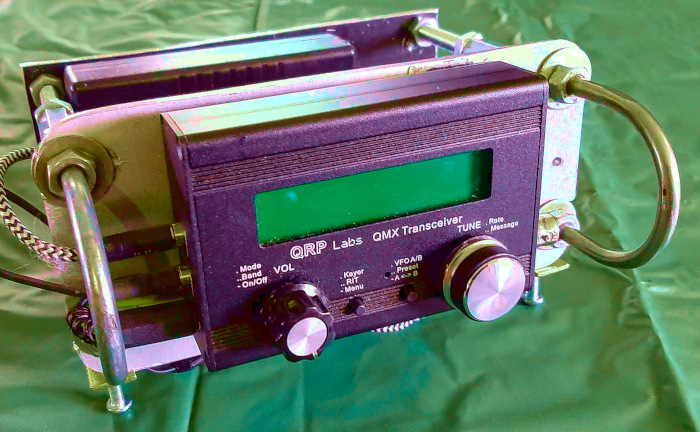
My current most used QRP radios include a QRP Labs low-band QMX – a cute little fella, but very fragile. Doesn’t like high SWR or any supply voltage over 12.00 volts. Also not very rugged, but it’s packed with features.
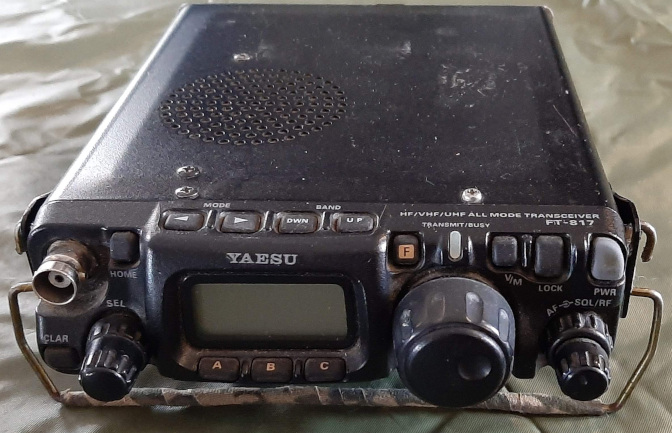
I bought this old steam-powered Yaesu FT-817 from a guy called Fred Flintstone in 2001. Back then Yaesu thought it was a good idea to make customers pay extra for luxuries like a memory keyer and a mechanical filter to narrow the receiver bandwidth. Being (like many hams, it seems) a miser I chose to build my own add-ons to make this great little multiband rig more usable. It has made a lot of QSOs for me. I have revived it after it spent a long time on the shelf. I like to think of this radio as a bulldog while the QMX is a clever little poodle.
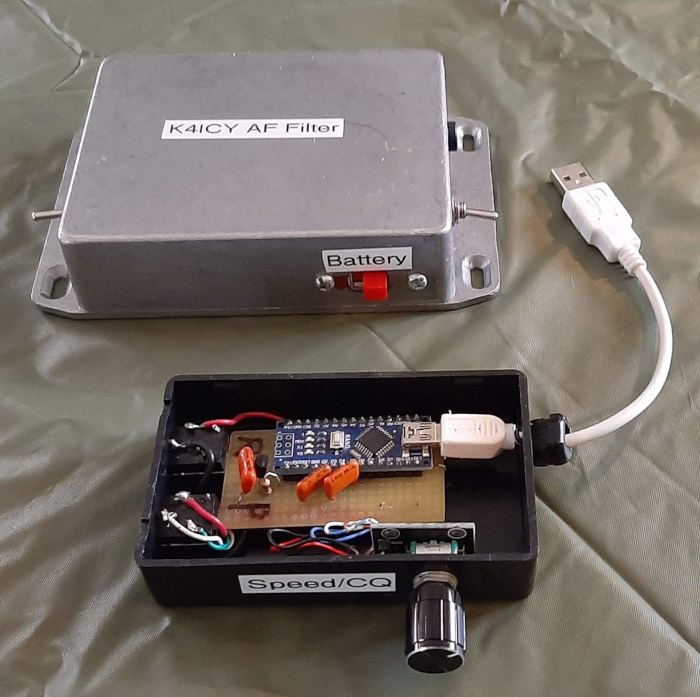
The K4ICY 2/4-stage audio filter plugs into the radio’s headphone jack and provides a narrow audio passband. It is based on a single chip quad op-amp. I built it inside a Hammond aluminum box because when in a plastic enclosure it picks up near-field RF and amplifies that too. It is powered by an internal 9V battery.
My build of the K3NG Arduino-based CW memory keyer is equipped with just one control. Turning the rotary encoder adjusts CW keying speed on the fly (a useful feature during a POTA activation). Clicking the rotary encoder knob sends a pre-recorded CQ message. It is powered by a single 18650 LiIon cell with built-in buck boost to bring the voltage up from 3.7 to 5 volts.
Where, outside the box, do we venture next? Stay tuned, or subscribe. And, if you have any suggestions or questions, please leave a comment below.

Help support HamRadioOutsidetheBox
No “tip-jar”, “buy me a coffee”, Patreon, or Amazon links here. I enjoy my hobby and I enjoy writing about it. If you would like to support this blog please follow/subscribe using the link at the bottom of my home page, or like, comment (links at the bottom of each post), repost or share links to my posts on social media. If you would like to email me directly you will find my email address on my QRZ.com page. Thank you!
The following copyright notice applies to all content on this blog.

This work is licensed under a Creative Commons Attribution-NonCommercial-NoDerivatives 4.0 International License.
Discover more from Ham Radio Outside the Box
Subscribe to get the latest posts sent to your email.
 Ham Radio Outside the Box
John,
One of your best posts lately (though, they’re all great)! I loved how you combined thoughts on propagation, band choice, and using efficient antennas into a single, practical article. It all rings true based on my experiences on the air. Keep up the outside the box thinking and sharing!
73, Paul
N4FTD
LikeLike
Thank you Paul. I truly appreciate feedback like that!
LikeLike
QRPers are possibly like fishermen…the fishing is always great, although sometimes the catching stinks!!
LikeLike
I like the fishing analogy. I like to call those spectrum displays on newer radios “fishfinders”.
LikeLike
I always look forward to your posts, John!
For me, ham radio is QRP CW. I don’t own any phone rigs for HF. I do have a couple of HTs though. My first rig after getting my Tech+ license was an old Heathkit HW-7. What a way to start! But I learned a lot and still run it occasionally. My daily home rig is an HW-9 to an indoor random wire. My everyday field rig is the original MTR 3b. I don’t do any of the games or contests. The POTA parks are too far without a car. Being retired, I also hate having to be in certain places at certain times, so contests are out.
So that means low pressure, fun operating. I still manage to get 20 or so contacts per week, and work stations all around N America. Sometimes I get surprised by stations in Europe or S America. QRP was starting to get a bit too easy, so I’m on a QRPp kick now. I built up a station using the Zachtek Flea transmitter and one of those mini receivers that are popular now. I also got a set of QRP crystals and an OXO transmitter and built a mighty 250mw 7 band blowtorch. No contacts on that one yet, but I got all winter to play with it.
For me, QRP and CW are ham radio. no screens or computers or keyers or spotters. Nothing to get between me and the airwaves. That’s real radio!
Keep doing what you’re doing, John. I really enjoy it!
Rick N8TGQ
LikeLiked by 1 person
Thanks for commenting Rick. I agree that a barebones radio and CW are the way to go. Modern radios – especially those that rely on the Internet for all or part of the connection are taking away the traditional adventure of experimentation. I admire your QRPp efforts, now that really is experimentation. I am sure it will yield plenty of contacts once the present unsettled propagation conditions are over. Good luck.
LikeLike
Totally agree with your sentiment about using CW and QRP. Got my original General class (WB8RXP) license back in ’76 while in H.S., but let it lapse during a stint in the Air Force. Now I’m retired and working to get it back, sad to see that CW is no longer a requirement in ham radio, that was part of what separated us from the CB users in the ’70s. In any case, planning on creating a few low powered tube transmitters transmitters for QRP work, not sure yet what receiver I’ll use, but would like it tube based as well. Whatever direction it takes, I’m excited. There are lots of parks in Michigan, and it’ll give me an excuse to get out and about. I’ll never use a computer or the internet for ham radio, what’s the point of that? Like you said, “Nothing to get between me and the airwaves“. 😉
LikeLiked by 1 person