
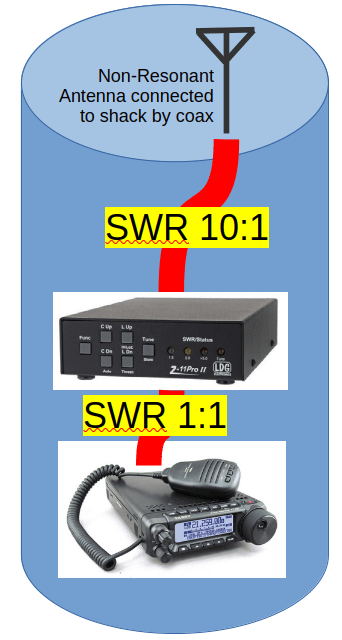
What happens when you press the magic TUNE button on your radio, or external automatic tuner? You will likely hear the rapid clicking sound of relays trying different combinations of capacitors and inductors as it looks for the lowest SWR to present to the radio.
But, a “tuner” does NOT actually tune your antenna. It simply provides an impedance match between your antenna system and your transceiver. It used to be more accurately called a “transmatch” but that term is seldom used these days.
The transceiver may “see” a perfect match coming from the “tuner”, but that low SWR exists only between the “tuner” and the radio. The SWR between the antenna system and the “tuner” might, in fact, be as high as 10:1! Like many other tuners, my LDG Z-11 Pro can resolve impedance mismatches up to 10:1.
Is that bad? And what happens to the signal after it passes through the “tuner”?
Greater minds than mine have discussed those questions at great length. Here is my understanding of what happens. Let’s say the antenna is an electrically short, non-resonant whip. It has a high capacitive reactance and will present a high SWR if it were to be directly connected to a transceiver. Instead, the antenna is connected to a “tuner” which transforms the impedance and provides a match close to the 50+j0 ohms preferred by the transceiver.
** But the SWR at the ANTENNA remains unchanged! **
Will the antenna still radiate a signal?
As is often said in antenna related forums, “RF gotta go somewhere”. However, because the antenna has a high SWR, only part of the signal is radiated and the rest is reflected back down the coax toward the shack. It is often thought that the reflected signal is converted into heat in the tuner (or transceiver). While that might be expected according to the Laws of Thermodynamics, it is only partially true. Actually most of the signal is re-reflected back toward the antenna where more signal is radiated with the remainder reflected, once again, back to its source. These back and forth reflections continue until there is no signal left to be radiated.
So all the signal eventually gets radiated then?
Once again, the Laws of Thermodynamics apply. Let’s assume the antenna is connected to the shack via a length of coax, and the tuner is in the shack. It could be an internal antenna tuner built into the transceiver, or an external tuner. As the signal passes along the coax toward the antenna it is attenuated due to the ohmic losses in the cable. At each reflection a little more of the signal is converted into heat in the coax. So, no, all the signal is not eventually radiated.
The transceiver reports a low SWR, but that only extends as far as the “tuner”. Between the tuner and the antenna signal losses are incurred due to the impedance mismatch. The amount of loss depends on the degree of impedance mismatch in the antenna system.
So now what? Non-resonant antennas are bad?
No, non-resonant antennas are not bad at all. If the big issue is lossy coax, but we use a very short coax – or no coax at all – the loss may be insignificant. In a field portable situation it is often possible to directly connect an antenna to the “tuner” or transceiver, eliminating the coax completely. If the antenna is non-resonant and a long transmission line is required, the coax may be replaced with ladder line, window line or open-wire line which has very low loss.
Another alternative is to use a remote antenna tuner. The signal will still be attenuated as it travels along the coax from the transceiver out toward the antenna, but the remote tuner will reduce the number of reflections necessary to radiate as much signal as possible.
Coax affects SWR
It is important to note that long lengths of coax affect the SWR seen by the radio. Some signal is lost in the coax, and that is also true for common mode current reflected back from the antenna. This means the SWR seen by the radio may appear to be better than it really is at the antenna.
A non-resonant high SWR antenna used with a tuner incurs insertion loss in the tuner and resistive loss from multiple reflections back and forth along the coax. These losses are not necessarily a concern and should be weighed against the convenience of being able to use the tuner to match multiple bands. A resonant antenna may incur less loss due to no tuner being required and low SWR at the antenna but it is a single band antenna.
There are situations in which only an inefficient, non-resonant antenna is available. In that case the inefficiency may be combatted by increasing the power transmitted. Paraphrasing the FCC’s Part 97.313 rules: An amateur station should use as much transmitter power as is necessary to carry out the desired communications. Clearly, if you are a die-hard QRPer and you only have an inefficient, non-resonant antenna to work with … well that’s the fun of QRP isn’t it?
This is a very complex topic and I can’t pretend to be an expert, so this post is intended to present the way I understand it. You may disagree, or have other explanations or opinions. If so, please share what you know in the comments.

Help support HamRadioOutsidetheBox
No “tip-jar”, “buy me a coffee”, Patreon, or Amazon links here. I enjoy my hobby and I enjoy writing about it. If you would like to support this blog please follow/subscribe using the link at the bottom of my home page, or like, comment (links at the bottom of each post), repost or share links to my posts on social media. If you would like to email me directly you will find my email address on my QRZ.com page. Thank you!
The following copyright notice applies to all content on this blog.

This work is licensed under a Creative Commons Attribution-NonCommercial-NoDerivatives 4.0 International License.
Discover more from Ham Radio Outside the Box
Subscribe to get the latest posts sent to your email.


@hamradiooutsidethebox.ca There was a time in ham radio when these were called match boxes, or matching networks. People understood that they didn't CHANGE the antenna; they just made the antenna SYSTEM compatible with the radio. And that's good; sometimes you want to use an antenna that won't offer a perfect SWR.
Then someone called it a "tuner" and it all went pear shaped. Awesome devices, poor name choice.
LikeLiked by 2 people
Remote Reply
Original Comment URL
Your Profile
Why do I need to enter my profile?
This site is part of the ⁂ open social web, a network of interconnected social platforms (like Mastodon, Pixelfed, Friendica, and others). Unlike centralized social media, your account lives on a platform of your choice, and you can interact with people across different platforms.
By entering your profile, we can send you to your account where you can complete this action.
Spot on!
LikeLike
Hi, John. This would be an ideal article for our club newsletter, Ballarat Amateur Radio Group. https://www.barg.org.au/. Can I reprint it with suitable acknowledgement?
Tom VK3DMK, BARG Newsletter Editor.
LikeLike
Thanks for your kind comment Tom. Please go right ahead and use my article in your newsletter.
LikeLike