
Only two? If you were to ask the military you might get a different answer. Indeed many hams actually use ex-military portable radios, such as the PRC series. Those radios are in a class of their own, but they are often heavy, designed to be carried into the field by fit, strong, young soldiers. But what are the choices for those of us who still like to backpack our ham gear into the back country, despite being well past our “best before” date?
I anticipate many readers might think differently, but this post is about my own criteria for assessing the field worthiness of a portable amateur radio transceiver. I am sure you are proud of your favorite radio. It has probably served you well over many xOTA activations. If, after reading this post, you feel your rig is up to the challenge then please nominate it for inclusion in the exclusive list of truly field expedient amateur radio transceivers by leaving a comment.
What makes a radio field expedient?
There are lots of radios – especially QRP rigs – that are lightweight and easy to carry in a small pouch. Does that make them field expedient? Perhaps, but are they hardened against environmental factors that may be encountered in the field? Lightweight and easy to carry in a small pouch are useful features but not always enough to guarantee success in the field. In this post I will outline my personal experiences which may be very different to your own. I don’t treat my field radio equipment with kid gloves. It gets bounced along rocky trails, subjected to extremes of temperature, moisture, bugs, sand and dust. A really good field radio will resist adverse environmental conditions. If it can’t handle that task out-of-the-box it must be covered in layers of protection to compensate.
Humps excluding Marilyns?
The Parks on the Air (POTA) program has brought about a huge increase in the number of hams taking their equipment out into the field to operate. POTA joins a broad array of similar activities like Summits on the Air (SOTA), World Wide Flora and Fauna (WWFF) and – mostly in Europe – Beaches on the Air (BOTA), Bunkers on the Air (also BOTA) and the very strangely named HuMPs Excluding Marilyns Awards (HEMA) program. Although this list is not exhaustive – there are other outdoor programs not listed – it illustrates the breadth and expanse of programs enticing hams to step outside their comfy shacks to assault the ionosphere.
Hit the road Jack
Just as there are many outdoor ham radio programs available to challenge us, there are also many different ways to tackle those challenges. My greatest admiration is reserved for those who climb mountains carrying their radio gear in a backpack, climbing steeply for many kilometers, ascending lofty snow-capped peaks before reaching the activation zone. In contrast, there are many who prefer to operate from inside a vehicle in a parking lot. There are certain advantages to operating this way. Your car or truck is your own private space where your park activation is less likely to be interrupted by other curious park users. It also provides shelter during inclement weather. I operate this way myself – but only during the winter when snow blizzards, ice-storms and temperatures cold enough to freeze your breath make the surface of the planet inhospitable.
During the warmer months my own preference is to enjoy the great outdoors in what I like to call the “Big Blue Sky Shack”. It is in this environment that I have encountered the conditions that truly sort out the rugged radios from the rest. My home turf is the small city of Owen Sound at the foot of the Bruce Peninsula in southern Ontario, Canada. The Bruce Peninsula extends 100km from my home up into Lake Huron along the Niagara Escarpment. Along the western side of the peninsula Lake Huron is bounded by sandy low lying land with many islands. The eastern side of the peninsula is dramatically different with tall cliffs plunging down into Georgian Bay – a 15,000 square kilometer extension of Lake Huron. The terrain on the peninsula varies between soft sand and hard ancient bedrock.

Winds crossing Lake Huron from the state of Michigan on the other side, 160km (100 miles) away, pick up a lot of moisture from the lake which is deposited onto the narrow peninsula in the form of rain or snow. Waves hitting the shoreline can be quite high – maybe not high enough for surfing, but enough to create spray along beaches.

at the entrance to Colpoys Bay
In winter we usually experience continuous snow coverage between December and April, and in summer temperatures can often reach into the 30s Celsius – as much as 50 degrees higher than in the depths of winter.
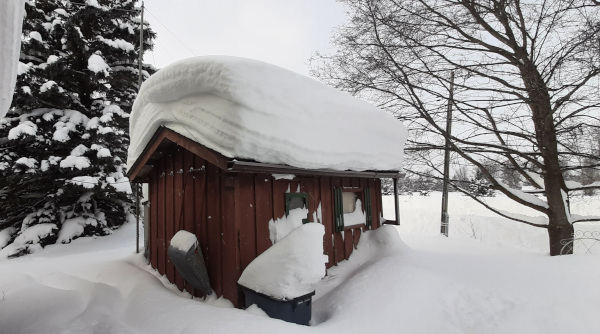
Honestly, just what gets me out of my nice air-conditioned in summer, heated in winter home-based shack? A love of the great outdoors! To enjoy the fresh air, to smell the scent of Canada’s 300 billion trees; maple, birch, spruce and pines. Unfortunately my radios have an inconveniently different point of view. They like a nice stable temperature, dry atmosphere and are highly averse to the ingress of sand and small flying, biting critters like mosquitoes and the dreaded no-see-ums. I once disabled my CW paddles by liberally spraying a cloud of bug repellent in response to an all out attack by these dreaded winged pestilences. If only radio equipment manufacturers would take these things into consideration then both I and my radios could get equal enjoyment out in the Big Blue Sky Shack. Really, why on Earth would CW key manufacturers not routinely protect their products from being sprayed with oily bug repellent? I jest of course.

Operating outdoors was an early passion of mine, before many of the programs we now enjoy even existed. I had purchased Yaesu’s FT-817 as soon as it was released. This was the early FT-817 before the revised FT-817ND was released. I still own that radio and have often thought about selling it, but whenever I lift it off the shelf and look into that tiny pug-like face I realize how much I would miss it. The FT-817 was built for the outdoors. It’s case just exudes ruggedness even though it still has shortcomings that limit its usefulness as a portable, field expedient radio. For example, it has provision for internal batteries – a set of AA NiCads, but its current draw is so high that the battery life is way too short for serious portable operations.
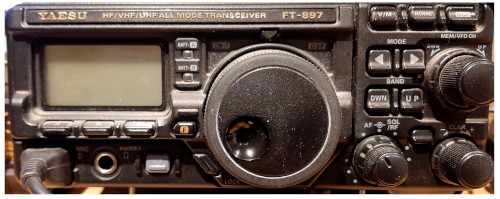
I then graduated to another Yaesu rig that also exudes ruggedness. I worked for a while in a ham radio store and every day I was exposed to many different radios that I could operate whenever I wished. But one radio caught my eye and each and every day the desire to own it grew stronger. It was the Yaesu FT-897, a 100 watt radio with all the band coverage of the FT-817 plus Digital Signal Processing (DSP). The case has that same bullet proof aura as the FT-817. It can support two internal battery packs so that when one is fully discharged a flick of a switch changes to the other pack. Both of these Yaesu radios have a rubber shrouded microphone plug that seals out unwanted stuff like sand, moisture, bugs – and bug spray! The FT-897 also sports a rugged 1/4 inch headphone jack which I really like.
What’s at the back Jack?
But … and it’s a big but … turn both of these radios around to see the rear panel and you will find 3.5mm (1/8 inch) jacks and mini-DIN connectors. What’s so wrong with that? Maybe nothing if your operating style involves working from your vehicle. But take that radio onto a beach (as I often do) and witness the magnetic attraction these miniature connectors have for sand particles. I have a strong dislike for 3.5mm plugs and jacks – especially the jacks. They are usually enclosed within a tiny sealed plastic box. If even a couple of grains of sand get inside contact integrity can be compromised. And besides, are these things designed for hundreds or thousands of insertions? I think not; they are designed to be cheap to produce. Cheap, fragile connectors may be appropriate on a mobile phone that is likely to be replaced every couple of years, but not for a field expedient portable radio. I have owned a couple of handheld radios from a certain manufacturer based in Japan (not Yaesu) that had particularly fragile 3.5mm jacks that failed very quickly. It was those radios that prompted my crusade against these pernicious connectors.
Ok, so we have radios with fragile connectors; what can we do about it?
I came up with one easy solution that doesn’t cost a penny. Simply leave these reliability-challenged connectors connected. Don’t unplug those headphones, microphones, CW keys and whatever other peripheral paraphernalia uses them. To achieve that you have to create an enclosure that secures all your external devices so that you don’t need to disconnect and pack them away separately each time you operate.
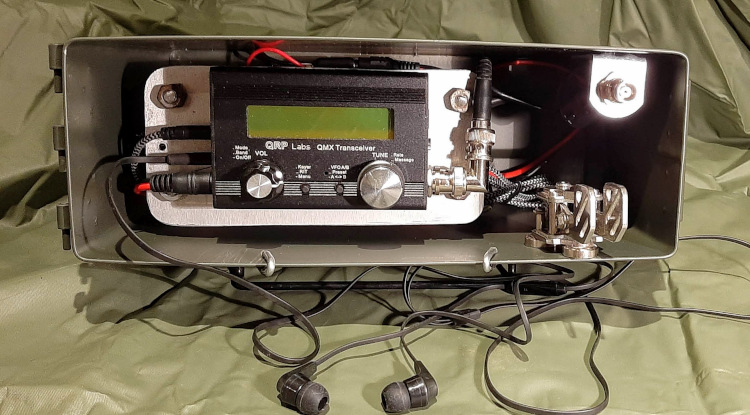
I built two of my field radios into steel ammo cases so that everything can be left connected between operating sessions. My little QRP Labs QMX radio is just bristling with connectors that are vulnerable to hostile environments. Inside its cozy 30 caliber ammo case it can remain totally oblivious to the hazards surrounding it out in the field. I pop off the heavy-duty steel lid that protects it in transit, connect an antenna, switch on the battery, lift out the connected earbuds and I am QRV.
My other main field radio is a QRP/QRO-optional Yaesu FT-891 built into a 50-cal ammo case. The FT-891 has several vulnerabilities and protecting it has become an ongoing project. The radio is a little too big to fit entirely within its (literally) bullet-proof steel box with the ammo case lid attached. The detachable head is mounted to an aluminum front panel and protected by thick steel U-bolts. All the vulnerable connectors remain safely connected inside the steel case. The only external connections required are for the battery, headphone and CW key.
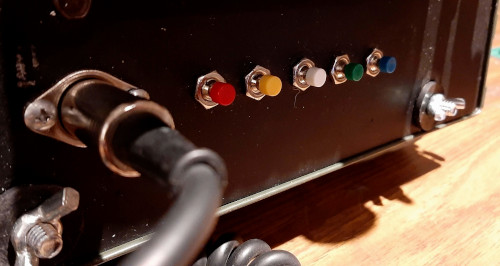
The battery is connected by Powerpole connectors; the headphone is a Heil Traveler with a beefy inline connector and the key connects via a jack on the front panel. The original 3.5mm jack on the aluminum front panel has been replaced; first with a cheap 1/4 inch jack which proved equally unreliable, then with a 5-pin DIN connector. I had considered buying a very rugged 3-pin XLR plug and jack but I already had the DIN jack as well as an old CB mic cord with a 5-pin DIN plug. We shall see whether they can withstand the rigors of the environment on the beaches and cliffs of the Bruce Peninsula.
Now, going back to the title of this post: “How many truly field expedient ham radios are available? Maybe only 2!”. Well, which two radios did I have in mind when I wrote that? Imagine designing and building a commercial radio with a strong, rugged, water resistant case and military grade connectors. You could take such a radio out into almost any environment and be confident that it will remain reliable and get the job done. Does such a radio exist? You have to look beyond the islands of Japan; beyond China. I have highlighted the dangers of sand getting into vulnerable connectors, so would it surprise you if a company in a very sandy country came up with such a radio? I am not sure which country actually manufactures these radios but one of its biggest distributors is in Dubai. If you would like to know more visit Lab599.com. They produce two radios that are truly field expedient and environmentally protected. Only one of the radios is currently featured on the website but a newer handheld HF transceiver has also been released.
Why I am taking up gardening
I want to grow roses; lots and lots of red roses. I can’t afford to go out and buy enough red roses to convince senior management (she prefers to be called “She-Who-Must-Be-Obeyed”) to let me buy a Lab599 TX-500 🙂

Help support HamRadioOutsidetheBox
No “tip-jar”, “buy me a coffee”, Patreon, or Amazon links here. I enjoy my hobby and I enjoy writing about it. If you would like to support this blog please follow/subscribe using the link at the bottom of my home page, or like, comment (links at the bottom of each post), repost or share links to my posts on social media. If you would like to email me directly you will find my email address on my QRZ.com page. Thank you!
The following copyright notice applies to all content on this blog.

This work is licensed under a Creative Commons Attribution-NonCommercial-NoDerivatives 4.0 International License.
Discover more from Ham Radio Outside the Box
Subscribe to get the latest posts sent to your email.
 Ham Radio Outside the Box
Outstanding article. Your writing is consistently clear, thorough, and engaging—no matter the subject, you never miss a detail. I’m always impressed by the depth and quality of your work, and I truly appreciate the effort you put into each piece. I learn something new—often many things—with every article you publish.
LikeLike
Thanks for your very kind comments. It is feedback like yours that makes all the effort that goes into publishing these articles so worthwhile. I truly appreciate it.
LikeLike
Hi John
I went with the original LNR MTR 3b. 4 buttons, 4 switches all flush-mounted in the top. A 7 segment LED screen is the only display, but I seldom look at it because it also has audio announcements in CW. It will run on 6 to 11 volts and has an all metal case. It was designed for outdoor radio.
I also keep everything plugged in full time to protect connectors. It’s nice just opening the hard drive case I use and connecting the antenna to the efhw transformer. Then I’m on the air.
I think where lots of people run into problems is trying to cover all bands from DC to daylight when they go to out play radio. More stuff means more problems. The 3b and maybe an HT are enough for me to worry about.
I love reading your posts. They get me thinking about stuff!
LikeLike
Thanks Rick. Yes I agree, the Mountain Toppers are good candidates for adding to the list, especially with the way you keep everything connected. I appreciate the feedback.
LikeLike
I agree with you regarding the LAB599 TX-500. My first test with it out of doors was a success with a battery powered 5w QRP circuit with a POTA activator 500 miles away. The speaker microphone is loud enough for outdoors, but I’ll be looking into headphones next. My next contact was in Ontario which was probably 750-800 miles. I really enjoy your writing style and content. Keep up the good work. 73 —> N1YZ
LikeLike
Thanks Rod!
LikeLiked by 1 person