
I once drove to a park about 45 minutes away from home to do a POTA activation then realized I had left my antenna at home. <<Panic>>. I improvised by digging a 33ft wire out of my pack, cutting it in half and hastily erecting a V-dipole with its ends only about 10ft above the ground. The propagation gods must have been in a benevolent mood that day because I completed the activation and even logged some DX with what was probably the craziest antenna I have ever used. You can read about it here: No Antenna? No Problem!
The next day I constructed a proper dipole that I always carry in an emergency bag in my truck. I have never had to use it. Then, just a few days ago I watched a YouTube video by N7KOM in which he performs a SOTA activation using a very simple wire antenna called the TinyAntenna. It comprised an inductively loaded 8ft radiator and a 13ft counterpoise. A tuner is required but it worked very well on the higher bands. Of course, a wet noodle would often work up on the top of a mountain. A commercial version of the TinyAntenna is available from N6ARA.
I was very interested in the idea and wondered whether I could successfully adapt the idea for my own needs. I wanted a single band, tunerless antenna that could be carried in a shirt pocket and kept for emergency use. This is what I came up with, and – spoiler alert – it works.
The original TinyAntenna uses a T50-6 toroid wound with 20 turns of wire for a loading coil. I didn’t have a suitable toroid. I thought about substituting what I thought was a T50-2. Unfortunately that toroid, purchased from a reputable Canadian electronics retailer, was definitely not made from type 2 powdered iron material, as I discovered when I wound a few turns of wire on it and measured the inductance. The required inductance was around 1.8 microhenries, so why use a toroid at all? In its place I substituted about 35 turns of enameled copper wire around a short piece of 1/4-inch diameter fiberglass driveway marker material.
For readers who don’t live in snowy regions: a driveway marker is a short pole with reflective coating used to mark the edge of your driveway when the snow lies deep and crisp and even. They are sold in lengths from 3 to 5 feet. I have a pair marking the end of my driveway; maybe I’ll rediscover them in a couple of months if the towering snow banks (almost tall enough to qualify for SOTA) eventually thaw.
Using a driveway marker core for the coil presented some challenges. It was easy enough to wind but when I tested it out on the barren, frozen wasteland that was once my deck I found big variations in SWR as I made minor changes to the spacing of the coil turns. The fix involved delicately drilling a small hole in the core at each end of the coil to hold the wire ends and keep the coil turns tightly compressed. Even fine gauge enameled copper wire can be surprisingly springy. A layer of shrink wrap was added to ensure the mischievous coil did not conspire to devise a way to change its inductance.
The TinyAntenna uses an 8ft radiating element and requires a tuner. It is designed to be usable on all the high bands. I lengthened the radiating element to 13ft and, with the addition of the loading coil (measured at 1.7 microhenries), my Emergency Field Antenna can be used without a tuner on 20m.
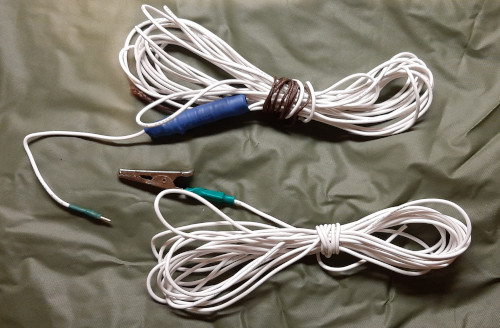
Note the radiator wire (top) uses a simple BNC center pin to connect to the radio. The blue component is the loading coil.
The bottom wire is the counterpoise. Both 26awg wires are 13ft long.
The original TinyAntenna has a feature that I found very interesting. It directly connects to a radio using only the center pin of a BNC connector. That probably shaves a couple of grams from the weight if you are striving to minimize the load you have to carry up a mountain. The closest mountain to my home base is called Kemble Mountain on the Niagara Escarpment. It soars at least a couple of hundred feet above the surrounding terrain. The ascent takes about 30 seconds in my truck. Needless to say, weight is not a priority.
I tested my Emergency Field Antenna using just the BNC center pin as a connector. I was pleasantly surprised at how securely it mated and remained in place. However, the antenna could be disconnected by a simple light pull on the wire. If that were to happen while transmitting the radio would suddenly see infinite impedance and – pop go the finals! So, I added a BNC shell (without the crimp-on sleeve, since there is no coax braid involved) and secured the assembly with shrink wrap.
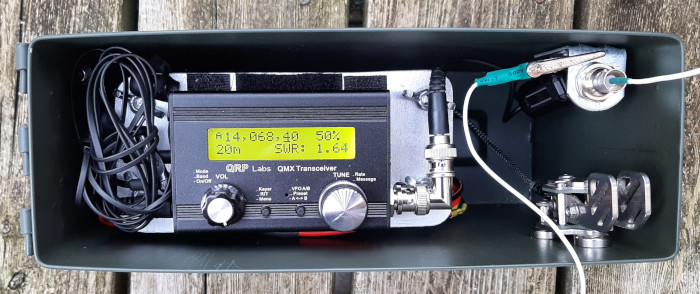
Out on the barren, frozen, ice-covered deck, another “learning opportunity” presented itself. Using the QMX’s SWR measuring tool the antenna presented a 3.5:1 reading on first power-up. That was definitely double plus ungood. The issue was that I was using a 13ft counterpoise on 20m – too short! Now, 13ft would be just fine if laid directly on the ground, but it was laying on top of random patches of ice and snow where I had cleared just enough space to operate. That was not a good ground. Moving the counterpoise around changed the SWR considerably. I found a patch of ice that satisfied the SWR meter and obtained a 1.64:1 reading. Not perfect, but good enough to risk transmitting.
The proof of the pudding …
Of course we all know that a low SWR does not a good antenna make, otherwise we could all happily use a dummy load for an antenna. Is this Emergency Field Antenna a dummy load? Despite the cold I had to find out. I called K4NYM who was activating a park in Florida 1100 miles (1770km) away. He was busy with a constant flow of hunters so I had to wait for my opportunity to pounce with my 4.5 watts into a decidedly compromised antenna. Patience prevailed and we QSOd. I gave him a 559 and he gave me a 449 report.
What next?
I realize this is meant to be a super-light pocket antenna for emergency use only and we can conclude that it is indeed fit for purpose. But, all the same, it probably has a use case when a rapid deployment in a public space is called for. I am thinking of activities like RaDAR (Rapid Deployment Amateur Radio) which is a form of radio sport in which the object is to make 5 contacts then move on a specified distance then repeat up to four times within a 4-hour time window.
The Ham Radio Outside the Box Emergency Field Antenna can be supported on a lightweight fishing pole and erected very quickly indeed. It seems ideal for RaDAR type activities but maybe with one small improvement. Instead of a single counterpoise wire, a set of ground radials would improve the efficiency. I carry a set of 4x13ft radials in my outdoor radio pack that can be deployed almost as quickly as a single counterpoise. In the spring – when I can see the green, green grass of home again I will give it a try.

Help support HamRadioOutsidetheBox
No “tip-jar”, “buy me a coffee”, Patreon, or Amazon links here. I enjoy my hobby and I enjoy writing about it. If you would like to support this blog please follow/subscribe using the link at the bottom of my home page, or like, comment (links at the bottom of each post), repost or share links to my posts on social media. If you would like to email me directly you will find my email address on my QRZ.com page. Thank you!
The following copyright notice applies to all content on this blog.

This work is licensed under a Creative Commons Attribution-NonCommercial-NoDerivatives 4.0 International License.
Discover more from Ham Radio Outside the Box
Subscribe to get the latest posts sent to your email.
 Ham Radio Outside the Box
Nice one John, I’ll have to give this a try.
Snow drifts On The Air 😂
LikeLiked by 1 person
Would you hook the radials to the same place the counterpoise is attached? Yes, I’m dumb as a rock.
Thank you
Monty/KF0GPX
LikeLike
That’s not a dumb question at all Monty. Yes the radials could be clipped on in the same place as the counterpoise, but I have fitted a banana jack to the BNC bracket so I can simply plug in my radials when needed. The alligator clip for the counterpoise was a temporary arrangement while I was testing the antenna.
LikeLike
I’m looking forward to seeing how it works for you. I don’t really need an another antenna project, but I think I see one in my future. 🙂 73, Craig WB3GCK
LikeLike
A ham can never have too many antennas!
LikeLike
I bought a tinytenna a couple of months ago, but really haven’t used it yet. The idea of a resonant tinytenna is awesome!
Looking at online calculators, it seems that an 8 foot wire and a T50-43 with 4 turns of wire should resonate around 14MHz – keeping ARA’s antenna size but adding your resonance. I’m hoping to get a change to try it out this weekend.
73,
Mike, KL7MJ
LikeLike
Good idea about the 14MHz resonator Mike. Thanks for the feedback.
LikeLike
Well, the -43 toroids didn’t work. I plan to try a FT82-6 with about 30 turns to work with an 8 foot radial.
LikeLike
I was looking at powdered iron toroid specs today. Type 6 is not recommended below 10 MHz, but type 2 works from 2-30 MHz i.e. the whole HF spectrum. I am going to order several -2, -6 and ferrite -43 types to play with. Let me know what works for you.
LikeLike
I made a version with a 13 foot radiator, a 17 foot counterpoise, and a T50-6 with 24 turns of wire. It tunes low, but I can get the SWR down if I pile the counterpoise up at my feet. I probably need to trim both wires, but I’d rather have an antenna that’s too long than one that’s too short!
LikeLiked by 1 person