
My wife and I enjoyed a short early fall vacation to take advantage of a period of warm, sunny weather. I used the opportunity to attempt some POTA activations and compare the performance of three of my field antennas in challenging propagation conditions. I had several parks on my radar and too little time to activate them all. In the end I settled on just 3, using a different antenna at each park.
Although the terrestrial weather was terrific, space weather – and hence radio propagation – was best described as “temperamental”. This would be a real test of whether each selected antenna would get my signal out under difficult conditions.
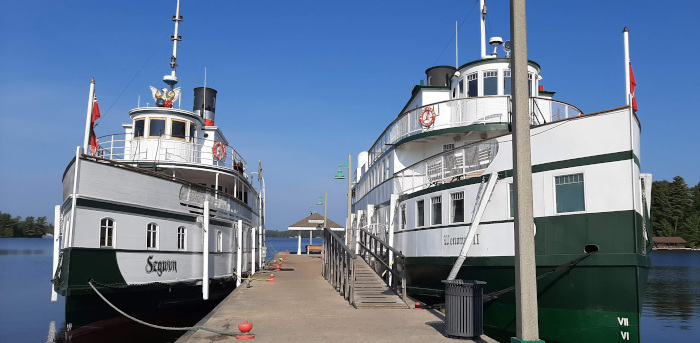
Our base was the town of Huntsville at the northern end of the district of Muskoka, Ontario. Muskoka is the playground of the rich, but also a great vacation area for the more humble among us. The picture above shows a couple of the tour boats that ply the waters of Lake Muskoka from their base at Muskoka Wharf in Gravenhurst. The Segwun is a restored 130 year-old mail ship; the Wenonah II is a modern replica of the first Royal Mail boat to sail the lake in 1866.
#1 Algonquin Provincial Park (CA-0138) | End-Fed Half-Wave Antenna
The town of Huntsville is an easy access point for exploring the huge Algonquin Park – Ontario’s first and largest provincial park. Algonquin Park was to be the site of my first – and most difficult – activation
From the Ontario Parks website:
The essence of Algonquin is in its vast interior of maple hills, rocky ridges, and thousands of lakes – 7,635 square kilometres of forests, bogs, lakes and rivers. The only way to explore the interior of this park is by paddle or on foot. There is also a second Algonquin – along the 56 kilometre stretch of Highway 60.

Algonquin Park is also the home to moose, wolves, black bears and many other species. Although we didn’t see any wildlife on this visit, previous visits were a different story. The moose in the picture was happily grazing right alongside Highway 60 which runs for 56 km through the southern part of the park.

Some years ago, while canoeing through the park interior, I was camped in a tent alongside a small lake. At around 2 am a large black bear raided our small campsite looking for food. Fortunately humans were not on his menu that night, but the incident gave me a very healthy respect for these sometimes dangerous animals. When I reported the incident to park officials afterwards the park warden simply shrugged and said “we gotta lotta bears here”. Estimates of the number of bears inside Algonquin Park range between 2000 and 3000.

There are many possible operating sites along the highway but I chose to enter one of the campgrounds to set up for my activation. The Mew Lake campground has a small beach area that was just perfect. Propagation conditions, on the other hand, were far from from perfect. All the indicators showed this would be a tricky activation attempt. I staked out my 29ft fiberglass pole and hauled up my linked End-Fed Half-Wave antenna.
An End-Fed Half-Wave (EFHW) is often misunderstood. It is often described as a multi-band antenna, but it is in fact only a half-wave on one specific band. It will operate well on harmonics of its design frequency but the radiation pattern will change. An EFHW can sometimes be made to work on other non-harmonic bands by means of a tuner, but even though a tuner can squeeze a low SWR out of it, the radiation pattern may not be optimum.
I had a choice of the 20m, 30m and 40m bands to work with. I had brought along my QRP Labs QMX low band radio on this trip and it doesn’t support the higher bands. The linked EFHW was therefore a good choice. I had carefully tuned each segment in the Outback (out in my backyard) so that by linking 3 sections of wire, the antenna could be a true half-wave on 20m, 30m or 40m. The wire was setup as an inverted-V with the apex at 29ft and the high impedance wire ends just a foot above ground.
I chose to use the full length for my activation on 20m. My thinking was that the wire would be a full-wave on 20m and would have 2 current (and radiation) maximum points and – maybe – a better chance of grabbing contacts over a wide area.

The K-index was 4, the Proton and Electron flux numbers were fairly high and the Interplanetery Magnetic Field index (Bz) was in negative territory. HF conditions on 20m were described as “fair”. Under these conditions one might be forgiven for wishing to redefine QRP to mean maybe, oh let’s say, 100 watts?
Get on the air and try harder!
But 5 watts was all I had to work with so it was a case of get on the air and try harder. RBN reports indicated my signal was getting out well enough, but the big demon in the ionosphere that day was QSB. Hunters would respond to my CQs; I would send my signal report and await a response. Sometimes the response didn’t come. Sometimes I called them again and did eventually get a response to complete the contact. QSB (signal fading) can be strange like that.

I had setup under the shade of a tree, but after 50 minutes the Sun had moved and both I and my little radio were getting quite hot. I had logged contacts in TN, VA, TX, IA, IN, IL, GA, MN, NC and SC. I had 13 contacts in the log and continued CQing was not yielding any further contacts so I decided to call QRT. Tomorrow would be another day for another activation in a new park – and with a different antenna.
#2 Arrowhead Provincial Park (CA-0140) | VP2E Antenna
Just outside the town of Huntsville is Arrowhead Provincial Park – named for plants with arrowhead shaped leaves that grow at the edge of the lakes. Arrowhead was our second POTA destination of the trip. It is quite a large park (but not on the scale of Algonquin Park) with several interesting features. Two rivers run through the park – the Little East River and the Big East River. Perhaps the biggest attraction on the Big East River is the Big Bend Lookout seen in the picture below.

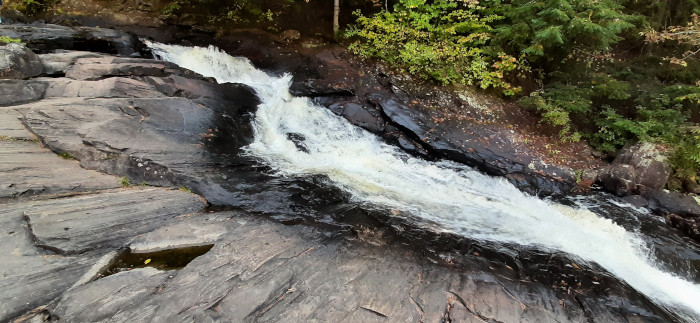
Meanwhile, on the Little East River, is the picturesque Stubbs Falls, seen in the picture below.
At the far end of Arrowhead Lake, where the Little East River enters the lake, is a dog beach that I knew very well from previous visits.


To one side of the small parking area I found an operating site well away from the many happy dogs enjoying a swim in the warm water that day. The shape of this area strongly suggested one particular choice of antenna – the VP2E (Vertically Polarized 2 Element).
The VP2E is an unusual antenna that I have described in a previous post. It is essentially a full-wave antenna erected as an inverted-V with a fairly low apex that can be supported on a short pole. The footprint of my homebrew 20m version of the VP2E was a perfect fit in this space.
Propagation conditions were a little better than the day before, but still not very strong for a QRP activation. Nonetheless, the VP2E performed splendidly. After 22 minutes of operating I had 8 contacts in the log. But then I hit a brick wall. The hunters stopped coming only 2 shy of a valid activation.

I took a pause to cool off in the lake and greet a couple of the dogs who bounded across the beach to meet me. I have always been a huge dog lover.
How to win at QRP
Feeling refreshed, I continued to call CQ. This was another case of how to win at QRP – keep on trying – and then try some more. Following the break the hunters were back and I logged another 5 contacts before the well went dry once again.
TIP (for CW ops): When activating a park watch your own spot on the POTA spots page. Each spot is timed and updated once every minute. If you are continuing to call CQ but the POTA website is not updating your spot it could mean you are not being heard. Take a break or call QRT.
When I saw my spot hadn’t been updated for 5 minutes I knew it was time to call it a day with just 13 contacts in the log just like the previous day. I had logged contacts in KS, KY, GA, TN, NC, TX and VA. The next day was to be our final day in the area before driving home in the afternoon. Two activations had been completed; could I squeeze in a third one on the way home?
#3 Torrance Barrens Conservation Reserve (CA-1669) | Vertical Whip Antenna
Our drive home took us south through Muskoka where one of my favorite parks is located. A short drive along a minor road took us to Torrance Barrens. This incredible area is characterized by large expanses of the bare rock of the Canadian Shield. It is frequented by astronomers because it is a designated dark sky preserve.

I have activated Torrance Barrens a couple of times before so I learned how to deal with terrain into which it is impossible to drive stakes and poles. There are a few short trees that could be used to support a wire antenna but my choice that day was a quarter-wave whip with ground radials. The whip had to be supported by my heavily modified old photo tripod, as can be seen in the picture.
There is an issue with using a vertical whip – it has a low angle radiation pattern. This might be an advantage for making DX contacts, but when propagation conditions limit the chances for long-distance contacts it becomes a potential disadvantage. Fortunately, propagation conditions had improved; the K-index was down to 1 so there was reason for hope.
As I began calling CQ contacts came in steadily. I could see that the low angle radiation pattern was working for me. There were some northeastern states in my log but I also logged contacts out west in KS, IA, ID, CO and AZ. There was a pause in the constant flow of hunters responding after I had 18 contacts in the log, so remembering I still had a long drive home, I pulled the plug and packed up my gear.
Comparing The Three Antennas
It is not easy to compare antennas when propagation conditions are so variable. The quarter wave whip is a regular standby that is often employed in crowded public spaces. It is fast and easy to erect and usually does a great job.
The End-Fed Half-Wave antenna gets a lot of copper in the air and can be used on multiple bands (either through working harmonic bands or by adjusting links) but it is also the least stealthy of the 3 antennas I deployed on this trip.
I think I would nominate the VP2E as my favorite antenna this trip. It occupies about the same horizontal footprint as the EFHW but its apex is much lower. My version of the VP2E has an apex only 14ft high. The VP2E also has a little gain and is slightly directional, but … it is a monoband antenna. Maybe being monoband isn’t really a disadvantage for POTA since the 20m band seems to be the hotspot for POTA.
Syndicating Ham Radio Outside the Box
I am flattered to have received several requests to use posts from this blog in newsletters, websites and publications around the world. One of the latest requests came from South Africa where selected posts will be translated and published in Afrikaans. At the foot of every post is a copyright notice stating the content of this blog may be used for non-commercial purposes without modification and with attribution. If you would like to use any material on this site I would be grateful if you would let me know the details by email (good on QRZ.com).
Help support HamRadioOutsidetheBox
No “tip-jar”, “buy me a coffee”, Patreon, or Amazon links here. I enjoy my hobby and I enjoy writing about it. If you would like to support this blog please follow/subscribe using the link at the bottom of my home page, or like, comment (links at the bottom of each post), repost or share links to my posts on social media. If you would like to email me directly you will find my email address on my QRZ.com page. Thank you!
The following copyright notice applies to all content on this blog.

This work is licensed under a Creative Commons Attribution-NonCommercial-NoDerivatives 4.0 International License.
Discover more from Ham Radio Outside the Box
Subscribe to get the latest posts sent to your email.
 Ham Radio Outside the Box
This is a FB report OM and the pictures are great. Those are some good looking lake boats. When propagation is “challenging” you definitely need to adapt your operating procedure to have any hope of completing an activation.
POTA is already a fairly canned exchange, which is what makes me able to do CW at 20wpm. But, when the QSB window is opening and closing rapidly an even more terse exchange is needed. Gone are the niceties of “Good morning <name>”, “UR RST”, and “TU <state/province>, etc. Just callsign, RST(once) and Bye.
LikeLike
Thanks Matt. I agree re the exchange. If I rush it too much though OMs may think I am sending a message in Vulcan. Good keying when using a very small key, balanced on my knee, while fighting off the mosquitoes and other nasty bugs is hard to maintain!
LikeLike