


I don’t like to waste time setting up my equipment out in the Big Blue Sky Shack. It makes sense to configure everything ready to unpack and get on the air as quickly as possible.
I also rarely have the luxury of operating from a nice comfy picnic table. I prefer operating in the back country while sitting on a lightweight folding camping stool with radio, battery, tuner and CW key right in front of me. With this arrangement everything except the antenna sits securely on a small kneeboard.
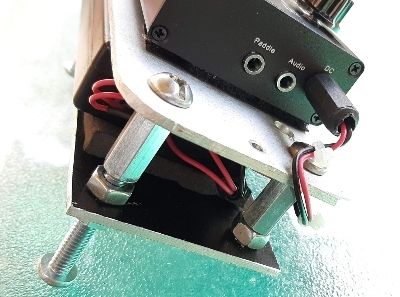
My current favorite radio is the QRP Labs QMX transceiver. I mounted the QMX with Velcro to the front of an aluminum plate. Behind the plate is a 3000mAh Talentcell Lithium Ion battery. The battery is held securely by gently sandwiching it between the front plate and a second aluminum plate.

A small high current diode is wired into the DC supply cable to drop the fully charged voltage of the battery from 12.6 volts down to 12 volts. As the battery voltage drops the diode can be taken out of circuit with a simple powerpole connector arrangement.
Four quarter-inch steel bolts hold the two aluminum plates together. Two of the bolts are longer than the others and act as legs so that the assembly sits at a comfortable angle for viewing.
The whole assembly can be mounted on a small modified clipboard used as a kneeboard when operating. A small steel plate was pop-riveted to the board for mounting my Putikeeg CW paddles. A second clip was also pop-riveted to the clipboard. The QMX/battery assembly is held securely between the two clips.
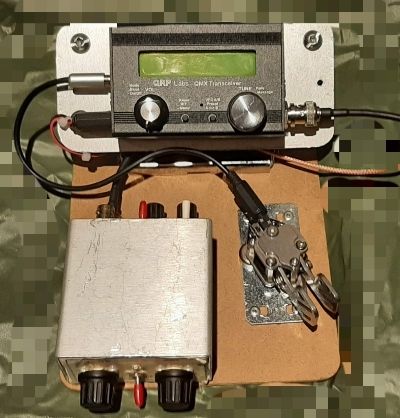
The final image shows how it all comes together in the field. The kneeboard sits comfortably on my lap while I operate.
The image shows one of the two QRP tuners I use in the field. The one in the picture is a Norcal BLT (Balanced Line Tuner). The BLT uses the Z-match topography which I sometimes find a little difficult to use. As an alternative I also have a “Super-Tee” tuner. This was a club construction project from over 20 years ago and still works well. The Super-Tee has a series of LEDs to indicate the SWR and a binary selectable set of toggle switches to insert precise values of inductance.
Everything fits into a compact padded radio case for further protection during transportation. I use a backpack to carry the radio, all accessories and antennas with me on my travels. Operating outdoors in what I like to call the Big Blue Sky Shack can be rough on delicate equipment. This is especially so when the equipment has to be transported down rugged trails, then used in harsh environments, like sandy beaches, for which it was never designed. The particular form of packaging I have described suits my own style of field expedient radio operations. It combines convenience with a reasonable degree of equipment protection.
I am sharing this design so that it may inspire others to create their own arrangements. The general ideas can be adopted for other radios too. If you have designed or built something similar please consider sharing information about it. You can describe your design or post links to your website, blog or published articles in the comments below.
Help support HamRadioOutsidetheBox
No “tip-jar”, “buy me a coffee”, Patreon, or Amazon links here. I enjoy my hobby and I enjoy writing about it. If you would like to support this blog please follow/subscribe using the link at the bottom of my home page, or like, comment (links at the bottom of each post), repost or share links to my posts on social media. If you would like to email me directly you will find my email address on my QRZ.com page. Thank you!
The following copyright notice applies to all content on this blog.

This work is licensed under a Creative Commons Attribution-NonCommercial-NoDerivatives 4.0 International License.
Discover more from Ham Radio Outside the Box
Subscribe to get the latest posts sent to your email.
 Ham Radio Outside the Box
Nice setup for the QMX. Looks like you’ve customized the tuning knob quite a bit also.
LikeLike
Thanks Matt. The tuning knob came from an old scrapped AM receiver. It is a push on type. I trimmed and packed a tiny piece of plastic inside to stop it going too far onto the encoder shaft and interfering with the click operations. Unfortunately I only had one of these knobs.
John Corby, VA3KOT HamRadioOutsideTheBox.ca
LikeLike