
QMX non culpa, mea culpa!
I thought I was smart. I have a physics degree; college taught us 1970s long-haired layabouts 3 ways to build an atomic bomb. But half a century later I make simple errors with my ham radio equipment. The fault is mine and not QRP Labs brilliant little QMX transceiver.
In the last post I described a side-by-side receiver comparison between an Icom IC-705 and the QMX. I recounted how when both radios were tuned to the same weak signal, the 705 heard it but the QMX didn’t.
I left my friend’s shack with my tail between my legs. I was so sure that on a receive only comparison the QMX would prove itself the equal of the mighty (and mighty expensive) 705. I had several ideas for things to check. Could it have been my earbuds? I switched out the simple over-the-ear earbuds for other headphones, but they all sounded the same.
Could it be the AGC?
The QMX’s AGC is highly sophisticated with 8 individual user-adjustable parameters. But wait, an AGC’s job is to attenuate strong signals. Surely it would not impact weak signals? I ruled that out.
Could it be the audio gain?
Using the QMX’s terminal mode it is possible to adjust the audio gain independently for each band. After reading the QMX manual more carefully I had a better understanding of how to read the signal strength indicator on the main display. It helps to have 2 pieces of test equipment: a reference signal source (I used an Elecraft XG3) and an electron microscope to count the tiny dots on the QMX display.
My QMX is the low band version supporting 80m, 60m, 40m, 30m and 20m. I have no interest in the 60m band so I ignored it. For each of the other 4 bands I checked the displayed signal strength when a 50 microvolt signal was injected. 50 microvolts is supposed to register S9 on a receiver, but the QMX showed S8 (or maybe my electron microscope is out of calibration).
I adjusted the audio gain on each band so that S9 was displayed. Could this have been the problem? No, not very likely at all. One S-unit shouldn’t make enough difference to cause even a weak signal to disappear. Good CW operators can often dig enough signal out of the noise to make a valid contact.
Could it be the CW filters?
The CW filters on the QMX are complex but I am not going to make any excuses. The resident genius behind all the wizardry is QRP Labs owner Hans Summers G0UPL who understands these things a whole lot better than I do. It took me a while to understand the new filters introduced in a recent firmware release.
As an aside I have to heap praise on the effortless firmware upgrade process QRP Labs products use. When I received my QMX in the spring it had firmware version 18; now it has version 26. Each release makes the radio incrementally better with more features. Each time I tell my wife (“you don’t need another radio!”) that I have a new radio. She now just says: “oh, another new firmware release?”.
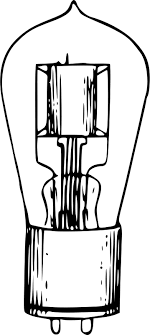
Real radios glow in the dark. I built my first tube receiver in the 1960s. It was a regenerative receiver that would transmit wideband RF if the “reaction” control wasn’t adjusted properly. Then I graduated to using transistors; I still have some of those early devices in my junque collection. Later, as a ham, I bought commercial transceivers but they were all analog devices. The QRP Labs QMX is the first SDR-based radio I have owned and I am still catching up on the differences between SDR and analog radios.
Perhaps the biggest change I have difficulty understanding is the absence of features that I had relied on in the past. For example, the QMX has no RF amplifier so there is no RF gain control. On older radios I was accustomed to adjusting the RF gain control to balance sensitivity with reduced background noise. So when I started using the QMX I was looking for a way to kill the background noise. Filters – bingo! Use a narrow filter to attenuate the noise – oh, but wait …
My QMX was set to a bandwidth of 100Hz using the wizardry of cascading audio filters. That produced less noise than wider filters, but it also became the source of my radio’s apparent deafness. Let me explain.
If you go to pota.app (the main Parks on the Air website) you will see a list of spots – I am referring to CW spots here. These spots are usually sourced from the Reverse Beacon Network (RBN). RBN skimmers often report frequencies slightly off where they are supposed to be – often 100Hz or so. Imagine a situation in which a weak station’s frequency report is off by 100Hz, and then Bozo-the-Brainless (yours truly) has set his filter to be 100Hz wide. Do you see a potential problem here?
Sitting in the Outback (out in the backyard) recently I was tuning around hunting POTA stations with my QMX. I couldn’t hear one of the activators so, just on a whim, I changed the CW filter from 100Hz to 200Hz. Abracadabra – signal appeared.
Putting the filters to the test
Back in the shack the Elecraft XG3 signal source was pulled out and set to produce a -107dBm signal on 14020 KHz. A sensitive amplified speaker was plugged into the QMX and the presence of a CW tone was verified. The QMX’s tuning was adjusted over a +/- 100Hz range while the CW filter was set to 300Hz, 200Hz, 100Hz and 50Hz.
The results were not unexpected. At a filter width of 300Hz and a receiver frequency of 14020.10 or 14019.9 the signal was loud and clear. At a filter width of 200Hz the signal was still audible, although noticeably quieter. At a filter width of 100Hz the signal was still barely audible and at a filter width of 50Hz there was no detectable signal.

Yes, the signal was still barely audible with a filter width of 100Hz, but the test was conducted using a precise RF signal source with no background noise. In the real world – i.e. out in the Big Blue Sky Shack, with a temperamental nearby star spewing huge clouds of radiation that dwarf our entire planet, and human-caused interference from LED lights, power lines and other sources – conditions are much tougher.
Quod erat demonstrandum, the baby-size box of Turkish electrickery wears big-boy pants and its operator wears a pointed dunce hat. Of course, I knew all along that my wonderful little QMX would redeem itself.
Help support HamRadioOutsidetheBox
No “tip-jar”, “buy me a coffee”, Patreon, or Amazon links here. I enjoy my hobby and I enjoy writing about it. If you would like to support this blog please follow/subscribe using the link at the bottom of my home page, or like, comment (links at the bottom of each post), repost or share links to my posts on social media. If you would like to email me directly you will find my email address on my QRZ.com page. Thank you!
The following copyright notice applies to all content on this blog.

This work is licensed under a Creative Commons Attribution-NonCommercial-NoDerivatives 4.0 International License.
Discover more from Ham Radio Outside the Box
Subscribe to get the latest posts sent to your email.
 Ham Radio Outside the Box
Thank you for this revelatory post. I’m not a CW operator/QMX user, but I am stepping into SDR usage via a Hermes-Lite2 and Thetis and it is a strange beast indeed compared to my FTdx3000. 73 de K3FZT / Steve
LikeLike
Thanks for the feedback Steve. Next time you’re shopping for a radio maybe consider the QMX. It already supports digital modes like FT8 and will soon be upgradable to SSB too.
LikeLike
Thanks. I didn’t know of the development projections. Will watch for the evolution. 73 de K3FZT / Steve
LikeLike
Hooray for the QMX!
Could you have imagined in the 1970s that you’d have a $150 radio the size a deck of cards that packed more computing power than most nations, at the time? And that you’d be fiddling with filter resolutions on the order of tens of Hertz?
LikeLiked by 1 person
When I went to college we learned computer programming using punched paper tape. That was soon replaced with advanced technology: punched cards. My phone has way more power than the college mainframe in the 70s.
LikeLike