
A fellow club member is the proud owner of an Icom IC-705 QRP transceiver. I am the proud owner of a QRP Labs QMX QRP transceiver. He spent CDN$2000 to buy his radio. I spent CDN$200 to buy my QMX (including factory assembly charge and shipping from Turkey). That’s a 10:1 cost ratio! I challenged him to a receiver test. So how did the contest go?

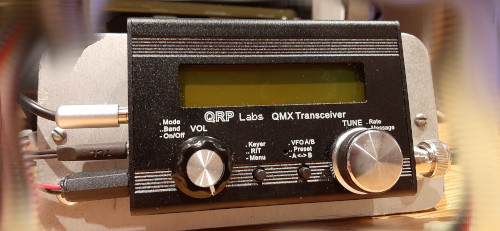
Well, I wish I could tell you the QMX kicked butt … but, well let’s just say that was merely round 1 of the battle. The QMX is a firmware driven SDR radio with an extensive list of settings that I may not have optimized yet. We listened for HF beacons with a coax switch to select the QMX or the 705. Both rigs fared equally well. Then we fired up the POTA app and sought out weak signals to test our receivers. Weak signals are common among POTA activators since many of us are QRP ops and propagation conditions have been challenging of late. The Icom was able to receive one weak station full quieting and 100% copyable while the QMX was, well … deaf. But it was settings that caused David to succumb to Goliath in round 1, I swear it.
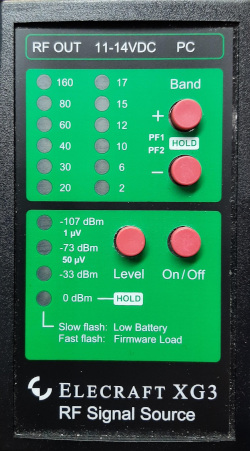
The ham driving the 705 (let’s call him Tom) pulled out an interesting piece of test gear that I really liked. It was an Elecraft XG3 RF signal source.
We hooked it up to both radios in turn and selected the 20m band, then injected signals into the rigs to see the response on the signal strength meters:
-107 dBm indicates S0 on the rig’s display
-73 dBm indicates S9
-33 dBm indicates S9+36
Both rigs passed that test. The IC-705 display is easier to read than the QMX but the whole radio is bigger and heavier than the QMX. Signal strength on the QMX is displayed as a bar graph with tiny dots that must be counted to represent S-meter levels. Anyway, the QMX responded well to the -107 dBm signal so sensitivity is not an issue. I am going to have to do some serious reading of the QMX manual and intense scrutiny of the menu system before round 2.
Some things I am considering:
- Maybe the radio is outstanding, but the earphones are partially deaf
- The new CW filter options are complicated and can be confusing
- The AGC settings are very detailed and can cause issues
- Maybe there’s a user problem (that’s me)
Chief suspects are the CW filters and the AGC
The QMX uses cascading filters to get a unique audio bandwidth that is the product of two combined filters. It’s a complicated arrangement that can lead to unexpected results. Here are the settings I have most of the time:
- CW passband: 100 (Hz) – I also occasionally use 50 Hz when it improves readability
- CW center: 700 (Hz) – the filter center frequency
- Auto-offset/tone: YES – offset and sidetone frequencies automatically adjusted when filter selection is changed
- CW offset: 700 (Hz)
- Sidetone frequency: 700 (Hz)
All filters can also be turned off which gives a passband of 150-3200Hz.
The QMX AGC system may be one of the most user-selectable AGC systems of any ham radio. There are 8 user adjustable parameters. My settings are:
- Threshold: S7 (signal level at which AGC is triggered)
- Slope dB per dB: 60 (all sigs above threshold should sound the same)
- Noise filter: 5 (units of 667 microseconds – prevents impulse noise triggering the AGC)
- Hang time: 30 (causes long impulses to be attenuated)
- Smooth samples: 50 (moderates attenuation rate to avoid audio clicks)
- Recovery dB/s: 50 (specifies speed of AGC recovery)
- Sample blocks: 2 (affects timing of peak detection)
- S9 sounds like S: 9 (S9 sounds the same whether AGC is on or off)
In addition, AGC can be turned on or completely off and the AGC action can be represented in a bar graph display on the LCD screen. If any of the user adjustable AGC parameters are causing a problem, then turning AGC off will eliminate the problem. Amazing control! My other radios have a simple AGC fast/slow setting.
QMX gets a vacation
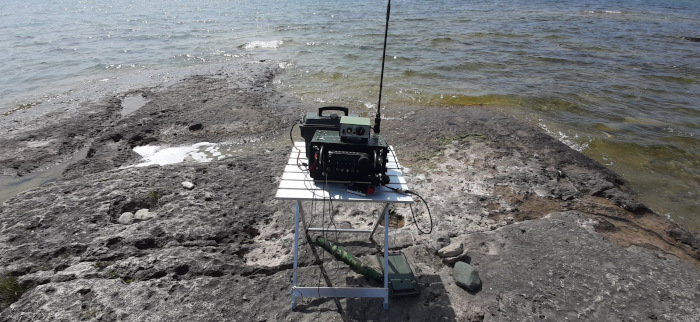
While I prepare my humble little QMX for round 2, I decided to take another of my radios for a POTA outing – my Yaesu FT-891 which can also be a QRP radio if I choose. On this occasion I chose to boost the power to combat dodgy propagation and dialed the RF up to a staggering 35 watts. It worked and produced 22 contacts in short order using only a 9ft whip with a home made loading coil for 20m.
The location was interesting. I set up right at the waters edge on the eastern shore of Lake Huron. A hundred miles across the lake is the state of Michigan and the water splashing on the ancient igneous rock under my feet had found the Canadian shore in Ontario’s northern Bruce Peninsula.
If you are a QMX user and have any ideas on the best settings for this amazing little radio please let me know in the comments below. Meanwhile, Yaesu has announced a long awaited replacement for the discontinued FT-817/818s. It is called the FTX1F and will be a big challenger for the Icom IC-705 and maybe some other popular field portable QRP rigs too.
Help support HamRadioOutsidetheBox
No “tip-jar”, “buy me a coffee”, Patreon, or Amazon links here. I enjoy my hobby and I enjoy writing about it. If you would like to support this blog please follow/subscribe using the link at the bottom of my home page, or like, comment (links at the bottom of each post), repost or share links to my posts on social media. If you would like to email me directly you will find my email address on my QRZ.com page. Thank you!
The following copyright notice applies to all content on this blog.

This work is licensed under a Creative Commons Attribution-NonCommercial-NoDerivatives 4.0 International License.
Discover more from Ham Radio Outside the Box
Subscribe to get the latest posts sent to your email.


As you alluded to, the key metric is the price to performance ratio.
I expect a $2000 radio to show quite well in the performance department. The fact that a $200 radio is competitive is the real story here.
Heck, the fact that you can have a high performance SDR at less than 200 bucks is huge.
73 de W6CSN
LikeLiked by 2 people
You are absolutely right Matt, but also consider that the 705 has a lot more features than the QMX. For example, it supports VHF and UHF and has an internal tuner and battery. Hans has described the QMX receiver as very sensitive so I remain hopeful that it will vindicate itself on that feature alone.
LikeLike
My very first field outing with the QMX, the radio worked Japan and Chile, as if to say “see, I am a real radio” 😉
LikeLiked by 2 people