
Those of us who like to operate our radios out in the Big Blue Sky Shack will understand two basic rules:
- 1. Don’t leave home without something important
- 2. Time is of the essence
Rule number 1 is obvious I suppose, but I learned it the hard way. On one occasion I drove nearly an hour to a beautiful Lake Huron beach intent on activating the park for Parks on the Air. After unpacking my kit onto a picnic table on a bright, hot, beautiful summer day, I began erecting the antenna. Then attached the coax; put the radio on the table, connected the CW paddles and headphones. Then out came the Bioenno battery and last of all, the cable to connect the battery to the radio. “Now where did I put that cable?” Frantic search under the table, in pockets, in truck. Eventually I did find the cable – in the shack after I got home!
On another occasion, in another park, I assembled the radio and accessories first because I felt uncomfortable with some park wardens sitting in a truck nearby. Erecting the antenna might attract questions. I needn’t have worried; the antenna was back at home in the shack!
Rule number 2 is “Time is of the Essence” – a phrase often found in legal contract documents. There are many reasons why it is often expedient to get on the air, get the job done and move on quickly. Weather is often a factor. Or the site where you choose to operate may be subject to territorial claims by a 300 pound member of the Ursus Americanus community. It is usually preferable to abort a back country radio operation and retreat rather than debate the lunch menu with one of those creatures.
My preference is to ensure as much of the equipment needed is pre-assembled and ready to go. What works for me is the “go-box” idea. Ideally, a go-box rig can be laid on a table – or lap desk – powered on and be on-the-air in a couple of minutes. If everything is already connected (except perhaps the antenna) then nothing is going to be left behind.
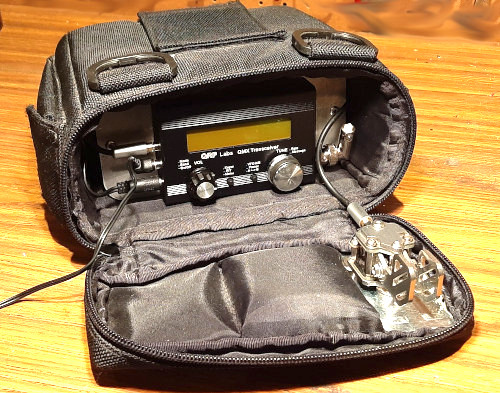
QRP Go-Box #1
My still fairly new-to-me QRP Labs QMX transceiver was the easiest rig to package up in a ready-to-go pack. The radio, TalentCell battery, Putikeeg paddles and earbuds all fit inside this padded bag I bought at a hamfest several years ago. To get on the air, all I have to do is flick the switch on the battery, connect an antenna and begin calling CQ.
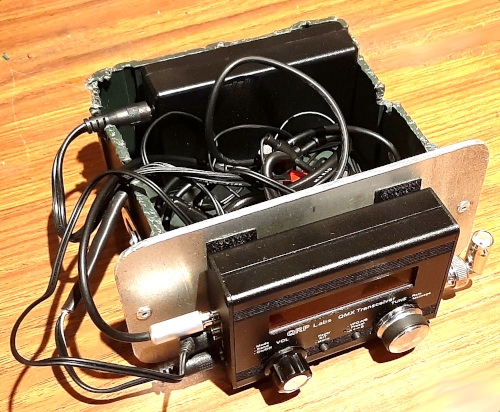
The paddles are magnetically attached to a steel plate glued to the inside of the lid of the padded bag.
Inside the padded bag is a plastic box pop-riveted to a custom aluminum front panel. The QMX transceiver is attached to the front panel with Velcro. There is ample space inside the plastic box for the earbuds and even a carefully wound wire antenna.
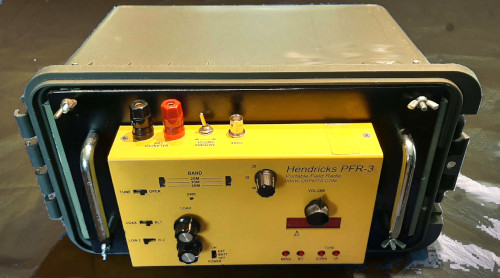
QRP Go-Box #2
The second featured go-box in my collection is also for a QRP radio; in this case my trusty old Hendricks PFR-3.
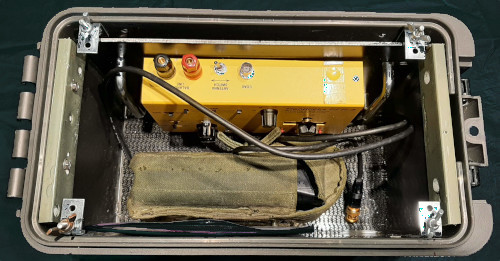
The PFR-3 radio is somewhat unique in that it incorporates a manual Balanced Line Tuner and, originally, an internal battery pack. I removed the internal battery pack from mine due to the inconvenience of having to remove 4 tiny screws to open the case – a delicate operation in the field.
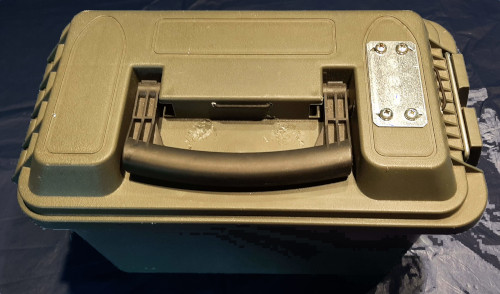
The go-box is a plastic 50-cal ammo case modified to make the lid removable. Note the steel plate fixed to the lid. This plate enables the lid to be used as a lap desk with the paddles attached by magnets.
The complete station – including wire antennas fits inside the go-box, making it truly grab-and-go.
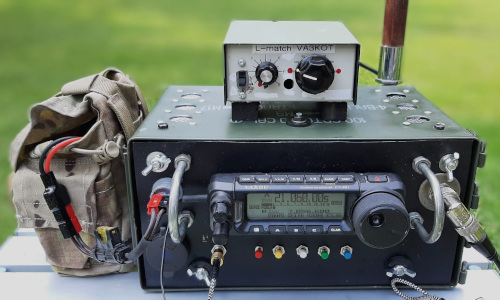
Go-Box #3: QRP or QRO? – Make your choice
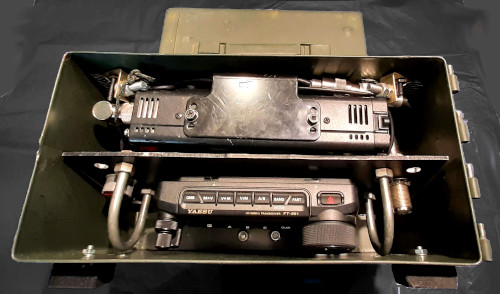
I confess to having an affection for military style radios. I like the appearance and the ruggedness. Inspired by other people’s designs for creating a bullet proof go-box, I bought myself a genuine NATO surplus steel, 50-cal ammo case.
These cases are the real McCoy designed to securely transport dangerous ammunition. The steel is very tough, very tough indeed.

The challenge was to create a ham radio go-box into which I could fit my Yaesu FT-891 and keep it safe and secure while it gets transported along some of the very rough trails in my area. It was a uniquely tough challenge to get everything to pack away inside the box then attach and close the lid.
The radio’s head was detached from the body. The body mounts inside the box, held in place using a mobile mount bracket. I had to cut ventilation holes in the ammo case to allow air to circulate. The radio’s head unit mounts on a custom made aluminum plate that fits inside the open top of the ammo case when the lid is removed.
The front panel also has a voltage meter with a USB-PD outlet, pushbutton switches for accessing the radio’s memories, a DC Powerpole input, a socket for CW paddles and an SO-239 antenna connector. Everything on the front panel remains connected when it is stowed inside the ammo case, enabling rapid deployment in the field. Provision is made for mounting a whip antenna directly on the back of the case. Alternatively, a wire antenna can be connected directly to the SO-239 on the front panel.
I like to think of the FT-891 as a QRP radio with additional booster power – up to 100 watts – held in reserve!
To summarize, there are two very good reasons for building a go-box. It saves time in the field and helps to ensure nothing is left behind in the shack. So far that is working well for me.
Help support HamRadioOutsidetheBox
No “tip-jar”, “buy me a coffee”, Patreon, or Amazon links here. I enjoy my hobby and I enjoy writing about it. If you would like to support this blog please follow/subscribe using the link at the bottom of my home page, or like, comment (links at the bottom of each post), repost or share links to my posts on social media. If you would like to email me directly you will find my email address on my QRZ.com page. Thank you!
The following copyright notice applies to all content on this blog.

This work is licensed under a Creative Commons Attribution-NonCommercial-NoDerivatives 4.0 International License.
Discover more from Ham Radio Outside the Box
Subscribe to get the latest posts sent to your email.
 Ham Radio Outside the Box
Here on the California coast we lack some the same motivations. No bear will be challenging me for a picnic table!
But a forgotten power lead or missing adapter has been the downfall of more than one activation. I’ve never left an antenna at home but it’s been close.
I like that QMX go-bag, especially the key attached to the top flap.
LikeLike
I’ve been lucky so far in that I haven’t met any bears while activating. Ontario has an estimated black bear population of between 80,000 to 100,000. A few years ago, while tent camping in the back country, a large bear raided our campsite in the middle of the night. I lay very still while it tried to claw our food bag down from where it was hanging. It was a frightening encounter. Most bears avoid humans, but a mama bear with cubs or rare predatory bear can be very dangerous.
LikeLiked by 1 person
Most of my radios have go boxes with everything needed to get on the air. I have big batteries in separate boxes, so they are ready to go, too. Great article.
LikeLike
Thanks. My biggest battery is a Bioenno 12Ah that I use with my FT-891. My QRP radios run off TalentCell batteries; I have a 3Ah battery and a 6.5Ah battery. Pleased to hear you use go-boxes too; they make setting up very easy.
LikeLike