
We just can’t win when it comes to propagation conditions. When the Sun is quiet during the bottom of the 11-year solar cycle, HF propagation conditions are challenging. So we all look forward to the days when the Sun is active and the bands are open again. But when we hit the top of the solar cycle – the situation we have right now – the Sun is so active it spews bad news for ham radio operators and hurls it straight at us.
We are at or near the peak of cycle 25 and a giant group of sunspots labeled AR3664 is causing repeated and sustained blackouts of the HF bands. If you take a look at an image of the Sun, AR3664 doesn’t look so big. That is an illusion because the star that supports life on our planet has a diameter of about 1.4 million kilometers. AR3664 is reportedly 200,000 km wide. The Earth has a diameter of a little less than 13,000 km. So the group of sunspots that is currently causing so much disruption to the bands is more than 15 times larger than the Earth.
QRP ’til I die
… or the bands die, whichever comes first! I have often read that not making any contacts is “all part of the fun of QRP”. Well, it’s May 2024 and AR3664 is wreaking havoc with the HF bands. How much “QRP fun” can we take? FCC part 97 rules say we should use only as much power as is necessary to maintain desired communications. That works both ways. QRP is fun, but actually making QSOs is even more fun. FCC will never mandate an increase in power to maintain desired communications but we can make our own decisions. My decision is QRP when possible, QRO when necessary.
QRP when possible, QRO when necessary
How much power is QRO? I don’t think it has ever been defined. It is generally accepted by QRP enthusiasts that 5 watts is the limit for CW and maybe 10 watts for SSB. Digital modes should probably follow the CW limit. So is anything over 5 watts classed as QRO? [my apologies for abusing the Q-codes again; QRO originally meant “shall I increase power”].
Barefoot, or with a Boot?
Contests often class operations using a transmitter power greater than QRP levels but not exceeding 100 watts as “Low Power”. Anything over 100 watts is “High Power”. That makes sense. Most transceivers in the low power class would be considered “barefoot” – to use old CB terminology. To get into the high power class requires an amplifier, also sometimes referred to as a linear or, again in old CB terminology, a “boot”.
What About QRPp? And What the Heck is QROp?
If you really have a high tolerance for “QRP fun” there is another term “QRPp” meaning 1 watt or less. I have coined the term “QROp” to define something substantially less than 100 watts, but greater than 5 watts. That is where I can be found when the god of the Sun worshipers is angry.
Haven’t you heard? 100 watts is only 2 S-units above 5 watts!
Yes, I have used that argument myself when discussing power levels with the “life is too short for QRP” brigade. But consider this: when band conditions are so bad you have to dig signals out from under the noise, 2 S-units could be the difference between really difficult copy and no copy at all.
When it comes to field portable radios, I have more QRP rigs than QRO rigs. And, for the record, I have never owned a “boot”. First choice for field ops is always one of my QRP radios. Just for fun, when AR3664 was doing its worst recently, I took my new QRP Labs QMX 5 watt transceiver out to the backyard to see what it could do. I could hear a few POTA activators on the air but they could not hear me, but it was “so much fun” trying. Reaching the limit of my tolerance for “QRP fun” I went inside the house and fired up my home rig which is capable of 100 watts “barefoot”.
I don’t like to take any radio to its limits unless it cant be avoided “to maintain desired communications” so I set my transmitter power up to a dizzying 75 watts. Propagation forecasts said conditions were poor. The A-index was 118 and the K-index was 8. I usually shut down my radio when the K-index goes above 5, but that day I called a POTA station and he came back to me with a 579 report. He was buried in noise but I gave him a generous 559.
On the Beach
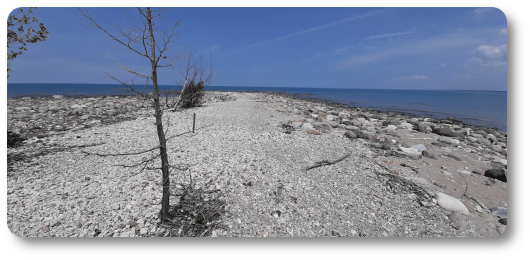
– looking across Lake Huron toward Michigan
I am currently re-reading one of my favorite novels: “On the Beach” the 1957 book by Nevil Shute depicting the harrowing aftermath of a nuclear war. A few days ago I was out on the beach in a local park with my QRO manpack. I recently rebuilt this rig inside a genuine 50-caliber steel ammo can. It may not be nuclear blast proof but it can certainly survive rough handling in the weather extremes that sometimes swing temperatures over a range of up to 50 degrees Celsius as the seasons change here in southern Ontario.
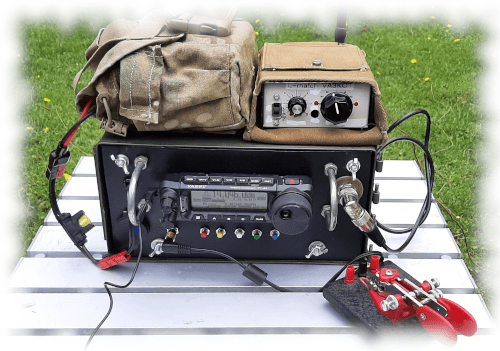
Using a simple whip antenna with radials spread out on the warm sand, power at 30 watts, band conditions “poor”, I made several CW QSOs with stations all over the US. Reports were not great but solid contacts were made – and that’s what I call “QROp fun”. AR3664 – do your worst!
Help support HamRadioOutsidetheBox
No “tip-jar”, “buy me a coffee”, Patreon, or Amazon links here. I enjoy my hobby and I enjoy writing about it. If you would like to support this blog please follow/subscribe using the link at the bottom of my home page, or like, comment (links at the bottom of each post), repost or share links to my posts on social media. If you would like to email me directly you will find my email address on my QRZ.com page. Thank you!
The following copyright notice applies to all content on this blog.

This work is licensed under a Creative Commons Attribution-NonCommercial-NoDerivatives 4.0 International License.
Discover more from Ham Radio Outside the Box
Subscribe to get the latest posts sent to your email.
 Ham Radio Outside the Box
You’re killing me with the “so much fun” comments. 😂 I’m at the point where I don’t bother with outdoor portable QRP when “Geomag Field” activity on the propagation widget on qrz.com is anything but green color.
Waiting out the solar storms gives me an opportunity to try something on the workbench. Or, just stare out the window wondering when my next impulse purchased QRP transceiver will arrive.
72
LikeLike
Hi Matt, not going out portable is definitely not fun! If conditions are poor I take my QROp (FT891) rig. Sometimes conditions improve while I’m out so I can still turn the power down to 5w. By the way, QRP Labs just announced the all band QMX+ QRP radio. I’m tempted, how about you?
LikeLiked by 1 person
Hi John, I am certainly tempted by the QMX+.
I imagine most of the component related design issues were ironed out with the original QMX(-mini) but given that new PCBs are involved I’ll probably wait a few months for rev 2 or 3 before buying one.
Winding all those toroids will give me something to do over the winter!
I’m also considering a modern, portable QRO rig like the FT-891. All of my 100 watt class radios are 35+ years old and not well suited to portable operating.
LikeLiked by 2 people
I’m with you on the QMX+ … I’ll get one, but it’s good to wait for the bugs to get ironed out, much like the first year’s production of a new car model.
LikeLike
Great post! I’m currently thinking about the FT-891 myself for similar reasons. In short, QRP is great when I’m fishing for fun and I’m often successful. If I’m fishing to eat however, then I’d like to turn up the power.
For example, I miss talking to some friends of mine in Arkansas that I used to contact via 2m repeater. Since moving to East Texas temporarily, I’m at the edge of 40m/80m NVIS range to them, some 220 miles (350kms). The ability to establish reliable contact with them every week via SSB would be wonderful.
For now, I’m going to try with the FT-818 and if I can’t make the trip often enough with it, the purchase of the 891 will be in my future.
LikeLiked by 1 person
This solar cycle will go down as the worst in recorded history. Im sorry i love the optimism but call it what it is, horrible. Im not alone in having spent a lot of time and money getting ready for this solar cycle only to be constantly disappointed. And please no “i did great on FT8″l. That FT8 is automatic and can contact other computers while youre sleeping or shopping ir at work. How is it ham were tuning up raingutters and talking around the world on 3 watts but today at the peak of this cycle with modern rigs, amps and yagis youre lucky to even make a contact.
LikeLike