
There are countless methods of launching a wire antenna into a tree that have been written about online. For example a PVC pipe air pressure machine. Sounds downright dangerous to me. Maybe they work just fine, but what if one of the joints isn’t glued properly and the darned thing explodes in your face? Besides, its a rather large piece of kit to haul up a mountain or out into the bush.
An old faithful is the slingshot used to fire a fishing weight on the end of a long length of nylon line. There are several drawbacks to this method, not the least of which is the use of slingshots being illegal in some jurisdictions. A slingshot can get a line very high into a tree, but just how high do you really need to go? For field expedient, temporary antennas, around 30 feet works well in many circumstances.
A simpler method involves throwing a weight attached to a line up over a branch. Some have suggested using a water bottle as the weight. Others prefer to invest in an arborist throw line with a leather pouch filled with half a pound or more of steel pellets acting as the weight. If it works for the professionals it’s gotta be good right?
My own method is constrained by my unique inability to throw anything in a straight line. I have written before about my baseball pitching skill of picking off runners on first base – while aiming for the plate! So I devised my own highly efficient method of launching antennas into trees that works and it’s cheap, really cheap.
The arborist method is great if you have a good arm and fine hand/eye coordination. If you don’t mind investing in professional tools only to see your investment irretrievably stuck in the brush at the top of a tree then go for it. An alternative is to make an antenna launching kit yourself with materials you probably already have, or can get for free, or in a pinch, can buy at a dollar store.
Here is what you will need:
- Latex party balloons (dollar store). Brightly colored balloons are easier to spot when your line gets stuck in a tree, or falls into long grass
- A small quantity of dry, fine sand
- Some small steel key rings
- About 100 feet of mason’s twine (dollar/hardware store). It is strong, yet very lightweight and slides through a tree quite well. I prefer a “woody” color like green because I use it to haul up my temporary field antennas. Woody colors keep the installation stealthy
- A couple of short lengths (about 12-18 inches) of paracord
- A small piece of rugged cloth, e.g. canvas or leather, about 9 inches long and 6 inches wide
- A trekking pole from which the tip has been removed leaving a smooth, tapered surface
Making “Sand Grenades”
“Sand grenades” as I call them, form the weights needed for the DIY arborist throw line. To build each one of these you will need 2 balloons, 4 ounces of sand and 1 key ring. I suggest making several sand grenades because Murphy says you will lose them. I have lost several by getting them stuck in a tree or overthrowing them into a swamp.


- Step One: stretch the balloons, then roll one of them along its length and, with a bit of jiggery-pokery, insert it inside the other balloon
- Step Two: Insert the tip of the funnel into the balloons and fill with sand. A kitchen scale is useful to measure the weight required
- Step Three: Tie the neck of the balloons around the keyring
Making a “David and Goliath” Sling
This style of sling comprises a canvas/leather/cloth pouch that is pinched together at the ends with a short length of paracord tied to each end. The size of the pouch should be sufficient to allow a sand grenade to nestle inside without falling out.

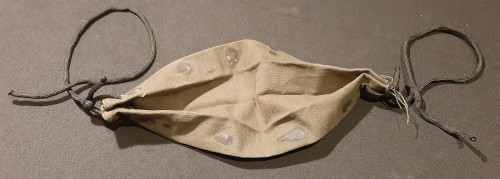
How to Use the DIY Antenna Launcher
Tie one of the pouch’s paracords to the end of a trekking pole, about 4 inches from the tip, using a robust knot such as a constrictor knot. You do not want this end to leave the trekking pole or else your sling will follow the rest of your kit up into the tree!
Tie the paracord at the other end of the sling’s pouch using a slip knot. This end should lightly grip the pole near its tip. It will fly off and release the sand grenade as the launch is executed.

Why use a pole? In the bible story David did not use a pole to operate the sling with which he killed Goliath. But there was an ancient weapon used by the Romans and others (a “pole sling”) in which a sling was attached to the end of a long pole. The pole provides mechanical advantage to increase the range and velocity of the projectile.
Now attach one end of the mason’s twine by tying a bowline knot with the loop about 4 inches long, then pass the loop through the keyring and back over the balloon. Secure the far end of the twine (e.g. with a tent stake) and place the sand grenade in the sling pouch.
Place the trekking pole over your right shoulder with the payload behind you, then flip the pole sharply upwards into a vertical position. The sling will release the sand grenade which will travel 30 or 40 feet (hey, maybe more – how’s your arm?) up into the tree.
An Even Simpler Alternative
A simpler alternative to using a pole sling is a dog ball launcher. Simply substitute the dog ball with a sand grenade and fire away. I have used this method too but since I often carry trekking poles on my back country field operations anyway, I prefer the pole sling method.
Help support HamRadioOutsidetheBox
No “tip-jar”, “buy me a coffee”, Patreon, or Amazon links here. I enjoy my hobby and I enjoy writing about it. If you would like to support this blog please follow/subscribe using the link at the bottom of my home page, or like, comment (links at the bottom of each post), repost or share links to my posts on social media. If you would like to email me directly you will find my email address on my QRZ.com page. Thank you!
The following copyright notice applies to all content on this blog.

This work is licensed under a Creative Commons Attribution-NonCommercial-NoDerivatives 4.0 International License.
Discover more from Ham Radio Outside the Box
Subscribe to get the latest posts sent to your email.
 Ham Radio Outside the Box
I do like the trekking pole idea. BTW Costco is selling a pair of ultralite ones for $40 (Cdn) now.
LikeLiked by 1 person
I have had good success with a small 12/16 oz water bottle 2/3 filled with water and the string tied around the top. Never had it stuck in a tree but even if it did its not a big loss.
LikeLike
Thanks for the comment Winston. I have tried the water bottle technique. It worked for me but I couldn’t get any decent height. My throwing arm just ain’t got what it takes!
LikeLike
The trekking pole idea is pretty cool. I’d love to see a video demonstration. — 72, Craig WB3GCK
LikeLike
Thanks Craig. Hmmm … video … I’ve been told I have a good face for radio! Besides YouTube is a pretty crowded space these days. But thanks for the suggestion.
LikeLike
Here’s my method: https://practicalantennas.com/construction/masts/bucket/
I can’t throw a ball upwards, either. But by swinging it underhand I can get a weighted tennis ball up to 20m / 60 feet if needed.
Lots of little pieces make a difference here:
I use braided mason’s twine, which slides over branches better than the twisted stuff. Often the problem is getting the weight down after it goes over a branch, more than getting it up in the first place. The braided line helps, as does having enough weight.
Also, how the line pays out of the bucket / etc. I can do it laying a tarp or blanket out on the ground and laying the rope back and forth on it (so it doesn’t catch on itself as it plays out), but the small bucket seems to work best. My plastic food jar (about 1.5 liters) seems to tangle less than the larger containers shown in some of the photos.
I don’t carry a throwing weight with me when backpacking, instead picking up a local rock. At one beach in Tasmania I couldn’t find any rocks, just an old sock, which I filled with sand and it worked just as well.
LikeLike
Thanks for the ideas Dale, much appreciated. I have tried the swing and throw method but I never seem to get the release point right. My line either sails horizontally for a long distance or flies vertically and falls back down behind me. Maybe I should go to a remote location and practice where nobody can witness my errors.
LikeLiked by 1 person
A horizontal throw is often because the string isn’t held tightly enough between the fingers, and slips out. Gloves help. As does practice. With very thin strings (like braided fishing line), I’ve added a meter or two of paracord or other thicker rope between the main line and the weight to give me a better grip. (A knot a the right spot also helps.)
And I still end up with the ball going straight up and falling behind me on occasion. (You’ll see that in some of the videos.) But the gentle swing with a heavier weight on a longer string seems to help, because the weight isn’t swinging as fast. It does take some practice, but for shorter heights like 10m it can be quick and easy. (Well, OK, I’ve been practicing it in some variation for a few decades…)
But of all the variants I have tried, it gives me the best height with the least equipment.
LikeLiked by 1 person