
We had a little light snow today and the temperature was hovering just below freezing, but I wanted to get outside and check out one of my old QRP rigs. The radio of the day was my Hendricks PFR-3. The “PFR” stands for Portable Field Radio. The PFR-3 is (or was; I’m not sure if it is still available) sold as a kit, but I bought mine fully-assembled from a ham who is now a silent key. This radio is a very fine little QRP rig. I can’t understand why it isn’t more popular.
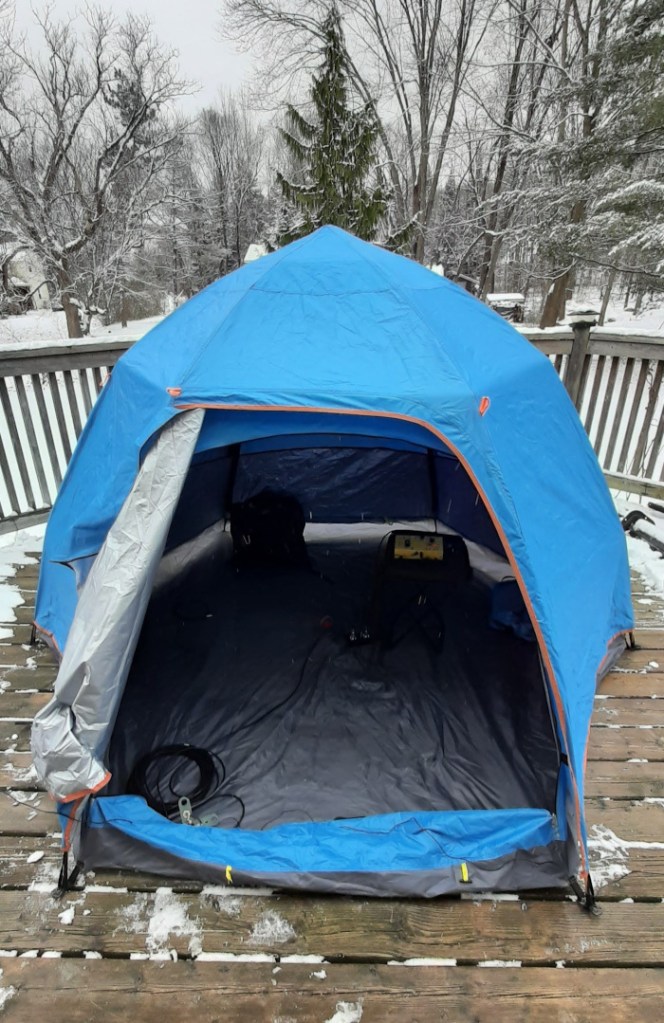
This was the perfect opportunity to test a portable setup I have been planning for outdoor winter radio operations. My shelter is a lightweight pop-up tent that can be carried to the field to provide a wind break and to keep the snow off operator and radio. I cleared the snow from my backyard deck and set up the tent in just a couple of minutes.
My QRP backpack and a camping stool were dropped inside the tent, then it was time to erect the antenna. I chose a random wire antenna (home made, of course, like all my antennas). I don’t usually like non-resonant antennas, but the PFR-3 has a built in manual tuner with LED SWR indicator so the random wire is a perfect match.
The radiating element is 29.5 feet long and the ground-mounted counterpoise is 21 feet – both coiled on the same winder. The 9:1 unun wound on a type-2 core is also mounted on the winder (see picture). The wire lengths were carefully chosen after a lot of experimentation to allow the PFR-3’s internal tuner to find a match on 20m, 30m and 40m – the three bands supported by the radio.

I tied a length of bricklayers twine to one of the sand-filled balloons that I use as a throwing weight and tossed it up over the limb of a tree about 25ft high, then pulled the end of the radiating element up and laid the counterpoise on the ground.
After tuning up on 20m I found a POTA activator in Indiana calling QRZ and threw out my callsign. Several stations were trying to contact him but my humble little QRP station beat the pile-up and the QSO was made. He even gave me a 599. I’m not sure if that was a contest-style report or a true signal report. Either way I was very pleased to make the contact.
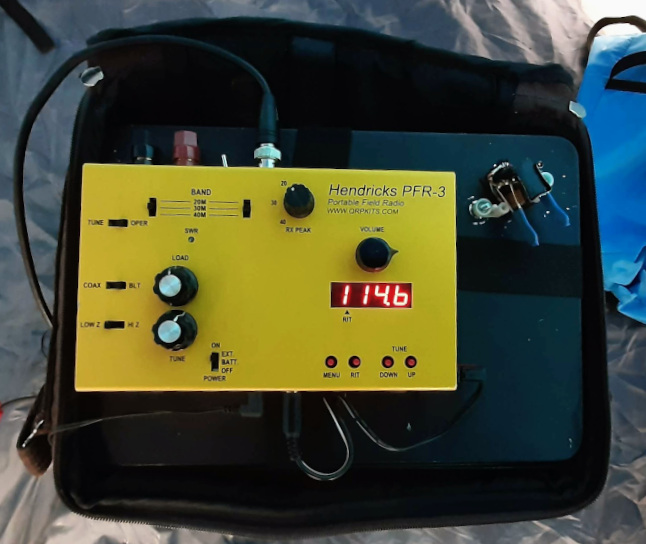
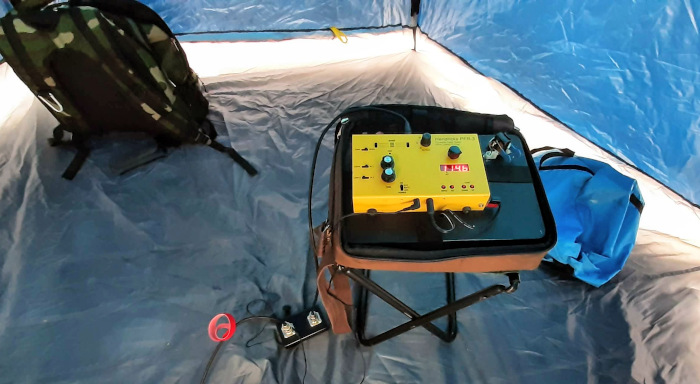
You can see the station details in the pictures. Note my home made Bulldog Clip paddle. I have made several of these; they are actually very smooth and easy to use. Not visible is the battery pack (mounted under the radio). I use three 18650 LiIon cells that seem to last forever. I modified the PFR-3 to accept Anderson Powerpole connectors. I really didn’t like the barrel connector that was originally fitted.
The PFR-3 has two keyer memories and therein lies a story. The version of firmware installed in my radio does not allow the memories to be erased once recorded! They can be modified. When I wanted to erase them, the best I could do was record a single “dit” over the previous memory content. And why did I want to erase keyer memories? My PFR-3 is very sensitive to common mode current and it manifests this weakness by playing keyer memory #1 spontaneously – during an active QSO! I have inserted a common mode current choke at the rig end of the coax to help stop this annoying glitch.
I am beginning to remember how much fun it used to be when I was a dedicated QRP operator. I love the lightweight equipment and low-capacity batteries that power the station for a long operating session. Now that the new solar cycle has improved propagation conditions considerably, I think my PFR-3 and my rejuvenated FT-817 QRP stations will be seeing regular use.
Discover more from Ham Radio Outside the Box
Subscribe to get the latest posts sent to your email.
 Ham Radio Outside the Box
One thought on “QRP On Deck”