
Just imagine, if you could get rid of all those lossy loading coils, impedance transformers, ununs, baluns, tuners and ground radial trip wires. What do you have left? Could it be the most perfect, the ultimate, 100% efficient, dream antenna? Yes, yes; it’s a dream! But back in the real world …
I spent most of the day recently, sweltering under a hot sun (suck it up John, the snow will be back before you know it) deploying all my recent experimental antennas, comparing results. It’s a lot of fun to experiment with various combinations of wire, whips, cores and coils, seeking “the one”, the best one, the antenna that will outperform expectations and fill the log book with DX galore.
Conditions that day were far less than perfect. Some stations I called faded away before the QSO was complete. Others couldn’t hear my 5000 mW signal at all. QSOs came along every few minutes of calling but most involved a struggle to squeeze enough microamps through my antenna to exchange signal reports and QTH. Every one of the antennas I tried bore the same result – until, out of desperation, I erected an antenna I had been keeping as an emergency backup. Suddenly the bands seemed alive; could this be “the one”?
We live on a Goldilocks planet
The Earth might be what astronomers call a “Goldilocks” planet – a planet with a breathable atmosphere, that is just the right distance from a star to maintain temperatures compatible with human life. Such planets are rare in the universe. Of course, there are areas on our planet that don’t meet the Goldilocks criteria and I’m sure Canada must be one of those areas. On a snowy, freezing cold day in February ain’t nothin’ gonna convince me I live on a Goldilocks planet.
But Goldilocks has a flaw – it doesn’t conduct electricity very well. I am sure you are wondering why this narrative has drifted off the topic of ham radio and into astronomy. Explanation coming. Maybe there would be all kinds of downsides to a planet that did have good electrical conductivity, but building antennas would not be one of them.
As a consequence we have to go to a lot of trouble to compensate for the Earth’s poor conductivity. One of my CW buddies has a full-size quarter-wave top-band vertical. It’s a monster of a vertical antenna and requires hundreds of ground radials to work. I am more of a field portable operator who likes to work with simple wire antennas. Something that can be deployed rapidly out in the field and taken down again just as quickly. I have used plenty of antennas that have ground radials and sometimes even had pleasing success with them. But, throwing just a few wires on the ground is inefficient, and when you are a QRP operator you don’t have watts to spare.
So, to sum up, sorry Goldilocks, but you can’t be part of my antenna; I need wire in the air, not on the ground. Before you reach for the comments section to remind me that the ground is always part of an antenna, yes you are correct. In fact even the ground thousands of kilometers away affects our antennas. Our signals, of course, bounce their way around the planet between the Earth and its ionosphere. And even a good antenna, on a day when the propagation gods are displeased, may be disappointing.
“The One”
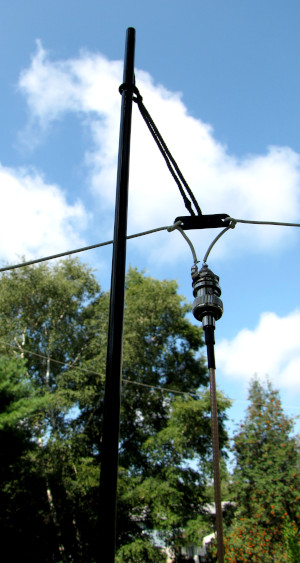
How about a simple wire antenna that is one half wavelength long, fed in the center. You could call it a Center-Fed Half Wave (CFHW) but a simpler way to describe it is with the word “dipole”. I have never been a fan of dipoles in the past. First, they occupy a lot of space. A flat top dipole requires three supports which takes longer to erect. Feeding dipoles in the center implies a long length of coax which may lead to losses.
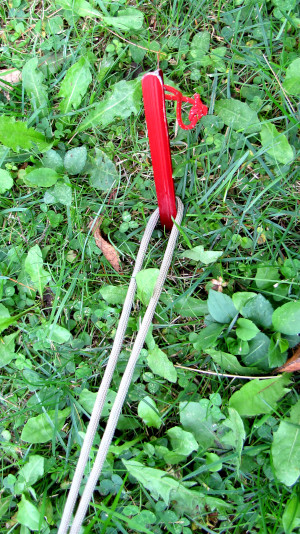
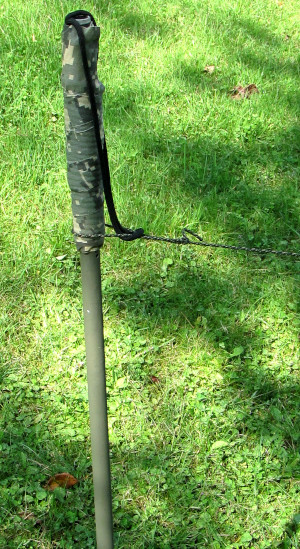
During a field deployment there are a couple of ways to mitigate these issues. If a dipole is erected as an Inverted V the horizontal space is reduced and only a single support is required. The radiation pattern changes from bi-directional to omni-directional, but maybe that’s sometimes a good thing. The ends of the dipole can be attached to the top of trekking poles, or simply pegged into the ground via a length of cord.
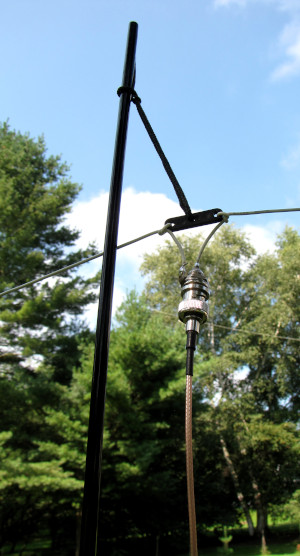
The long coax issue can be overcome using a sleeve dipole. A sleeve dipole comprises one quarter wavelength of coax and one quarter wavelength of wire. It is physically fed at one end, but the electrical feedpoint is in the center where the coax inner conductor is joined to the wire. The coax acts as part of the feedline while the outer surface of the coax braid forms a quarter wave element due to the skin effect.
There is a variant of the sleeve dipole called the Off-Center Fed Sleeve Dipole (OCFSD) which has been discussed here on Ham Radio Outside the Box in the past. The one I built supports multiple bands, but requires a 4:1 unun at the electrical feedpoint and a tuner in the shack. But, this post is all about keeping a simple wire antenna sweet and simple – no ununs, baluns, tuners etc allowed.
Another idea is to feed the dipole in the center using Open Wire Line (“OWL”). Now it becomes what is known as a “doublet”. OWL has very low loss, even over long runs. A doublet can support multiple bands with the aid of a tuner. But, again, this post is all about keeping a simple wire antenna sweet and simple – no ununs, baluns, tuners etc allowed.
Doesn’t a simple coax fed dipole require a balun at the feedpoint?
Technically, yes it does. If the dipole is perfectly symmetrical it is a balanced antenna. Feeding it with coax creates an interface between a balanced antenna and an unbalanced coax feedline. There is a possibility of common mode currents flowing back down the outer surface of the coax braid causing problems at the radio end.
Here we can get away with cheating a little. QRP operators have the advantage that any common mode current caused by lack of balance in the antenna, or by pickup of signal in the feedline will be very small and probably dissipate before reaching the radio. This little hack will probably not work at higher power.
But don’t you have to erect a dipole a half wavelength above ground?
No. Nein, nicht, non. For low angle radiation aimed at DX then, yes, erecting the feedpoint up high is definitely an advantage. But those of us activating or hunting any of the now numerous xOTA programs don’t have to follow that rule. I have had success with a 20m dipole with the apex at only 16ft. The angle of radiation is very high, but there is enough signal at lower angles to make intra-continental contacts. Similarly, my 40m dipole is targeted toward contacts in the eastern half of North America.
So simple dipoles it is then, or …
My antenna attention span can best be defined using quantum physics, i.e the science of things that are infinitesimally small. But for now I will be using simple wire dipoles for my field operations. Am I being too strict in my definition of “the one” antenna? Many a good contact has been made with miserably compromised whips, wands and wires. Perhaps my next venture will be a revisit with the Off-Center Fed Sleeve Dipole to explore how it compares with a pure, unadulterated dipole. Stay tuned.
Trust me I am a X-spurt
No really, but with the explanation that “X” is an unknown quantity and, according to the American Dictionary of the English Language, “spurt” is “a sudden forcible gush or jet” or, put another way: a short burst of energy. I have also heard “spurt” defined as “a drip under pressure”. So you can place whatever value you wish on my “X-spurtise”; it is based on endless tinkering and experimentation. I often venture down blind alleys and produce results that are worth the product of one-squared and infinity to the power of minus one. Occasionally I may also accidentally stumble on a good idea; I’ll let you be the judge.
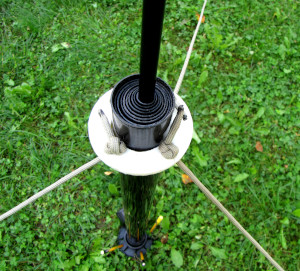
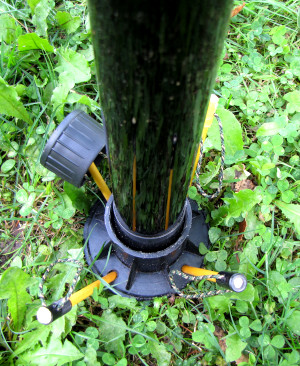
Gallery

Help support HamRadioOutsidetheBox
No “tip-jar”, “buy me a coffee”, Patreon, or Amazon links here. I enjoy my hobby and I enjoy writing about it. If you would like to support this blog please follow/subscribe using the link at the bottom of my home page, or like, comment (links at the bottom of each post), repost or share links to my posts on social media. If you would like to email me directly you will find my email address on my QRZ.com page. Thank you!
The following copyright notice applies to all content on this blog.

This work is licensed under a Creative Commons Attribution-NonCommercial-NoDerivatives 4.0 International License.
Discover more from Ham Radio Outside the Box
Subscribe to get the latest posts sent to your email.
 Ham Radio Outside the Box