
Why was it born so beautiful, why was it born so small?
I have to admit to a love/hate relationship with my microscopic, yet bursting with features, QMX transceiver. This marvel of technology is densely packed into a shirt pocket-sized sturdy aluminum case. Just how did the R&D department at Turkey’s QRP Labs manage to squeeze so much into so little? And the big question is why?
Way over yonder where Europe joins Asia lies a radio electronics laboratory in which the entire research and development department goes by the name Hans. My imagination conjures up a picture of something akin to Santa’s toy factory at the North Pole (where, incidentally, there is no land – just constantly shifting sea ice; sorry kids).
And why did I buy this marvelous, lilliputian, bite-sized box of electronic Turkish delight? I guess it was the cute factor – the same reason I bought my Yaesu FT-817 back when it was first released. I have thought about selling that FT-817 many times but that cute puppy dog front panel keeps looking up at me and I change my mind every time. My QMX is cute in a different way in that it’s very small size was the “flash the cash” factor that put my name at the bottom of a very long wait list. After a long 6-month delay I received my micro miracle and haven’t stopped using it ever since.
He’ll be coming up the mountain when he comes
I don’t need to haul my radios up mountains. The nearest mountain to where I live – naively called “Kemble Mountain” – is just a local high point along the Niagara Escarpment. I could ride a bicycle up it’s south face in five minutes. So, no mountains, no need for ultra-light radio equipment. I can carry my outdoor portable wireless sets in a backpack when operating on a trail. So once again: why did I buy a sub-miniature radio? Oh yes, it’s cute; like a little puppy. Now I have my QMX, I really like the little thing so it’s definitely a keeper.
But I like BIG radios
Let’s look at it this way: the QMX is BIG on features, now all I gotta do is fix its physical size. I think I have a solution – strap it to a brick; well actually a Lithium Iron Phosphate brick.
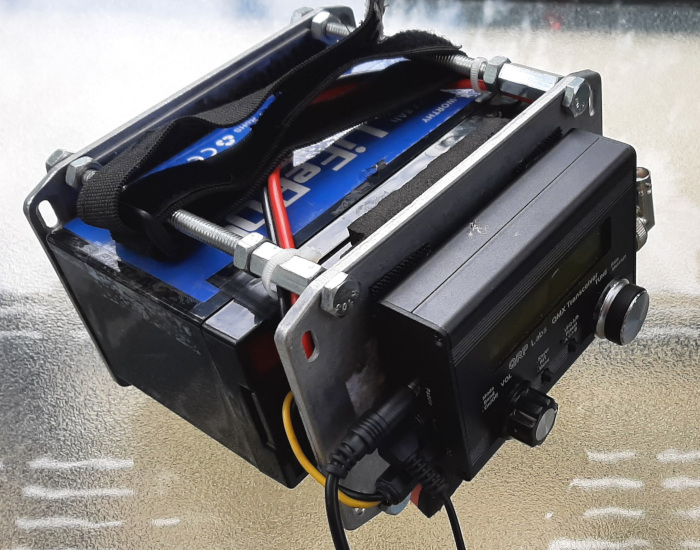
I have rebuilt my QMX-based portable wireless communication set so many times and yet here I go again. As you can see from the picture above, the “brick” is an Eco Worthy 8 Ah Lithium Iron Phosphate battery. Its main function is to anchor the QMX to the surface of the planet – a task it performs admirably well. Oh, yes, it also powers the QMX.
What??? An 8 Ah battery could supply power to half a dozen QMX radios! Yes, but I refer you to its primary function. In fact the high capacity battery is very useful when I venture forth on a multi-day radio road trip. I charge the battery at home with a Sky Toppower PS3010H constant current, constant voltage bench power supply (available on Amazon).
Charging details: I programmed the PS3010H to charge the battery at a constant current of 1.0 amp up to a terminal voltage of 14.2 volts and then to automagically switch to constant voltage until the charging current drops to zero. The battery is then good for several days of operating.
By the way, all those R&D boffins, collectively known as Hans, fixed one of the most annoying features of the early QMX models, and that was the need to keep the supply voltage closely regulated to 12.00000000 volts. This was achieved by using series diodes in the supply line, or a buck converter. I chose the latter, and I have kept “Buck” in circuit despite the clever firmware fix that eliminated the need. I’m the kinda guy who wears a belt and suspenders to keep his pants up. Or maybe just think of it as a backup or redundancy system. If a future firmware release breaks the fix I won’t have to watch as the QMX’s delicate BS170 final transistors make a smoky ascent to the heavens.
And while I’m up on my soapbox …
The dastardly diminutive dimensions of the QMX are not my only gripe. Small size dictates small connections to the outside world. Ok, I have griped about this before, but I don’t like tiny connectors – those one-eighth of an inch (3.5 mm) jacks for hooking up earphones and paddle keys are a failure point waiting to happen – especially when subjected to the rigors of operating in the field. But, there is an easy solution; simply keep all accessories plugged in and there should not be a problem. Take a look at the picture below.
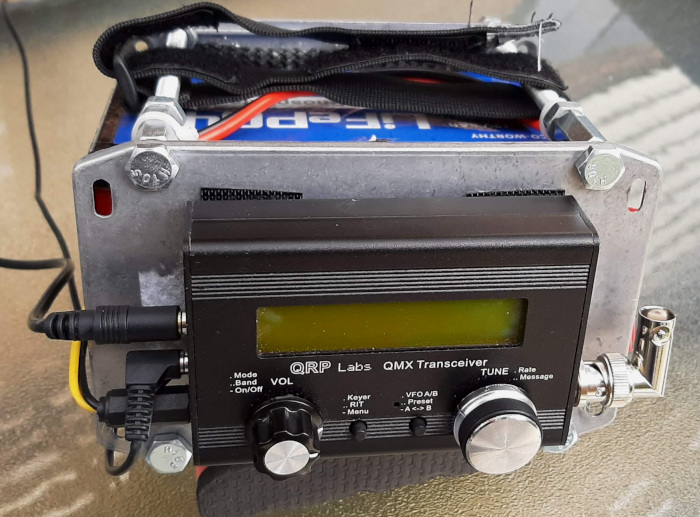
There is another benefit of this everything-connected-ready-to-go solution: it is literally ready to go. My QMX-on-a-brick kit is transported inside a rugged, waterproof European military respirator bag. I don’t even need to remove the rig from the bag to operate, simply hook up an antenna and start firing RF up to the Heaviside layer. No need to stop for several days, the battery is good for it.
There is something else I should mention …
If the QMX hadn’t been designed to be quite so small there is one other missed opportunity that could have been considered. When ordering a QMX transceiver there is a band selection decision to be made. I chose the low band version and that gives me 80m, 60m, 40m, 30m and 20m. Sometimes I wish I had chosen a version supporting the higher bands. Now imagine, if the original design had placed all the band specific components on a separate circuit board, we could possibly have popped open the case and switched circuit boards to gain access to more bands.
So, paraphrasing a song popular in some parts of the world, I ask again: “why was it born so beautiful, why was it born so small?”
Footnote:
It is easy to gripe but, in all seriousness, QRP-Labs founder and head honcho, Hans Summers has produced so many wonderful products for ham radio enthusiasts – and at very affordable prices too. As a well known British knight of the realm, who gathers no moss, once wrote: “You can’t always get what you want, but if you try sometime you find you get what you need”.

Help support HamRadioOutsidetheBox
No “tip-jar”, “buy me a coffee”, Patreon, or Amazon links here. I enjoy my hobby and I enjoy writing about it. If you would like to support this blog please follow/subscribe using the link at the bottom of my home page, or like, comment (links at the bottom of each post), repost or share links to my posts on social media. If you would like to email me directly you will find my email address on my QRZ.com page. Thank you!
The following copyright notice applies to all content on this blog.

This work is licensed under a Creative Commons Attribution-NonCommercial-NoDerivatives 4.0 International License.
Discover more from Ham Radio Outside the Box
Subscribe to get the latest posts sent to your email.
 Ham Radio Outside the Box
Hi hi John,
I really chuckled while reading that. Nice article!
Greetings from the Vaulted Towers of the Penthouse R&D Suite here at QRP Labs Towers Global Headquarters of R&D division.
Indeed, QMX is small. But why oh why, why not just get a QMX+? This thing has the same firmware, same functions, performance, yet it has all the bands 160-6m, and is BIGGER, there’s even plenty of space inside to pile lots of batteries if you want, and a Dev kit board as a platform to pile them all on!
Vy 73 Hans G0UPL
http://qrp-labs.com
LikeLike
Thanks for taking my article in the good spirit intended. Re QMX+ … I am weakening.
LikeLike
Of course, the QMX+ was designed to be the larger brother and overcome all your criticisms. Most of us who bought the QMX also now own a QMX+ all band radio with GPS.
LikeLike
Thanks for the feedback. All my articles contain a fair amount of satire so no real criticism was intended. I have held off buying a QMX+ because I wouldn’t know what to do with my QMX once I had one. But, I am weakening …
LikeLike
Interesting view on the QMX. I picked the same freq. bands as you as I do SOTA CW and these are the most dependable (who wants to have to keep climbing the same mountain?) and It’s very suitable for this activity. I also have a QMX+ which gives me 1.3-50mHz as a base station with a 40m delta loop and. With an ZM-2 atu this works all bands. Here’s a photo of both rigs with my mini paddle nestling coyly below the QMX. 73 Richard EI8JWB [image: WhatsApp Image 2026-08-13 at 14.05.39 (1).jpeg]
LikeLike
Thanks Richard. I do most of my operating outdoors; 20m and 40m are the bands I use most. I have an FT891 in the home shack so I’m not sure where I would use a QMX+. Maybe I’ll order a kit to keep me busy during the long winter months. By the way, the images didn’t work, is there a link I could follow to get them?
LikeLike