
Following high level, wide-ranging, bilateral talks with senior management (XYL) a far-reaching, binding agreement was today handed down to me. The focus of the agreement is contained in the executive summary which reads: “ya got enough radios already”.
And it’s true
I own more radios than I really use. Nearly all of my radios are of the vintage variety. The sole exception is my QRP Labs QMX. The QMX is unique in that it is an SDR radio so it can be updated as needed. One day, perhaps, even the hardware will become obsolete although it is more likely to succumb to the fragility of its low-cost construction – or the indelicate treatment to which it is subjected in the rigorous outdoor environment where I like to operate.
Radios become obsolete quite quickly as technologies evolve. Many modern rigs incorporate what I like to call a “fish finder” – a waterfall display enabling an operator to “catch” another station with a simple tap on a touchscreen. Fantastic yes, but is it just “nice to have” or an essential convenience for modern operating?
Most of my own outdoor operations are related to POTA. Once out in the Big Blue Sky Shack, preferably far from the madding crowd, in a location accessible only via Shanks’ Pony (an old Scottish expression – “shanks” are legs), I set up my station, find an open frequency, call CQ and work the hunters until they quit coming. What level of technological sophistication does that require? Even a very basic, unsophisticated, boat anchor rig can accomplish that. Does it really require a “fish finder”? Well, a fish finder would be nice, but spinning the dial and listening up for active stations worked for many years. Wanna go high tech? Check the clusters on a mobile phone.
Technological advances can even be detrimental. Remember old tube rigs? They were robust (until the tubes needed replacing). Tube rig operators never had to obsess about SWR. High SWR in a modern radio can result in voltage peaks that can send delicate FET PA transistors to the semiconductor cemetery. Sure tubes (or “thermionic valves” as they are known in the Land of Hope and Glory) can be big and fragile. I remember, when I was a kid exploring the thrill of electromagnetrickery, I owned a receiver with tiny, wire-ended tubes. But this isn’t a post about boat anchor technology – no matter how our romanticized recollections of youth bring out fond memories of days gone by.
Back to the future
I bought my Yaesu FT-891 a few short years ago based on recommendations I read online. I wanted a radio that would pack a punch and make getting QSOs from a campsite almost a sure thing. I remember self-spotting on the POTA website with the comment “100 watts!”. I wanted to attract hunters who wouldn’t have to struggle to hear me. A hundred watts for a CW signal is equivalent to AM broadcast signal strength compared to SSB. Alright, I exaggerate, but it quickly occurred to me that a QRP CW signal into an efficient antenna would get the job done equally well. Since that time I have rarely strayed from QRP – or sometimes QROp (20 watts for a 1 S-unit signal boost) when conditions are bad.
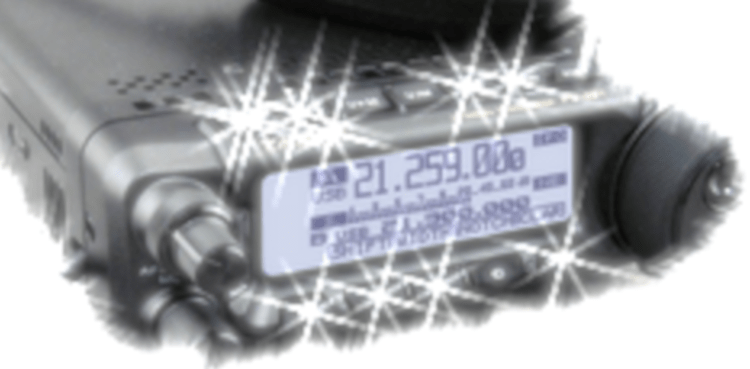
The Yaesu FT-891 is an interesting radio. It’s compact format makes it easy to carry into the field, but also has a downside. Small radios bury most of their impressive set of features in layers of menus. And the FT-891 has an impressive set of features. Audio bandwidth can be set as wide as the mighty Mississippi or as tight as Scrooge’s purse strings. Zero beating the other station’s frequency can be accomplished in a single button press if the “ZIN” function is programmed to one of the A, B, C buttons on the front panel. Then pressing the <F> key repeatedly brings up another four layers of menus. These menus allow the operator to select and adjust other levels of IF filtering like “APF – Audio Peak Filter”, “CNT – Contour”, “SFT – IF shift”, “IPO – Intercept Point Optimization” and “NCH – Notch”.
Filters can get you into trouble
During one POTA activation I recall hearing a hunter respond to me, but his signal sounded like a series of atmospheric clicks. “What the heck is that?” I remember thinking. “Is he testing whether I can copy railroad code?” (I can’t). I set my RIT (Receiver Incremental Tuning) a little off frequency and suddenly his signal was perfectly clear. The problem was my filter was set too narrow. Responding to an activator a little away from zero beat is a technique often used to stand out in a pile-up; it works in SSB too. Since my filter was too narrow the hunter’s signal was just outside my passband. Some CW operators are able to use the filter between their ears to separate a signal in a busy band. It takes some concentration – more than I have.
Tis a gift to be simple
All those menus are such fun to play with while working a pile-up out in the back country with mosquitoes, deer flies and other winged pestilences trying to have lunch on the back of your neck. As you swing an arm wildly to crush the airborne assault your CW key crashes to the forest floor and the contacts fill with wet sand and soil turning dits and dahs into incomprehensible gibberish. The hunters have fled and you are back to sending CQ trying to entice them to return. Wouldn’t it be nice to have a simple radio instead?
It get’s worse
It’s fine and dandy reducing a QRO rig’s power to peanut level. On the FT-891 it’s a simple matter of holding the <F> key down for 2 seconds, rotating the Multifunction knob to select section 16 of the Mariana Trench level menus, then choosing which of the six HF power sub-menus to adjust. Then click the Multifunction knob again, rotate it to the desired power output, from 5 watts to 100 watts; click the <F> key again and in no time at all you’re all set.
But there’s still a problem. The FT-891, like many other QRO radios adjusted for low power, still sucks power out of your battery like a camel filling its hump before a trek across the desert. The FT-891 draws over 5 amps even when the output power is wound down to 5 watts. By contrast, the QMX and other QRP radios can run when powered by a tiny 9 volt alkaline battery.
Big eyes, small wallet
Twenty years ago I worked for a few months in a Toronto establishment known to local hams as “the candy store”. Every day I had every one of the big Japanese manufacturers radios to play with. The staff were encouraged to become familiar with all the radios on display so that we could offer expert advice to customers. My big wide eyes fell on one particular radio from Yaesu; it was the FT-897 – a radio that I began to covet but couldn’t afford to buy at that time. I left that employment to start my own business and after a while I had the funds to buy that rig.
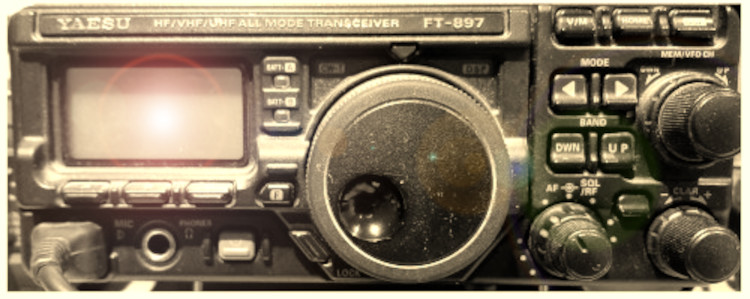
The Yaesu FT-897 is a big and chunky, yet rugged looking QRO radio that was intended for use in the field. I used it as a base station radio instead and it served that purpose until quite recently. It is old-tech now but maybe that’s a bit of an advantage. You see, it is relatively simple compared to the later FT-891. The FT-897 was introduced before IF filtering was widely available to the low budget ham market. Instead it has audio frequency filtering – accessible from the front panel – that works remarkably well. I can narrow the CW receive bandwidth down to 60Hz (danger of missing calls), 120Hz or 240Hz very easily without diving deep into a menu system.
The FT-897 does not integrate very well with common programs like FLrig and FLdigi. Too few functions can be controlled with CAT commands – unlike the newer FT-891. So the momentous decision was made to switch the two radios. Who cares if it takes a lot of clicks, twiddles and turns to select a desired feature on the FT-891 if the clicks, twiddles and turns are replaced with on-screen slider controls? The FT-891 is now my shack radio and I am very happy with it in this role. My XYL is equally happy that we don’t have to have another full and frank discussion about my urge to deplete our retirement savings to buy yet another whizz-bang box of tricks that will only keep me happy until the next whizz-bang box appears.
And the old FT-897? Is that going to be my regular portable rig now? Sorry old fella, you’re still a little hungry on battery amps. Maybe field day, perhaps.

Help support HamRadioOutsidetheBox
No “tip-jar”, “buy me a coffee”, Patreon, or Amazon links here. I enjoy my hobby and I enjoy writing about it. If you would like to support this blog please follow/subscribe using the link at the bottom of my home page, or like, comment (links at the bottom of each post), repost or share links to my posts on social media. If you would like to email me directly you will find my email address on my QRZ.com page. Thank you!
The following copyright notice applies to all content on this blog.

This work is licensed under a Creative Commons Attribution-NonCommercial-NoDerivatives 4.0 International License.
Discover more from Ham Radio Outside the Box
Subscribe to get the latest posts sent to your email.


Listening was the sensory technique used by millions hams to find other stations prior to the arrival of Fish Finder radios.
Nothing against FF’s but an effective radio that you listen to can always be made less expensively than a radio you look at.
LikeLike
I wonder if you can sell off the current holdings and find a combination of QRP radio and external amplifier to suit both your need for a field radio and a home station. Properly packaged, you might be able to just disconnect power and coax to change roles. It would mean keeping the radio in a field case even on the bench in the shack, but might solve the dilemma.
LikeLike
krispyhappilyb5d62be045: I had thought of that idea in the past but being dependent on just a single radio is a risky gambit. From time to time I take my older radios out into the field. I have a Hendricks PFR3 which is a very simple but very capable QRP rig. It is 20 years old but still works very well. It is going to get some outdoor use in the spring. I have ruggedized my QMX sufficiently to protect it from some of its shortcomings so it will also get some more field use.
LikeLike
Disregarding looks, fads, nostalgia, previous levels of technical knowledge, and focusing on details like weight, power consumption, and operability seems like a better route.
Being new to SOTA & POTA doesn’t have a chance to erase my “fond” memories of humping a 90LB ALICE Pack with an FM radio kit (lithium batteries to surpass the size & weight of a brick) in the Army. From the PRC77 to the next generation secure mods (KYK57s…?), to the SINCGARs of the late 90s….Most dismounted COMMS people cannot design equipment from years of technical expertise, and they must use crash courses to get-by.
I’m not the least-bit embarrassed to buy new radios, baluns, and tuners that can help me talk to ppl who are thousands of miles away. I do prefer cutting and testing my own wires.
So, your articles were very valuable in helping me to decide on which QRP Rig; I went with the Yaesu FTX-1F. The menues and sound settings match the settings on my DX10.
I’m having trouble in giving up my Cold War Era ALICE Pack to carry my QRP Rig, but I too am dealing with being in my 60s and the abundance of old training & parachute injuries….the usefulness of your knowledge seems to go way beyond the radios.
Seeing the antenna mount clamped onto a pack frame opened another possibility for me.
Thank you
LikeLike
I have never owned one but I do like the look of those old PRC milsets. I have been thinking about getting an ALICE frame for carrying my gear to the field. I have an ALICE waist belt and suspenders at the moment. I added a couple of small respirator packs to the belt to carry my radios, battery and wire antennas. Even with QRP rigs there is other gear like chair, table, water, food, camp stove etc to carry and that is where an ALICE frame and maybe a small pack would be useful. Your FTX-1F is a good choice although I would be nervous about carrying a rig that cost that much to the kind of places where I like to operate. Thanks for telling your inspiring story.
LikeLiked by 1 person