
I have been on a quest recently. My objective: to explore strange new antennas and boldly go where no ham has been before. It is not that I particularly seek out the weird and wonderful; instead I try to adapt existing antenna designs using lateral thinking (“ham radio outside the box”) to create variations that make backpack outdoor operating sweet and simple.

The long and the short of it
You may recall an antenna idea I posted some time ago called “Long Tall Sally”. The theory behind that idea was that a vertical antenna does not have to be a quarter wavelength long. By stretching the vertical radiating element, the radials can be made shorter, thereby reducing the antenna’s footprint. I built a 25 feet tall radiating wire with two raised radials about 5 feet long. Long Tall Sally was resonant on the 20m band.
A quarter wavelength vertical antenna has a feedpoint impedance that is a close match to 50 ohms, but as its length increases so does its feedpoint impedance. Long Tall Sally’s feedpoint impedance is around 200 ohms and requires a 4:1 transformer to bring it down to 50 ohms.
That’s a good question officer, I can explain
Then I did another experiment. One of my favorite antennas is the Rybakov. A Rybakov is a 25-29 feet long vertical radiating element (length not critical) fed against a ground plane. It too uses a 4:1 transformer and is tunable on all the bands from 40m on up. It is usually supported on a telescoping fiberglass pole. In the winter, my fiberglass pole has a habit of getting stuck in the extended position so I sought an alternative that would eliminate the pole. I didn’t want to have to explain to a police officer why I had a flapping 30ft pole draped over the roof of my truck.
I came up with the idea of using a telescoping stainless steel whip which does not get stuck in the cold. I have a whip that extends to 18.5 feet. The theory is that by using a small inductance at the base of the whip, the electrical length could be extended to match the Rybakov’s physical length. A coil with an inductance of 5 microhenries gets the job done. The whole antenna directly attaches to the external frame of my backpack and can be set up in just a few seconds. The idea worked but still has one drawback – it requires a ground plane. I used 4x13ft ground radials. The radials are easy to deploy in warm weather, but not so easy in winter when the snow is deep and crisp and even.
While sitting in my soft, warm and comfy recliner chair sketching ideas on the back of my eyelids, another idea began to materialize. How about stretching the vertical radiating element all the way to a half wavelength long? The essence of this idea is a well-established antenna called a vertical End-Fed Half-Wave. For the 20m band this is about 33 feet tall. Ugh! That means using a telescoping fiberglass pole again so scratch that idea. But wait. Suppose I apply the inductive base loading idea that I used for my winter Rybakov?
Crazy huh?
Well let me introduce the Coil Loaded End-Fed Half-Wave (CLEFHW) antenna. It comprises the same 18.5 feet long whip, base loaded with a coil with an inductance of 6.6 microhenries. How did I arrive at that inductance? I used the online calculator at 66pacific.com. However, that online calculator, while useful, is intended for quarter wavelength verticals. I wanted to calculate the value of a base loading coil for a half wavelength antenna. I couldn’t find an online calculator for base loading half wavelength verticals but for every problem there is a solution.
The bands are in harmony
Some of our ham radio bands are harmonically related. The relationship is not exact but in some cases is close enough for our purposes. When I am doing a POTA activation on 20m I usually hang out in the QRP section of the band around 14060 KHz. On the 40m band the QRP watering hole is around 7030 KHz. That is a very fortuitous coincidence. A half wavelength on 20m is a quarter wavelength on 40m. So I surreptitiously plugged the 40m frequency into the online calculator and got the answer I needed.
But will it work?
The weather hasn’t been kind to southern Ontario for the last couple of weeks. As I write this post we are experiencing a blizzard – high winds and quickly accumulating snowfall. The snow is the kind of very fine crystals that get caught in the wind and swirl around making outdoor operating a less than optimum experience. A couple of days ago we did get a break in the weather so I set up an ugly prototype of a CLEFHW on my deck in the outback (out in the backyard) just to see if I could make it work.
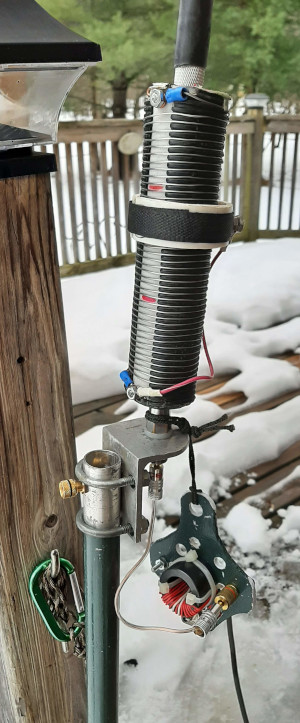
Its ugly, but it seems to be doable
I didn’t have a 6.6 microhenry coil handy so I grabbed my homebrew variable inductor. In the shack I set it to the required inductance using my Almost All Digital Electronics L/C Meter IIB. Then off out into the frozen, barren tundra on my deck to try it out. The ugly prototype was certainly not an elegant setup but my RigExpert antenna analyzer showed the idea was sound in theory. I had an SWR of 1.49:1 on 20m.
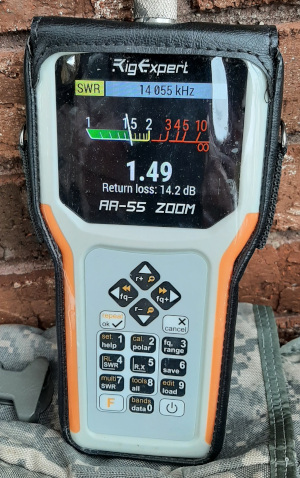
49:1 outside the box
Of course, a 49:1 transformer was required. I have made several of these and, perhaps unsurprisingly, I use an “outside the box” design. The secondary is 14 turns of 20awg insulated solid copper wire on a FT-140-43 toroid. The primary is a separate winding comprising 2 turns of the same wire wound on top of the center of the secondary winding. I do not use a capacitor across the primary since, in my experience, it doesn’t make any significant difference on the higher bands.
Short Tall Sally?
The end result is an End-Fed Half-Wave antenna for the 20m band that is only 18.5ft tall and can be mounted on my backpack frame and erected in seconds. For QRP operation no counterpoise at all is needed. A short piece of coax will be sufficient to dissipate the very small common mode current along the outer surface of the coax shield.
Is a CLEFHW efficient?
Heck no, I don’t expect it to be terribly efficient. Those of us who like to trek into the woods carrying a complete station on our backs don’t worry too much about antenna physics. We know we are using “compromised” antennas but as long as the contacts roll in we are happy backpackers. The loading coil and the transformer may introduce some loss but there is no fundamental reason why the CLEFHW should not be a perfectly viable antenna for field operations.
Could it work on 40m?
Could a 20m EFHW work on 40m? Sounds like a naive question but the answer (if like me you think outside the box) is a qualified “yes”. Remember we used the online calculator to find the value of inductance required to base load our whip for operation on 40m? So, if we take out the 49:1 transformer and throw out some radials we have an instant quarter wavelength vertical antenna for the 40m band. With a tuner we should be able to squeeze 15m out of it too.
Field Trials
Up here in the Great White North we don’t even button up our Mackinaws until it gets down to a hundred below. I have other tales of winter bravado to tell in exchange for a beer or two. I read some multi-decadal oscillation of ocean currents somewhere in the world will combine with the expected El Nina to produce an exceptionally cold and snowy winter this year. So far it ain’t lookin’ good. If my aging snowblower keeps chugging along I may be able to break out of the shack before winter’s end to see if I can make some contacts on my new CLEFHW. Meanwhile I’ll work on tidying up the design to make it more suitable for the rigors of the Big Blue Sky Shack. I’ll keep you posted.
Help support HamRadioOutsidetheBox
No “tip-jar”, “buy me a coffee”, Patreon, or Amazon links here. I enjoy my hobby and I enjoy writing about it. If you would like to support this blog please follow/subscribe using the link at the bottom of my home page, or like, comment (links at the bottom of each post), repost or share links to my posts on social media. If you would like to email me directly you will find my email address on my QRZ.com page. Thank you!
The following copyright notice applies to all content on this blog.

This work is licensed under a Creative Commons Attribution-NonCommercial-NoDerivatives 4.0 International License.
Discover more from Ham Radio Outside the Box
Subscribe to get the latest posts sent to your email.


One thought on “A CLEFHW Antenna?”