
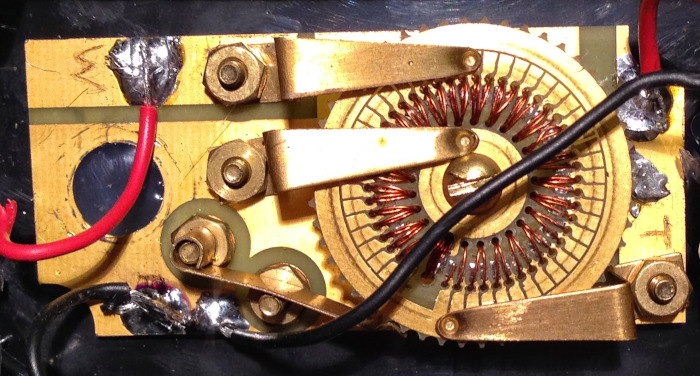
A lot of information has been posted online recently about very short portable vertical antennas. There must be some magic in how they work, surely, since they appear to disobey the laws of physics. I used to own one called a “Miracle Antenna”; it was manufactured in Quebec, Canada. It comprised a 57-inch telescoping whip mounted on a remarkably well-engineered toroidal loading coil with many taps selectable by means of a rotary switch. The Miracle Antenna could be used from 80m up to 70cm with a suitable counterpoise. The loading coil switch had a bypass position so that the antenna could be used as an unloaded whip for VHF/UHF. The 57-inch (~1.5m) whip is a three-quarter wavelength on 2m; 70cm could be selected by shortening the whip.
I made lots of contacts!
I was thoroughly impressed by my Miracle Whip; I made lots of contacts with it. Really; it worked remarkably well – but only on VHF. Perhaps if I had tried harder with it I could have snagged some QSOs on HF too, but that never happened. It was relegated to the role of a great 2m band antenna used for accessing my local repeater.
So what’s up with very short antennas?
First, let me dispel one myth about them. With a suitable transmatch (tuner) or adjustable loading coil, a nice low SWR can be obtained even from the shortest of shorties. Let’s say you can tune for 1:1 SWR on multiple bands. Great! Now key up and start working the pile-ups! Yes? Or no?
Whoa … Not so fast pilgrim!
The SWR that the radio sees results from a private negotiation between the transmatch and the radio; the antenna doesn’t enter into it. Compare it to a wild west cowboy town. The local sheriff maintains law and order inside the town, but outside the town it’s still the untamed wild west.
The SWR at the feedpoint of a very short vertical antenna (excluding loading coil) is very high. That high SWR is presented to the “tuner” as a high impedance that the “tuner” transforms to 50 ohms resistive, or close to that value. That “varmint” of a shortie antenna remains a wild, untamed, high SWR beastie. Why is that?
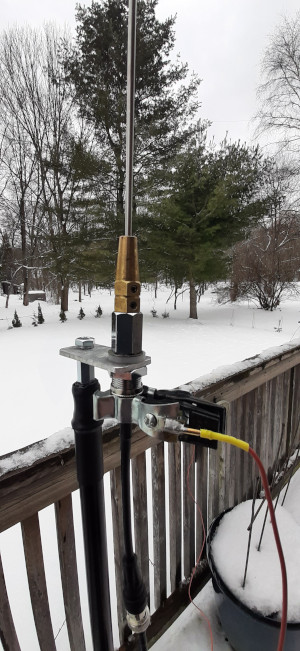
There is another factor to consider and it is critically important. It’s called Radiation Resistance (Rrad). Rrad is a strange animal in that a high Rrad results in higher efficiency of the antenna. Very short antennas have a very low Rrad. I set up a 57-inch whip on a tripod and attached a 17ft counterpoise, them measured the Resistance and Reactance on the 20m band. The numbers I obtained were 1.98 – j53 ohms. The reactance value (X = -j53) was actually a lot better than I expected and I have a theory about why that is. I will explain later in this post.
Now let’s look at how antenna efficiency is calculated. An antenna has two types of resistance; Radiation Resistance (which is good) and Loss Resistance (Rloss which is bad, very, very bad). Loss resistance includes every connection between components in the antenna system, ohmic loss in any loading coils as well as ground loss in the counterpoise system. Efficiency is the ratio between Radiation Resistance and total resistance:
Efficiency = Rrad/(Rrad+Rloss)
Lets assume the Rrad value is equal to the real component of the antenna’s impedance; in the example given above that’s 1.98 (let’s call it 2) ohms. Determining the value of the total loss resistance is not easy. There will be a few ohms of resistance in all the connection points and definitely in the loading coil – especially for a base-loaded vertical since the current is at a maximum at the antenna feedpoint. But the biggest losses may come in the ground system.
Typically, from accounts I have read, operators often lay just a single counterpoise wire on the ground. The current in this wire will be the same as the current in the radiating element and will be almost totally lost in the ground.
Now, let’s look at how my experimental shortie vertical antenna would perform if I took it out to the field. And, also, let’s assume I used a base loading coil to resonate it instead of a tuner. If I adjusted the coil to give a 1:1 SWR guess what? That would be VERY BAD, VERY VERY BAD. Here is why:
We can insert the value I measured for Rrad into the efficiency formula given above:
Efficiency = Rrad/(Rrad+Rloss) – inserting measured value of Rrad: Efficiency = 2/(2+Rlos).
Since we have also measured an SWR of 1:1 the feedpoint impedance is 50 ohms (resistive) comprising the total of Rrad + Rloss.
Now we can deduce the value of Rloss as the difference between the 50 ohm resistive impedance at the feedpoint minus Rrad. Rloss = 50 – 2 = 48 ohms.
So the efficiency of our shortie antenna can be calculated as 2/50 = 4%.
Gadzooks!!!
If little shortie is used with a QRP radio putting out 5 watts into the antenna, the actual radiated power will be only 4% of 5 watts = 200 milliwatts. That’s sad.
Hey Jude, don’t make it bad
“Take a sad antenna and make it better”. There are two ways to make an antenna better. We can increase its radiation resistance or reduce its loss resistance. The first way is very easy; the second is more difficult. To increase its radiation resistance all we have to do is make it longer. We know that a half wave antenna has an endpoint impedance that is resistive and very high – typically 2000 ohms or more. If we plug that into the equation we get an efficiency of 2000/2000+48 = 98%.
“What a load of horse feathers, I still make plenty of contacts with my short vertical”
Yes, of course your 200 milliwatts will still be heard and you will still make contacts. Let’s introduce another bit of physics to explain why. It’s called the Inverse Square Law. It states that the strength of your signal is proportional to the square of the distance between the transmitting station and the receiving station. Modern HF receivers are very sensitive and can receive signals down into the microvolt range. If the receiving station has “big ears”, i.e. a big efficient antenna, it has a better chance of picking up very weak signals and will hear your 200mW signal. But at a certain distance the Inverse Square Law dictates that the strength of your signal will have fallen below the threshold at which even Big Ears can detect you. But, the Inverse Square Law applied to stations closer to you means your 200mW will still be heard.
If the DX can hear you, can he still work you?
Now let’s look at another situation in which Big Ears can hear you fine business and replies to your call. Now yet another bit of physics comes into play – it’s called the Reciprocity Principle. Simply put it states that an antenna’s transmit efficiency is the same as its receive efficiency. So Big Ears is calling you but you may not be able to hear him.
There’s no free lunch
There are lots of shortie antennas available. If you choose to build, or buy one you will have to accept that, while you may have fun with it, it has limitations. When propagation is good you may even get some pleasant surprises.
Oh, I see, that’s why …
Finally, I wrote earlier in this post that I was surprised at the relatively low capacitive reactance of the shortie antenna I put up for testing. I think I can explain why. At my home QTH in southern Ontario, Canada, winter hasn’t finished its dastardly doings yet. It was way too cold and windy outside to venture out onto the planet’s surface for antenna experiments, so I set up my 57-inch whip on a tripod inside the house and laid 17 feet of wire across the floor as a counterpoise. It is possible that this appeared as an ungrounded Off Center Fed antenna to my RigExpert antenna analyzer. The total length was just under 22 feet which is about 2/3 of a half wavelength on 20m. The analyzer might then have perceived this as a less inefficient antenna than a short vertical (0.075 wavelengths on 20m) worked against an electrical ground.

Help support HamRadioOutsidetheBox
No “tip-jar”, “buy me a coffee”, Patreon, or Amazon links here. I enjoy my hobby and I enjoy writing about it. If you would like to support this blog please follow/subscribe using the link at the bottom of my home page, or like, comment (links at the bottom of each post), repost or share links to my posts on social media. If you would like to email me directly you will find my email address on my QRZ.com page. Thank you!
The following copyright notice applies to all content on this blog.

This work is licensed under a Creative Commons Attribution-NonCommercial-NoDerivatives 4.0 International License.
Discover more from Ham Radio Outside the Box
Subscribe to get the latest posts sent to your email.
 Ham Radio Outside the Box
@hamradiooutsidethebox.ca Coil-shortened verticals are not antennas, they are half-antennas. The other half are the radials or counterpoise. They can be relatively efficient when paired with decently sized radials, but then the complete system is obviously not so small.
This setup worked quite well.
LikeLike
Remote Reply
Original Comment URL
Your Profile
Why do I need to enter my profile?
This site is part of the ⁂ open social web, a network of interconnected social platforms (like Mastodon, Pixelfed, Friendica, and others). Unlike centralized social media, your account lives on a platform of your choice, and you can interact with people across different platforms.
By entering your profile, we can send you to your account where you can complete this action.
You may have a good point if the other half is above ground since raised radials also radiate. Wouldn’t that be similar to a dipole where one side is shortened by a loading coil?
LikeLike
Enjoyed this and other blogs you have posted.
Tim G5TM
LikeLike
Thanks Tim.
LikeLike
“Lets assume the Rrad value is equal to the real component of the antenna’s impedance; in the example given above that’s 1.98 (let’s call it 2) ohms.”
Actually, when you measure it that way, the 2 ohms is the SUM of the radiation resistance and the loss resistance.
Yes, that seems low pretty low for loss resistance, but that will depend on the height above ground, among many other factors (including the length of coax between the feedpoint and your analyzer). I modeled the antenna at 5′ over ground, and got an impedance of 15 – j800 ohms. Of that, I suspect that the radial is contributing to the radiation resistance. The same whip modeled over a perfect, infinite ground plane (so zero ground loss) gives 2 – j840 ohms.
So 2 ohms probably is a reasonable number for the radiation resistance of such a whip in practice.
The other issue is that, whether you use a coil or an antenna tuner to match it to 50 ohms for the transmitter, that isn’t the number you use for the efficiency calculations. Rather you would measure the impedance of the antenna and ground system, and use the resistance so measured, which is the sum of the radiation resistance and loss resistance (ground loss resistance plus matching coil resistance). So, if you have 10 ohms of ground loss resistance, the unmatched antenna should measure 12 – j840 ohms, or something like that. Then adding a series loading coil of +840 ohms to resonate it, gives you 12 + j0 ohms, plus the loss resistance of the coil (about 4 ohms if the coil Q is 200).
So now you have 16 + j0 ohms, and that is the value you would use in your efficiency calculations. The impedance transformation to match that to 50 ohms might have some additional losses, but those aren’t generally included in antenna efficiency.
Using an antenna tuner (or a tapped coil with one end grounded) to resonate the antenna and match it to 50 ohms at the same time hides that intermediate value (the raw resistive component of the antenna), so the efficiency calculation doesn’t work. (You can see the problem if you use the antenna tuner to match a 200 ohm antenna to 50 ohms.)
LikeLike
Thanks for your very knowledgeable comment Dale. I consult your site practicalantennas.com quite frequently. In performing this analysis I was searching for a way to establish Rrad for the short whip. Other sources I consulted make assumptions about the value of Rrad that work out very close to the value I came up with. My value of 2 ohms certainly does include some loss resistance but I tried to minimize the loss component by measuring the R and X values for just the whip without any coils, cap hats etc. I used a counterpoise that was above ground to minimize ground losses. Any loss resistance might just have been in the conductors and connections. But if we assume my 2 ohms includes 1 ohm loss the efficiency drops even further.
I performed a further experiment this morning by setting up the same whip with a loading coil and above ground counterpoise and measured the same values. The base of the whip was 5 feet above ground and the single counterpoise wire (as might be used by short whip operators in the field) was also 5 ft above ground. My RigExpert measured an SWR of 1.49 and an R value of 35.1 ohms. If I plug in an estimated value of 1 ohm for the radiation resistance the efficiency works out to be around 3%. Any further comments you may have on this would be most welcome.
LikeLike