
It was almost time to make lunch but I had an idea that just wouldn’t wait. I figured I had 20 minutes to zip down to the basement shack/development lab and throw a simple circuit together on the workbench. I had been re-reading (for the 1000th time) AA5TB’s website about using a parallel tuned circuit to transform the high impedance of an End-Fed Half-Wave antenna down to 50 ohms. I had built a QRO version already but now I need a QRP version.
Why use a parallel tuned circuit coupler?
The objective was to avoid the use of very high impedance ratio transformers (e.g. 49:1). These transformers have received heavy criticism in online forums for numerous reasons that I won’t go into here. An alternative that is often considered to be the best option is an L-network. According to Steve AA5TB, an L-network provides better bandwidth but less feedline isolation.
I do have a QRP tunable L-network coupler on the drawing board. It will use series toroidal inductors where each inductance can be shorted out using a toggle switch. A broad range of inductance values will be selectable in binary fashion by opening and closing the toggle switches. A polyvaricon will provide variable capacitance. It’s a bit of a complicated and slow arrangement compared to the tuned circuit coupler where the only adjustment needed is the variable capacitance. So back to AA5TB’s design.
In a rush (I was hungry) I dived into my component and junque drawers, found a polyvaricon with a range of about 16-160pF, then a 2.7Kohm resistor and a BNC jack. But I still needed a coil. I have wound many coils over the years and they fill the graveyard drawer in my shack closet. I picked up one that looked like it might do the job, even though it’s a scrappy, ugly beast. When I built it I used a small cutoff of the kind of plastic board that realtors use for their “For Sale” signs. I wound 19 turns of thin solid core telephone wire around it. The winding measured 4 microhenries on my Almost All Digital Electronics L/C meter IIB.
The coil still needed a secondary winding so I wound 3 turns of the same wire over the center of the primary and connected the ends to the BNC jack. The primary winding and the 2.7Kohm resistor (simulating the impedance of the EFHW) were connected in parallel with the polyvaricon. I didn’t really expect this rushed, kluge matching circuit to work but it was a first step. I could improve the coil later once I had the initial measurements.
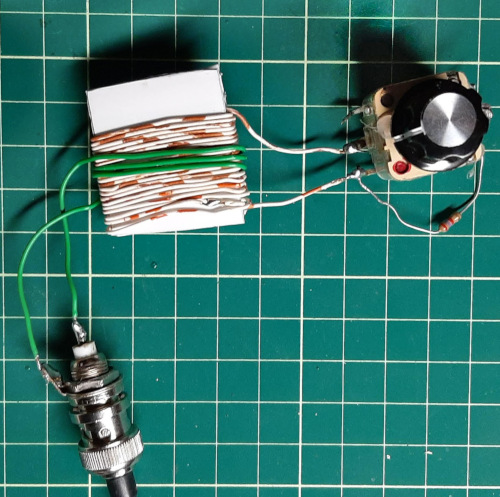
I love it when a project just works!
I hooked the ugly bench project up to my RigExpert AA-55 Zoom antenna analyzer and performed a quick SWR measurement on 40m, 30m, 20m, 17m, 15m, 12m and 10m. On each band the SWR could be adjusted to 1.5:1 or less. The polyvaricon does not allow very fine adjustment so tuning is a little touchy. Feeling lucky I also checked 80m – well maybe that was over-optimistic, so no joy there.
Next, I checked for resonance on each band by looking at the R and X measurements on the analyzer. Sure enough I could get resonance (i.e. X=0) on 40m, 30m and 20m. I could not tune X down to zero on the higher bands but came pretty close.
N.B. I am not implying that a single end-fed wire can be used on all bands from 40-10m using this coupler. An EFHW antenna may be tunable on multiple bands but its radiation pattern becomes distorted on its 3rd and higher harmonics. Low SWR does not indicate the antenna is useful on other than its fundamental frequency and its 2nd harmonic.
Gone to the dogs
I have placed an order for quite a lot of toroid cores from Kits and Parts. When my order makes its way through the United States Postal Service and over the border, Canada Post will take charge of it and load it onto a dog sled. It will then be hauled through the frozen barren tundra, crossing multiple time zones and finally end up at my door. No doubt the “postie” will ring my bell and seek payment of further taxes before handing over the package. When that happy day arrives – assuming the dog sled isn’t ambushed by hungry polar bears en route – I will replace the coil with a much nicer one wound on a type-2 powdered iron toroid.
Times are hard, so I’m a scavenger
It would be nice if I could find another polyvaricon to wire in parallel with the main one. A lower capacitance device would allow me to make both coarse and fine tuning adjustments. I tear apart old AM/FM radios to scavenge the components so there may be just the part I need sitting in the junque drawer already.
And, of course, the project will get a nice enclosure to make it look nice and protect it against the bumps and grinds it will incur during my back country ham radio missions.
Finally, when the second consecutive Arctic weather season is finally over and I can get outside without wearing parka, mukluks and snowshoes, I will hook up various wires to what I hope will be the finished product. I have prepared a 40m half-wave wire already. It has links for 30m and 20m so it can be used on its fundamental frequency on each of those three bands. And, of course, a 0.05 wavelength counterpoise too.
How to look simply radiant
If the counterpoise is omitted the antenna may still “tune” but the coax becomes the counterpoise and will radiate. Since a lot of portable operators, like myself, like to directly connect the coupler to the radio (or via a very short coax) the operator becomes the counterpoise and will radiate. That thought is perhaps the ultimate endorsement for QRP!

Help support HamRadioOutsidetheBox
No “tip-jar”, “buy me a coffee”, Patreon, or Amazon links here. I enjoy my hobby and I enjoy writing about it. If you would like to support this blog please follow/subscribe using the link at the bottom of my home page, or like, comment (links at the bottom of each post), repost or share links to my posts on social media. If you would like to email me directly you will find my email address on my QRZ.com page. Thank you!
The following copyright notice applies to all content on this blog.

This work is licensed under a Creative Commons Attribution-NonCommercial-NoDerivatives 4.0 International License.
Discover more from Ham Radio Outside the Box
Subscribe to get the latest posts sent to your email.
 Ham Radio Outside the Box
@hamradiooutsidethebox.ca it's a fantastic little circuit. I have a Pacific Antenna "SOTA" tuner that I should take out more often.
LikeLike
Remote Reply
Original Comment URL
Your Profile
Why do I need to enter my profile?
This site is part of the ⁂ open social web, a network of interconnected social platforms (like Mastodon, Pixelfed, Friendica, and others). Unlike centralized social media, your account lives on a platform of your choice, and you can interact with people across different platforms.
By entering your profile, we can send you to your account where you can complete this action.
@hamradiooutsidethebox.ca Your L-network idea is good, but in your implementation you may have introduced your own substantial loss mechanism. Molded inductors of the kind you have shown in the photo, usually have a maximum Q of 25. If you transmitted 5 watts into the network, you would find that the inductor gets hot.
A far better choice is an air-wound inductor, or a toroidal inductor around a core such as T-68-6 (for QRP power levels). These solutions can give Q>100. Use magnet wire of at least 22 AWG to further improve the Q.
LikeLike
Remote Reply
Original Comment URL
Your Profile
Why do I need to enter my profile?
This site is part of the ⁂ open social web, a network of interconnected social platforms (like Mastodon, Pixelfed, Friendica, and others). Unlike centralized social media, your account lives on a platform of your choice, and you can interact with people across different platforms.
By entering your profile, we can send you to your account where you can complete this action.
The coil in the picture is a temporary experimental coil while I await delivery of some toroids I have ordered.
LikeLike
There is some voodoo going on with these parallel tuned L-C couplers that I just can’t seem to get my head around. I have the same problem understanding N6ARA’s TinyGAWANT.
The question I can’t seem to get past is; if the parallel L-C circuit is tuned for resonance at the operating frequency then what incentive does the current have to move into the radiator connected to the top of the tank circuit?
It seems more likely that the current would be happy just sloshing back and forth between the L and the C, eventually dissipating as heat in the R. Empirical evidence suggests these couplers do work, at least to some degree, but I’m just not grokking how.
LikeLike
Matt, parallel tuned circuits were very common in old TRF (Tuned Radio Frequency) rigs that were common when I first got into the hobby. They present a high impedance to RF at the resonant frequency so it has nowhere else to go except the antenna. In contrast, a series LC circuit passes RF and is used in artificial ground tuners.
LikeLike
“Graveyard drawer.” I love it. I have a couple of them. 🙂 73, Craig WB3GCK
LikeLike