
Back in October 2024 I wrote a post with the title “Old Barebones” – A QRP Z-match Builder Project. The project’s purpose was to construct a simplified version of the Norcal Z-match tuner (which I also owned) to use with my QRP Labs QMX transceiver. The Norcal tuner included some features that I simply did not need – such as balanced transmission line terminals, a simple LED SWR indicator and three switches (Balanced line/BNC, Tune/Operate, High/Low impedance). The schematic was copied from the Norcal tuner – a superb design that I didn’t think I could improve. The end result was a very simple device with three BNC connectors, a toroidal inductor and two polyvaricons, all packaged in a small Amazonian plastic enclosure. Alright, it is an ugly device mainly due to the inelegant knobs I chose to use. But it works very well indeed and has become my main QRP portable antenna matching unit. Heck, it cost me a big fat nothing to build thanks to my extensive junque box stocked from years spent hoarding miscellaneous bits and pieces. When I have finished twiddling the knobs I can always put my hat over it to hide its lack of elegance.
Then, out of the blue, I received an email from Mallory KD5ZZU who expressed an interest in building her own version of “Old Barebones”. Mallory queried whether the design would work on the high bands. I had only tested mine on 20m, 30m and 40m, so I hooked it up to my home 80m EFHW and my portable 13ft tripod vertical antennas to test whether a low SWR could be achieved with Old Barebones on 17m, 15m 12m and 10m. Fortunately Old Barebones did a splendid job on both antennas so Mallory took the plunge and built her own version.
Note: My 80m EFHW (End-Fed Half Wave) is used primarily on 80m but is also useful on 40m and 20m. Using a tuner to obtain a low SWR on the higher bands protects the radio from high SWR but does not imply that the antenna is useful on those bands.
Mallory experienced a hitch in the construction though. Her first build did not function as expected and she asked for ideas on what to look for to resolve the problem. It turned out to be the connections to the polyvaricons that were the problem. Polyvaricons often have several sets of vanes and multiple connection points. I had used a capacitance meter to identify the correct connections in my original build. Realizing this may be the problem, Mallory quickly identified the correct connections and got her tuner working. She wrote that she was able to achieve a nice low SWR on all bands from 20m to 10m with her 71ft EFRW and 9:1 unun. A great result.
But Mallory doesn’t need to cover her version of Old Barebones with a hat to disguise its appearance. It is a beautiful design built into a custom 3D printed case with 3D printed knobs and looks terrific.
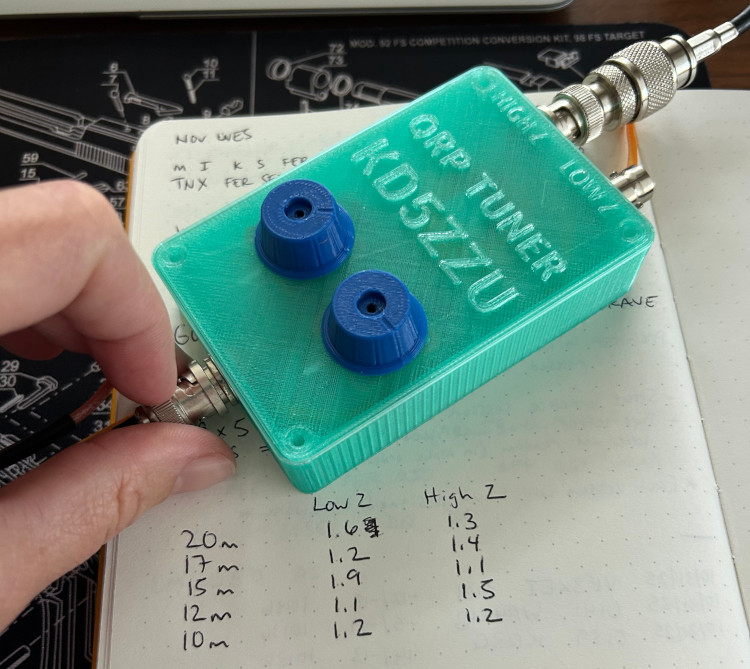
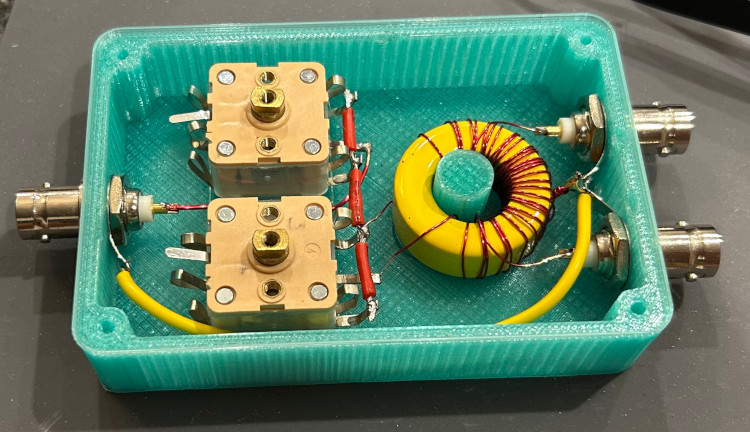
If anyone else is interested in building this simple construction project Mallory has kindly provided links to an online source for the parts and the 3D print files:
- Polyvaricons: https://a.co/d/hOYgP2f
- Toroids: https://a.co/d/7mItRXw
- Magnet wire: https://a.co/d/ffqdHo9
- BNC posts: https://a.co/d/5mwLEVI
Here is a link to the 3D print design of the knobs: https://www.thingiverse.com/thing:3035549/files
Here is a link to the file to 3D print; it’s a print profile (modification) from the original designer of a customizable enclosure box: https://makerworld.com/en/models/2002942-custom-enclosure-box#profileId-2400746
A note on the use of Old Barebones
I designed Old Barebones for use with my QRP Labs QMX transceiver which has a convenient “Tune SWR” feature that reduces the output power to 25% to reduce the stress of high SWR on its delicate finals during the tuning process. I have also used Old Barebones with my Yaesu FT-817 but I manually reduce the power to 1 watt or less during tuning. If using Old Barebones with any radio that does not have an SWR indicator I recommend incorporating an SWR indicator in the tuner circuit similar to the original Norcal BLT design.
Polyvaricons?
The word “polyvaricon” is presumably a contraction of “Polymer Variable Condenser” meaning a plastic enclosed variable capacitor using a plastic dielectric. It is believed to be the trademark of a Japanese company that manufactures these devices. But shouldn’t it be called a “polyvaricap”. I remember back in the dawn of my existence that capacitors were called “condensors” but that term disappeared a long time ago. Strange old world.
What is a Z-match?
“Antenna tuners” are often named after their topology. For example, an L-match comprises a series inductor or capacitor and a complementary parallel capacitor or inductor. The combination of inductor and capacitor forms an “L” shape. However, there is no immediately apparent “Z” shape to the components in a Z-match, so I presume the “Z” refers to impedance. Let me know in the comments if I am wrong.
Pros and Cons of the Z-match
From the GQRP organization in the UK:
Advantages of the Z-Match
- Matches balanced loads without the use of lossy baluns.
- Being a parallel resonant circuit, the Z-match can provide some band-pass filtering for your receiver and harmonic attenuation for your transmitter.
- A well-designed Z-match tuner has a high Q and is more efficient (less lossy) than other types of tuners.
- The fixed inductor simplifies construction (no switches or rollers needed).
Disadvantages of the Z-Match
- Tuning is usually very narrow and can be a bit touchy sometimes to tune up
Thanks again to Mallory KD5ZZU for sharing her build with Ham Radio Outside the Box and congratulations Mallory for turning my original inelegant build into something with class!

Help support HamRadioOutsidetheBox
No “tip-jar”, “buy me a coffee”, Patreon, or Amazon links here. I enjoy my hobby and I enjoy writing about it. If you would like to support this blog please follow/subscribe using the link at the bottom of my home page, or like, comment (links at the bottom of each post), repost or share links to my posts on social media. If you would like to email me directly you will find my email address on my QRZ.com page. Thank you!
The following copyright notice applies to all content on this blog.

This work is licensed under a Creative Commons Attribution-NonCommercial-NoDerivatives 4.0 International License.
Discover more from Ham Radio Outside the Box
Subscribe to get the latest posts sent to your email.
 Ham Radio Outside the Box