
Confession: I am not really a contester, I have far too short an attention span to spend hours sitting in a chair pounding brass. This year I chose to operate from local parks and turn Field Day into an opportunity to earn a couple of activations for Parks on the Air. I went out on Saturday afternoon and again around noon on Sunday when the last of the Field Day operators were probably getting anxious to squeeze just a few more QSOs into their logs.

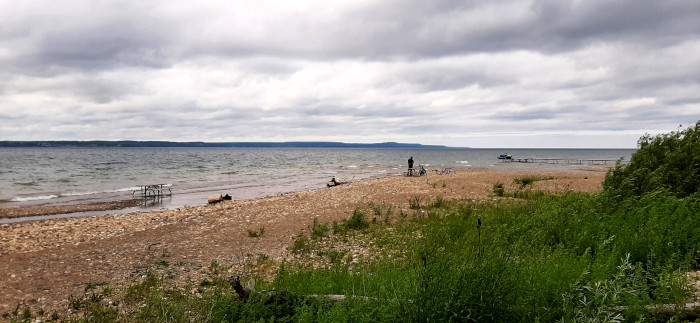
The weather on Saturday was quite cool and windy. I had chosen a spot behind a rocky beach at Ainslee Wood Conservation Area (CA-6005) on the shore of Owen Sound Bay, which is part of Georgian Bay in the Great Lakes system. It was so cold that I had to pick a spot sheltered by a small tree from the chilling wind blowing off the lake. Even so, after a little over an hour I was too cold to continue after logging just a paltry 12 CW QSOs by Search and Pounce on the 20m band. Enough to qualify a POTA activation but less than I had hoped for.
Sunday was a completely different story. I set up at Hibou Conservation Area (CA-5651) very close to Saturday’s location. I found a picnic table at the very edge of the lake which was sitting on water pooled among small rocks. The Sun was shining brightly and the temperature was edging above 30 degrees Celsius. After a couple of hours, I had 20 S&P CW QSOs in the log and packed up before getting a bad sunburn.
Station Equipment
Field Day 2025
Field Day operates at a fast pace so I didn’t want to slow things down with my usual QRP rig, especially since band conditions have been so poor lately. Instead I brought along the Yaesu FT-891 set to a more powerful 25 watts. Would 5 watts have been enough to get the job done? Yes probably; there were a lot of stations on the air all eager to make contacts.
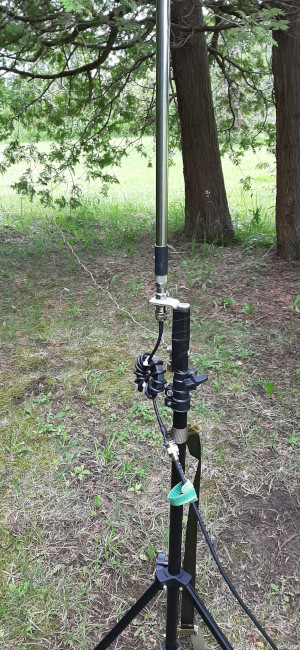
The antenna was my ham-made POTA Performer made with a tripod mounted 17ft whip and a single raised radial for a counterpoise. The POTA Performer had done very well during a POTA hunting session the day before so it earned the job of working Field Day. How would it handle the job? That was what I was there to find out.
The whip is actually an 18.5ft telescoping stainless steel unit from AliExpress. I left the bottom section collapsed for my 20m operation. The SWR measured on the FT-891 was 1.3:1 with no transformers, coils or tuners required. The fact that the POTA Performer does not require any loading devices or tuners may be the reason it has been getting rave reviews on the ham radio forums and YouTube. The efficiency is enhanced by avoiding all those lossy coils and matching devices used by other ham antennas.
POTA Performer on the low bands?
The original design was for a multiband antenna for 20m and up. It can be operated on 30m and 40m by adding a loading coil but that would negate its high efficiency basic design. A better option might be to replace the whip with a quarter wave wire suspended from a pole or a tree.
SWR = 3:1? Oh no!
Saturday’s erection was on a grassy area about 100 feet from the lake, but on Sunday the same antenna was standing above a couple of inches of freshwater at the edge of the lake. When I powered up the radio the SWR was a horrifying 3:1. To bring the SWR down to less than 1.5:1 I had to shorten the whip quite considerably. I was surprised that the freshwater of Georgian Bay had such a strong effect. Maybe the thousands of tons of salt recently delivered by ship to the nearby Port of Owen Sound was responsible, who knows.
The original POTA Performer uses 2 radials set at 90 degrees to achieve a little directionality. My own modeling suggests a single radial works just as well and reduces the ground footprint to 2 dimensions which is convenient in many portable operation setups.
Beamwidth
The beamwidth is quite wide – almost 180 degrees. I didn’t have a compass with me on Sunday and made the mistake of assuming I was facing south when, in fact, due to the irregularity of the Great Lakes coastline, I had actually oriented my radial to the west. Some of my signal was landing among the polar bears in Canada’s far north. The POTA Performer did a good job getting my signal into distant states such as California, Utah, New Mexico and especially Colorado where I made several QSOs. Surprisingly I also made a few good contacts into New England and other “13 Colonies” states off the back of the antenna.
How directional is a single radial POTA Performer?

It all depends on the elevation at which we measure the front/back ratio. My version of this antenna has the base of the whip at about 3ft above ground. EZNEC predicts a maximum radiated signal strength at an elevation of 25 degrees. The front/back ratio at 25 degrees elevation is just under 4dB. That would get my signal into the western part of the North American continent while dropping a small part of the radiated signal off the back of the antenna into the mid-Atlantic Ocean.

If we examine what happens at an elevation of 45 degrees, the front/back ratio improves to almost 7dB.
At an even higher elevation angle, say 60 degrees (not shown), the POTA Performer struggles to maintain a usable signal. That is not unexpected since vertical antennas do not perform well for Near Vertical Incident Skywave (NVIS) propagation. At 60 degrees elevation the front/back ratio increases to almost 13dB, but since that is only 2 S-units down, it could explain my contacts down the Eastern Seaboard. It could also justify my choice of RF power. 25 watts made the contact, 5 watts maybe would not have got the job done.
Omnidirectional option
The QTH for most of my operations is Southern Ontario, Canada which means most of my QSOs are with stations in the United States. I made only one QSO with a Canadian station during two sessions over the Field Day weekend and that was in Alberta in Western Canada. So it makes sense for me to use a slightly directional antenna.
Stations that are surrounded by other hams – for example in mid-western states, or mainland Europe – may prefer an omnidirectional antenna. There are two ways to make the POTA Performer omnidirectional. In the original configuration involving 2 raised radials, simply re-orient the radials so that they are 180 degrees apart instead of 90 degrees. In a previous post I wrote that I preferred the option of laying a set of 4 radials on the ground; it simplifies the job since no adjustment is required for band changes. My own EZNEC modeling shows no disadvantage of going this route.
The very satisfactory results that have been achieved with this antenna make it a prime candidate for my portable operations kit bag. Nevertheless, the urge to experiment goes on. I am currently re-visiting the possibility of using a vertical delta loop for portable operations. Full-wave loops generally have a good reputation and a vertical delta loop is no exception.
I have also been working on a portable 2-element beam for 20m. It has very promising specs but may prove to be too difficult to erect for temporary portable operations. If it works it could overcome the challenges of working QRP during poor band conditions. Stay tuned for future posts on Ham Radio Outside the Box.

Help support HamRadioOutsidetheBox
No “tip-jar”, “buy me a coffee”, Patreon, or Amazon links here. I enjoy my hobby and I enjoy writing about it. If you would like to support this blog please follow/subscribe using the link at the bottom of my home page, or like, comment (links at the bottom of each post), repost or share links to my posts on social media. If you would like to email me directly you will find my email address on my QRZ.com page. Thank you!
The following copyright notice applies to all content on this blog.

This work is licensed under a Creative Commons Attribution-NonCommercial-NoDerivatives 4.0 International License.
Discover more from Ham Radio Outside the Box
Subscribe to get the latest posts sent to your email.
 Ham Radio Outside the Box
Thank you very much for the information
73 de Uwe, DL4YCA
LikeLike