
The winter takes it all – aka A Brief Break Activity
We haven’t had this much winter snow for several years. Every day seems to bring a fresh snowfall to add to the accumulation on the ground. My poor John Deere snowblower is getting a real workout keeping the driveway clear. I live on the corner of two streets and as the snow plows turn the corner they deposit a fresh wall of the blessed white stuff across the end of my driveway. All the trails and parks I like to visit to play radio in the summer are buried and impassable. Even parking spaces outside the parks are cutoff by walls of hard-packed snow and ice. Since I prefer to operate outdoors instead of inside a vehicle I am having a hard time getting out to scratch my radio itch.
What’s a ham to do?
A few weeks ago I ordered a small ice-fishing shelter from an online company named after a river in Brazil. It’s an uninsulated pop-up style nylon shelter that keeps the wind off my back. Several layers of warm winter clothing and a good pair of mukluks take care of combating the frigid air’s attempt to lure me into hypothermia.
I am not an ice-fishing person but this compact shelter is an ideal way of getting some comfort while playing with my wireless set when the weather isn’t too extreme. I am toying with the idea of taking my shelter down to the Owen Sound harbor and setting up on the ice alongside the other huts. Our harbor is completely frozen over and likely to remain so for several weeks. The port of Owen Sound, Ontario is not a busy place, but every winter the harbor attracts big “Great Laker” ships that come to rest and await the opening of the spring shipping season on the lakes. The last arrival needed the assistance of a Canadian Coast Guard ice breaker to get into the harbor.

It might be fun – if a little overwhelming – to setup my radio-fishing shelter alongside the hull of one of these behemoth vessels. Their steel hulls would probably make an excellent reflector for my signal.
Although we have been getting a motherlode of snow, temperatures have remained quite reasonable, hovering around -5C to -15C most days. A couple of days ago, in between snowfalls and with the thermometer reading a relatively balmy -6C, I set up my radio-fishing shelter on my driveway. I could tell I was on my driveway because I could just see the tips of my driveway markers peeking above the snow banks.
If this was a regular winter season I would have already completed several POTA activations under the shelter of my new nylon home-from-home. In previous winters I have happily snow-shoed my way into a park towing my radio sled, but age and a recently acquired medical condition have limited my physical prowess. So, unfortunately, this was the first time I have had the chance to try it out. I was feeling almost desperate. Day after day was passing by and the feeling of unease was building to intolerable levels. I just had to get out and disturb the ionosphere and if that meant a driveway radio session then so be it.
The radio-fishing shelter is a bit of a pig to set up. It relies on the tension in several poles to keep its shape. There are four sides and a roof section that have to be tensioned by pulling them out via a short strap in the center. I guess I’ll eventually get the hang of it – maybe by summer! The best part of its construction is that there are no poles to assemble; it’s all one piece and with the strength of Hercules it can be erected very quickly.


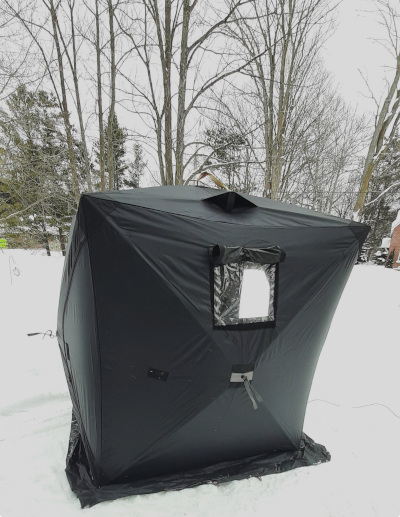
It is actually quite comfortable inside the shelter. There is ample space for two operators, but since I prefer to operate alone I have room to spread out my gear.
I use a simple camping stool to sit on while operating. A second camping stool acts as a table on which to mount my rig. A lesson I learned during this test setup was to add a small shovel to my portable kit. I had set up on compacted snow several inches deep and the back of my seat began to sink into the snow almost tipping me over.
I own a small folding shovel that packs away into a case only a few inches long. I am going to throw this into my backpack for future deployments.
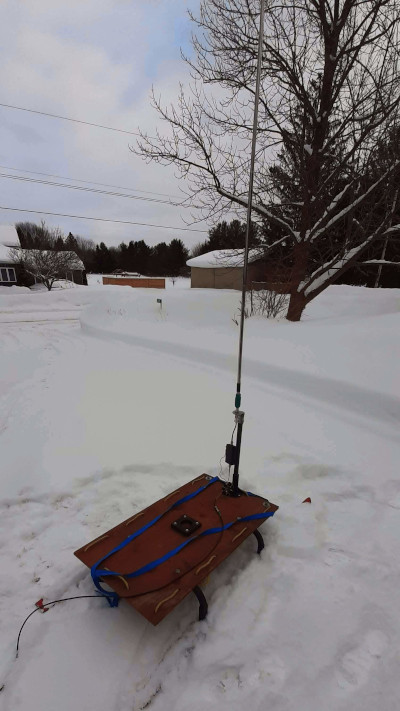
My fameless DIY radio sled sits outside the shelter and, in addition to carrying all my gear out onto the tundra, acts as a support for the antenna. For this deployment I set up my CLEFHW (Coil-Loaded End-Fed Half-Wave) 20m antenna.
The CLEFHW is a resonant antenna and requires no tuner, so it’s a nice simple way to operate. My driveway – and the rest of my home – sits right in the Niagara Escarpment which is a POTA entity. However, the rules say a valid activation has to be on public property so I restricted myself to hunting.
Operating as a POTA hunter has become difficult these days now that POTA is such a popular activity. The difficulty is increased when pumping out puny peanut power and hoping to get the edge on other hunters with their big indoor rigs and more efficient antennas. Operating QRP takes skill and quite a bit of good luck and patience. Suffice it say that I QSOd, packed up and ran for the warmth of home.
I am looking forward to better weather later this winter when – maybe – I can get out to do an activation. POTA activations are much easier than hunting because the hunters clamor for my attention rather than vice-versa. Only another two months of winter to go so there is hope!

Help support HamRadioOutsidetheBox
No “tip-jar”, “buy me a coffee”, Patreon, or Amazon links here. I enjoy my hobby and I enjoy writing about it. If you would like to support this blog please follow/subscribe using the link at the bottom of my home page, or like, comment (links at the bottom of each post), repost or share links to my posts on social media. If you would like to email me directly you will find my email address on my QRZ.com page. Thank you!
The following copyright notice applies to all content on this blog.

This work is licensed under a Creative Commons Attribution-NonCommercial-NoDerivatives 4.0 International License.
Discover more from Ham Radio Outside the Box
Subscribe to get the latest posts sent to your email.
 Ham Radio Outside the Box
I’ve just learned that “Great Lakers” ARE big. (I really wasn’t aware of that.)
LikeLike
Yes, Great Lakers are long but narrow. The shape is dictated by the need to fit into the various locks along the way. Some of these ships are over 1000 feet long.
LikeLiked by 1 person
I’m glad I’m not the only one who operates backyard portable. Good to hear you’re getting out and out of the wind.
LikeLiked by 1 person