

We’ll get back to the drinking straw question in a moment, but first let me describe another new project that took shape on the Ham Radio Outside the Box workbench recently – a QRP L-match.
You may recall that we recently described a Z-match builder project that we called “Old Barebones” – because it is a stripped down, rugged, basic tuner suitable for field expedient backpack portable operations. If you read that post you may also recall how “Old Barebones” used FBU tuning knobs. FBU? (Functional But Ugly).
The problem, you see, is polyvaricons – those tiny variable capacitors used in portable AM/FM receivers. Polyvaricons do not have a standard shaft. AM/FM radio manufacturers get around this problem by using custom plastic moldings to create a means of rotating the shaft. Tuning a mass-produced AM/FM receiver is often accomplished by adjusting a thumbwheel protruding from the edge of the radio. Polyvaricon conversion kits are available; maybe somebody somewhere has devised a 3D printable conversion kit. I have my own solution.
About the L-match builder project
I like L-matches; they are simple to build, they can match low impedances to 50 ohms and they can match high impedances to 50 ohms. Some say they have lower insertion loss than other types of tuner. A long time ago I built a QRO L-match that has served me well, but recently I decided to add a QRP version to the kit bag.
Just like Old Barebones, I built this one into a petite plastic enclosure that closely matches the dimensions of my current favorite QRP transceiver – the QRP Labs QMX. Incidentally, I actually regret buying that QMX. I bought the low band version that supports 80m, 60m, 40m, 30m and 20m. I rarely use 80m when portable, I never use 60m which leaves me with a 3-band instead of 5-band radio. Soon after I placed my order I realized I should have ordered the mid-band version that includes higher bands. In fact, soon after I placed my order QRP Labs introduced the QMX+ which covers all the bands from 160m to 6m. I am tempted to order a QMX+ but if I do I know I’ll probably never use my QMX again.
Building the L-match
An L-match comprises a series variable inductor and a parallel variable capacitor. Whether the variable capacitor is on the antenna side or the radio side determines whether low impedances or high impedances can be matched. L-matches often include a switch to select one or the other. As was described in my “Old Barebones” post, I like to avoid switches in my backpack portable kit. Switches break! It is a simple task to reverse the connections if a suitable match can’t be found – especially when using BNC connectors.
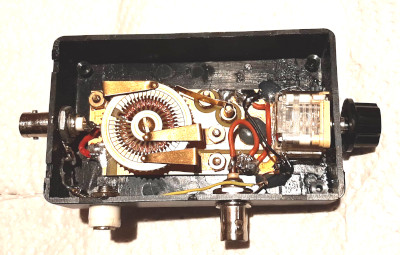
About 20 years ago I bought a “Miracle Whip” antenna made by a now defunct company in Quebec. It comprised a 57-inch telescopic whip tuned by a very well engineered variable inductor and was designed to tune 80m to 2m. The Miracle Whip was intended as a companion for the Yaesu FT-817 and mounted directly on the rear SO-239 antenna connector. Over time the whip broke (my fault) and the variable inductor was extracted and re-housed in the same plastic enclosure that now contains my QRP L-match. All I had to do was add a polyvaricon.
It was a really tight squeeze. I had to remove part of the Miracle Whip’s circuit board to fit the polyvaricon inside the enclosure. But it works; the L-match performs well and since it comprises only passive components there was no magic smoke to release even if I had made a wiring error.
Fire all of your guns at once and explode into space
I don’t own a gun but I think all of the neurons inside my head must have fired at once while sitting in my comfy recliner sketching ideas on the back of my eyelids. Quite suddenly I realized I might have a solution to the FBU (Functional But Ugly) polyvaricon knob problem.

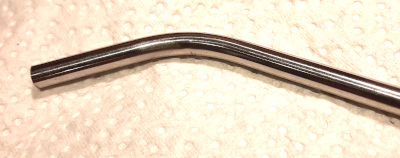
Some time ago I purchased a set of stainless steel drinking straws from the local Dollar Store. Could I make a new polyvaricon shaft from one of these things? Would it fit?
Using a digital caliper I determined that it just might be possible but would involve some detailed metalwork. It was necessary to cut a wide slot in one end of the new shaft to fit over the polyvaricon’s stubby original shaft. A Dremel tool with a cutting blade made short work of the slot and a fine file finished the job. Now I had a new shaft and a new problem. How to secure the shaft to the polyvaricon?
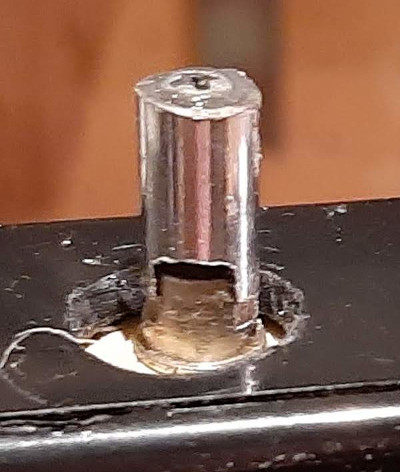
A search through my extensive collection of small nuts and bolts came up with a tiny bolt with the right thread and a suitable length. I hoard all the tiny fasteners extracted from old and junk electronics – a practice that has paid off many times. The new shaft was cut to a length that fit snugly inside the standard equipment knob I had selected. Now the final assembly involved filling the new shaft with quick setting epoxy glue and sliding it over the protruding tiny bolt. I had to secure the enclosure in a mini vise to keep it vertical while the glue set.
It works! Maybe I’ll get around to replacing the FBU knobs in Old Barebones one day too. Meanwhile I am scouring charity shops and garage sales looking for old AM/FM radios to dismantle for more polyvaricons, tiny screws and whatever else I can recycle into future projects. There are other tuner/transmatch topologies I would like to try and they too will be built from scratch on the Ham Radio Outside the Box workbench.
Help support HamRadioOutsidetheBox
No “tip-jar”, “buy me a coffee”, Patreon, or Amazon links here. I enjoy my hobby and I enjoy writing about it. If you would like to support this blog please follow/subscribe using the link at the bottom of my home page, or like, comment (links at the bottom of each post), repost or share links to my posts on social media. If you would like to email me directly you will find my email address on my QRZ.com page. Thank you!
The following copyright notice applies to all content on this blog.

This work is licensed under a Creative Commons Attribution-NonCommercial-NoDerivatives 4.0 International License.
Discover more from Ham Radio Outside the Box
Subscribe to get the latest posts sent to your email.
 Ham Radio Outside the Box