
I actually don’t like Z-matches very much, so why did I build one? I’ll get to that in a moment, but first I should explain why I am not a fan of the Z-match. These devices comprise two variable capacitors and one fixed inductor. The fixed inductor limits the tuning range compared to other types of tuner. Tuning is quite coarse and the two variable capacitors interact significantly so it can sometimes be frustrating to nail down the best setting.
Tell me why?
The honest truth? I built one because I am a compulsive builder. I already own a Z-match – a Norcal BLT – I didn’t build that one, instead I bought it from another ham who had built it from a kit.

Building my own gear is not only very satisfying but could one day be essential. We can all order almost anything we need online and have it delivered to our door the next day. Unless, let’s say, the delivery guy can’t do his job because the road has been destroyed by an unusual weather event. Unlikely you say? QRPer Thomas K4SWL could probably convince you otherwise.
Back in the spring my QRP Labs QMX transceiver arrived. The QMX has an interesting feature called “Tune SWR”. The feature reduces the supply voltage to 50% (user variable) which drops the RF power to 25%. Antennas can then be matched using an external tuner while the SWR is displayed on the QMX screen. It works very well and helps protect the PA transistors during the tuning process.
Using the QMX’s Tune SWR feature eliminates the need for an SWR bridge in the tuner. All I needed was my Norcal BLT tuner’s Z-match circuitry. The built-in SWR bridge and LED indicator were redundant.
So why couldn’t I simply set the BLT’s “Tune/Operate” switch to the “Operate” position which removes the SWR bridge from the signal path? Well, I could do that, but like I said, I’m a compulsive builder. Besides, I had some other considerations I wanted to incorporate into my homebrew tuner. The BLT has three tiny toggle switches; one selects either the balanced line terminals or a BNC coax connector. A second selects high or low impedance antenna matching. The third switch is the Tune/Operate control. I eliminated all three switches.
Keep It Sweet and Simple
I don’t currently use any antennas with a balanced feedline so “pop” that switch is gone. My DIY Z-match does not have an SWR bridge so no need for a Tune/Operate switch – “pop”. Finally I designed an alternative to the high/low impedance switch – “pop”, there goes the last switch!
Switches – particularly the very small ones – can be quite fragile. I once broke a big tough toggle switch by bouncing my equipment around in the back of my truck en-route to an activation. Hold a soldering iron on one for too long and the plastic around the solder tags will melt – I’ve done that too!
So what’s left?
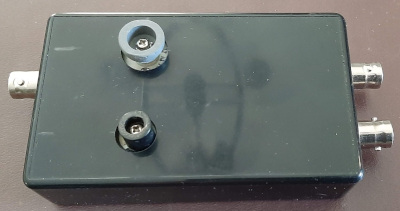
The final design comprises nothing but a small plastic project box, 2 miniature variable capacitors (removed from old AM/FM radios), one inductor wound with 26awg magnet wire (from a junk box transformer) around a small type 6 powdered iron toroid (from a junk box circuit board) and 3 BNC connectors (ordered online and delivered right to my door. With continuing sympathetic thoughts for the unfortunate victims of the two recent hurricanes).
Here is the schematic for the DIY barebones, QRP Z-match:


Testing Old Barebones
I set up my Rybakov antenna in the Outback (out in the back yard). A Rybakov is a short vertical random wire antenna. Mine comprises a 27ft vertical radiator wire fed through a 4:1 unun (home made, of course). A common mode choke connects to the coax. Four 13ft wires on the ground constitute the radial field.
I fed the Rybakov through 25ft of RG-58 coax. At the radio end of the coax I placed Old Barebones and then hooked up my QRP Labs QMX transceiver set up for “Tune SWR” on three bands: 20m, 30m and 40m.
Old Barebones has two BNC connectors to select either high or low impedance antennas. I started on high impedance. All three bands were easy to tune, although on 40m the SWR was 1.76 which is usable but a little higher than I expected.
Then I reconnected the coax to the low impedance BNC. 20m showed no improvement – in fact it was a little harder to tune. On the other hand both 30m and 40m tuned up to an even lower SWR with no difficulty at all.
The finished tuner is very lightweight, only 3.3 ounces (93 grams) which is perfectly suited to backpack portable ham radio operations.
The dimensions are 4 inches (10cm) x 2.25 inches (5.7 cm) x 0.75 inches (1.9cm) (excluding BNC connectors and knobs. Coincidentally, this is almost identical to the dimensions of the QMX and the 3Ah Talentcell LiIon battery that powers the QMX.
About those knobs!
Agreed, those knobs won’t win any awards for beauty. Polyvaricons do not have regular shafts so it is quite difficult to find satisfactory knobs for them. Yes, there are solutions out there – my Hendricks PFR3 radio has plastic shaft extensions that are held in place by long screws and allow regular knobs to be fitted. I scrounged these polyvaricons (plastic variable capacitors) from old AM/FM radios and adapted the custom molded control knobs for my own purposes. Old Barebones isn’t embarassed to wear them so I’ll stick with what works. If it works – it works. Beauty is in the eye of the beholder.
Help support HamRadioOutsidetheBox
No “tip-jar”, “buy me a coffee”, Patreon, or Amazon links here. I enjoy my hobby and I enjoy writing about it. If you would like to support this blog please follow/subscribe using the link at the bottom of my home page, or like, comment (links at the bottom of each post), repost or share links to my posts on social media. If you would like to email me directly you will find my email address on my QRZ.com page. Thank you!
The following copyright notice applies to all content on this blog.

This work is licensed under a Creative Commons Attribution-NonCommercial-NoDerivatives 4.0 International License.
Discover more from Ham Radio Outside the Box
Subscribe to get the latest posts sent to your email.
 Ham Radio Outside the Box
5 thoughts on ““Old Barebones” – A QRP Z-match Builder Project”