
I know many hams like to operate from inside the comfort of their vehicles. I do too, but only in the depths of winter. Winters in Canada and most of the northern states can often be very challenging so some form of shelter becomes essential. But, in the warmer months (both of them, hi hi) I prefer to get out into the great outdoors to get my radio therapy.
You put the load right on me
There is one major disadvantage to operating “backpack portable” – the whole station: radio, battery, chair, table, poles and everything else you could possibly need has to be carried on your back. Your operating site may be some considerable distance from the parking lot where you have left your vehicle. So what’s the solution?
For every problem there are two solutions
Yes, indeed, for every problem there are two solutions – the first solution is the learning experience (“heck, that ain’t gonna work; there’s gotta be a better way”). The second solution is the strategic one. Backpack too heavy? Loosen the load. Solution number two doesn’t happen in one shot; it’s more of an evolution – a developing plan.
This is not the end; it is not even the beginning of the end, but it may be the end of the beginning
Sir Winston Churchill
Big wheel keep on turning
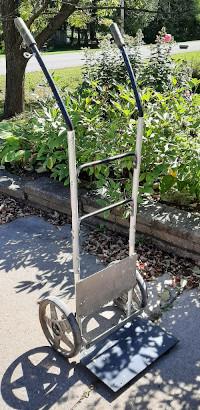
My first solution was to build a wheelie cart; it had two wheels salvaged from an old golf cart and did a fine job carrying my excessively heavy field radio gear – until I tried to take it down a trail. My first learning experience was that trails in these parts are not wide and smooth. Trails go up and down, over big rocks, across multiple giant cracks in the bedrock with no visible bottom, through mud and sometimes become so narrow you may wonder where the trail went.
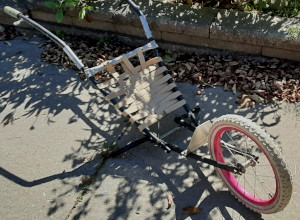
Lesson learned; I built another wheelie cart, this time with only one wheel – a bigger bicycle wheel. Definitely an improvement. After a redesign to correct a balance issue it worked quite well – on some trails. I live and do most of my outdoor radio operating on the Niagara Escarpment. The escarpment runs for hundreds of kilometers from Niagara Falls in the south up to a point at the tip of the Bruce Peninsula in Lake Huron. It is a rugged rock formation roughly a couple of hundred feet high that creates many interesting – and challenging – features. My “unicart” with heavy load was not exactly ideal for navigating the steep, uneven, rocky terrain found here.
No wheels on my wagon, now I’m not rolling along
Of one thing I am certain; my field radio kit is going to continue to evolve. Life is a learning experience that never ends. So here is where I am right now. Both the one-wheel and two-wheel carts are in semi-retirement. They have been replaced by something I have had all my life; something so versatile and adaptable that it is perfect for the job – my back!
Optimizing the backpack
The first step was to throw out all the things in the backpack that were causing it to be so heavy. That included the radio! Yes, I replaced my 100 watt radio and its heavy battery with a QRP rig. I operate CW exclusively and 5 watts of CW has the same punch as 100 watts of SSB. QRP radios need a smaller battery too – a double weight saving.
QRP operating takes a little adjustment after years of QRO. When hunting POTA activators, it takes a little skill and a big slice of luck to break the pile-up of QRO hunters with big antennas. When activating it’s a different story, QRP CW gets the job done – just don’t be offended when a hunter hands you a “229” RST report. POTA doesn’t care whether you got a “599” or “229” – you made the contact and the result is the same.
About that backpack

A thought crossed my mind quite recently – if I have to carry that big backpack across field and dale it had better earn its keep beyond just holding all my radio gear together. Could the backpack do more?
That thought gave me an idea. On a recent field trip I had to deploy a quarter wave vertical antenna on a solid rock surface. I used my modified photo tripod to support the antenna. Almost perfect, but is there an even better solution?
That tripod is quite a heavy device. It was once a high quality piece of gear from back in the days when I enjoyed hanging out in darkrooms, processing black and white films. Could my backpack itself support an antenna instead?
A couple of hours spent in my garage workshop resulted in another piece of modified gear. I had an old aluminum backpack frame. It was just a little too big for the job for which I now needed it. A little bit of greasy handiwork transformed it into a very lightweight external frame that is a perfect fit for my Molle (Modular, Light Load-carrying Equipment) tactical backpack.
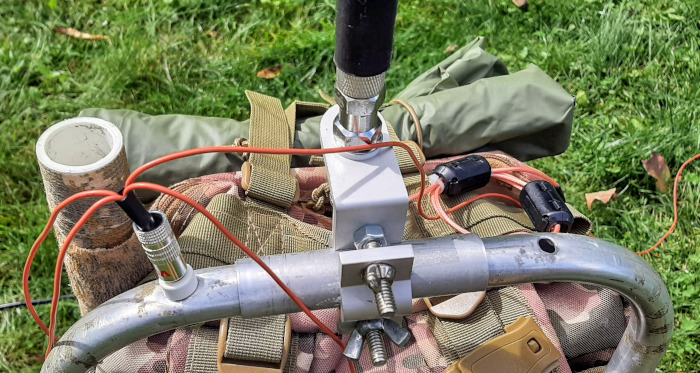
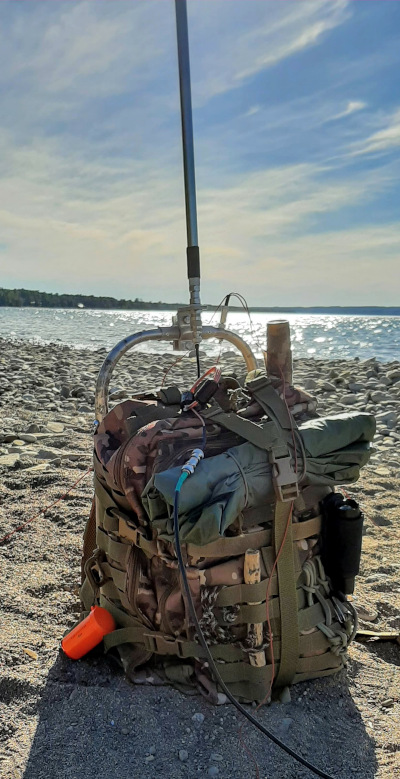
You can see in the picture how this works. The top rail of the backpack frame is used to secure a CB mirror mount type bracket into which I can screw my antenna whip. I bought the mirror mount bracket online and when I first fitted it there was no DC continuity between my radial connection point and the coax shield. The bracket was anodized! A Dremel tool soon fixed that problem.
Field trials – including a couple of successful POTA activations – with this arrangement verified that the backpack has sufficient stability to support a 20m quarter wave whip. Now I can simply slip the backpack off my back, set it on the ground, break out the radio and get on the air.
My chair is a folding stool that also has shoulder straps; it can be carried on my chest very comfortably. I tried one of those Helinox type chairs (mine is a much cheaper copy). They are very comfortable for relaxing but not for operating a CW key. Also I found the legs sink into the ground too easily – a problem I solved by attaching tennis balls to each of the four legs. A kluge fix for a poor chair design.
My table is a lap desk – a piece of discarded realtors “For Sale” sign covered in green cloth. It weighs almost nothing and fits inside one of the backpack compartments when not in use.
What about wire antennas?
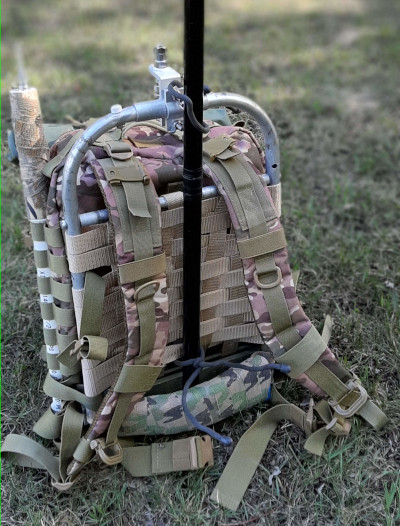
Attaching a telescoping stainless steel whip to the backpack was an easy task. Finding a way to get the backpack to support a fiberglass pole for wire antennas required a bit more thought.
My VP2E antenna uses a center support pole that is only 14 feet high. It is made from “crappie” fishing pole tubes and is very light. Using flexible plastic-covered steel straps made connecting the pole to my backpack very easy. It remained rock solid throughout a recent POTA activation.
I also own a 29ft fiberglass antenna pole. I suspect its going to be too heavy for the backpack to support. But then, maybe I’ll find a way. Basic physics can solve that problem. The 29ft pole (an MFJ 33ft pole repaired after a catastrophic collision with a brick wall) is only needed for my linked (20m, 30m, 40m) End-Fed Half Wave antenna. I rarely use 30m and I have some ideas for a different kind of 40m wire antenna – more on that in a later post. Maybe I won’t be needing that 29ft pole after all.
Why not ditch the backpack and just throw a wire up into a tree?
Well, if you prefer to operate “picnic table portable” close to where you parked your vehicle that’s a good idea. Drop your QRP rig and tiny battery into a small hand-carried bag with a neatly coiled length of wire to use as an antenna and you’re in business. That’s just not my style.
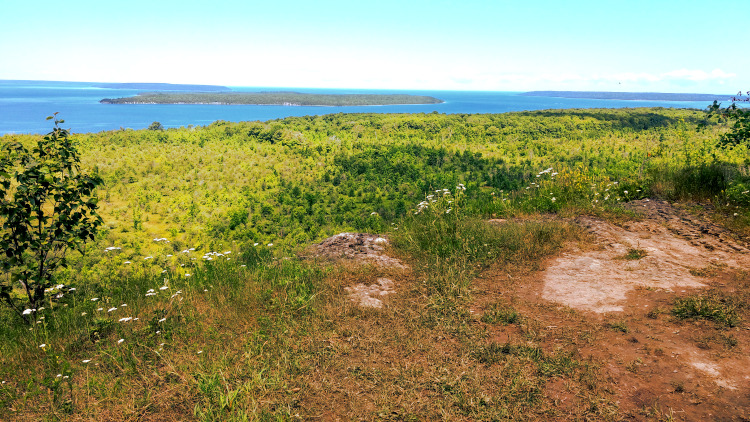
The trees are all 200 feet below. The lake is a further 100 feet lower.
My favorite operating spot is on the edge of a cliff at the end of a tricky one kilometer trail. There are no tall trees to support an antenna and definitely no picnic tables. But, the relatively high elevation and the breathtaking view out over some of the islands in Georgian Bay is spectacular. Ham radio surrounded by the beauty of nature sure beats winter operating inside my truck.
Spare a thought
Finally, I would like to express my deepest sympathy for all the people who were in the destructive path of hurricane Helene. Fellow QRPer Thomas K4SWL has written a harrowing account of the havoc and destruction wreaked by the storm on his area in western North Carolina. If you haven’t already read his account I strongly suggest you follow the link and read it now. A lot of words are written about amateur radio emergency communications and, in my opinion, a lot of time and effort is wasted pursuing emcomm in the wrong way. When you are faced with a real-life disaster situation, as Thomas is facing following the hurricane, you do whatever is necessary to help your immediate neighbors right here, right now. Where there is no power and no passable roads you will not be assisting emergency services, you will BE emergency services. Thomas, you have my most sincere respect in this situation.
Help support HamRadioOutsidetheBox
No “tip-jar”, “buy me a coffee”, Patreon, or Amazon links here. I enjoy my hobby and I enjoy writing about it. If you would like to support this blog please follow/subscribe using the link at the bottom of my home page, or like, comment (links at the bottom of each post), repost or share links to my posts on social media. If you would like to email me directly you will find my email address on my QRZ.com page. Thank you!
The following copyright notice applies to all content on this blog.

This work is licensed under a Creative Commons Attribution-NonCommercial-NoDerivatives 4.0 International License.
Discover more from Ham Radio Outside the Box
Subscribe to get the latest posts sent to your email.
 Ham Radio Outside the Box
2 thoughts on “How to Take Backpack Portable Radio to the Next Level”