
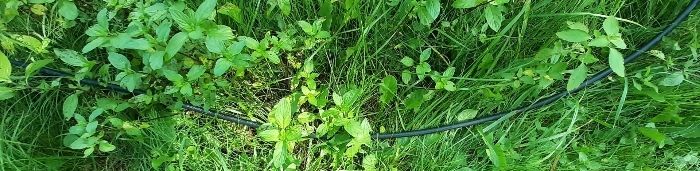
When singer/songwriter Paul Simon penned the lyrics to “The Boxer” in 1970 he may have anticipated my recent experiments with a particularly weird, unbelievable and incomprehensible antenna called “The Snake”.
A ham hears what he wants to hear and disregards the rest
The snake I wrestled for a couple of fruitless hours under a hot Sun, with the high humidity typical of a July day in Southern Ontario, was made of RG-58 coax. In my passion for experimenting with new antennas I wanted this to work. I really wanted this to work. This ham heard what he wanted to hear and disregarded the online naysayers. I was determined to monkey around with it – I was a believer and I couldn’t leave it if I tried. Until I wasn’t.
A snake antenna is a weird beast. According to online sources, it comprises a length of coax fed at one end – but only the center conductor is connected; the shield is isolated. At the far end, the center conductor and shield are shorted together. The coax is a “random” length, but like other end-fed random antennas, certain lengths are to be avoided. No radials or counterpoise is required. No ununs, baluns or transformers are required. The antenna can be erected as a vertical, a sloper or even laid directly on the ground – it just works. Do you smell snake oil yet?
Tell me lies, tell me sweet little lies
If this is all beginning to sound like a spoof, then believe me it is not. I am not yet convinced that I didn’t fall for a spoof myself though, but I really did build this antenna. It didn’t work for me but if you do an online search using the term “snake antenna” you will find accounts of how it did work very well for other people.
If I were a rich ham
If wealth was measured in coaxial cable lengths then I am a rich ham indeed. Some years ago I picked up a big reel of RG-58 at an auction for just a small fistful of dollars. As that kind of rich ham I could afford to experiment with crazy antennas. I pulled out 26 feet of coax – I chose this length to match the Rybakov antennas that I have previously built and which actually work very well.
The instructions I read suggested monitoring the SWR while trimming the antenna 4-inches at a time. Let me stress that this a random length antenna and requires a tuner to bring the SWR down to a level at which a transceiver will be happy. I measured the “native SWR” using my RigExpert AA55 Zoom analyzer. I was looking for an SWR of 10:1 or less so that it would fall within easy tuning range of a good external tuner.
Trimming is performed at the far end where the center conductor and the braid are shorted, so it is not a quick and easy job to do. After a few cuts I decided to go straight to one of the lengths recommended in the reference text. A length of 23 feet and eleven inches was reported to yield a native SWR of 2.2:1 on 20m. It didn’t. I was getting SWR readings well above that.
Bring in the Cavalry
In old western movies, when all seemed lost, the US Cavalry would gallop in and save the day. My cavalry was my home made L-match. I have several tuners but the one I trust the most is the L-match. With the L-match hooked up a lower SWR was obtainable, but it was still 5.5:1 – and unstable. I tried a counterpoise, but that didn’t help at all.
If at first you don’t succeed, redefine success
At this point it was fairly obvious that my snake antenna was born to be wild. It was not going to work for me, at least not without a lot of chin stroking and head scratching. Had I debunked a spoof, or was I missing something?
Reviewing the Situation
Let’s take a close look at the snake antenna and try to determine why it might – or might not – work.
First up; it is fed at one end, but only the center conductor is connected. Odd yes, but that is also true for vertical whip antennas.
Next: No radials or counterpoise required. Do you hear the sound of alarms going off? Feeding the antenna at one end works for most vertical whips but only if there is some kind of counterpoise. In the absence of a counterpoise the radio or the operator becomes the “other half” of the antenna. It could be argued that a half-wave antenna needs no counterpoise, but even that idea is disputed. Besides, even allowing for a velocity factor of 0.66, my snake was neither a quarter wave nor a half wave.
“The snake antenna can be laid directly on the ground – and just works”
Well, this statement didn’t just sound alarm bells; it set off an alarm with the kind of noise a ship’s horn makes when sailing through a fog. I have built “Grasswire” antennas that lay directly on the ground, and they do work, but they have to be at least one wavelength – and preferably multiple wavelengths – long. I hope I never meet a real snake that long.
And then: at the far end of the antenna, the center conductor and the shield are shorted together. So what have we wrought? Is this a folded monopole? Is it a sleeve monopole?
A folded dipole is achieved by folding the ends of each side back towards the feedpoint. A folded monopole would then be one half of that arrangement – inefficient but it could conceivably work. However, since the snake is made from coax, the center conductor is shielded by the braid so it is unlikely to radiate.
A sleeve dipole is made from coax by removing the braid for a quarter wavelength at the far end. The physical feedpoint is at the near end, but the electrical feedpoint is in the center. The “other half” of the dipole is the outer skin of the braid in the first quarter wavelength. There are significant differences between the snake antenna and the sleeve antenna; notably, the only exposed radiating surface in the snake is the braid along its whole random length.
I have a theory. Perhaps the whole antenna is a 1:1 transformer in which the center conductor is the primary. Feeding a signal into the primary induces a signal in the braid (the secondary) which then radiates. But then what is the purpose of shorting the far end? Does that make it an autotransformer – or an unpredictable random length stub?
Why didn’t my snake work?
If my theory is correct, the efficiency of the snake depends on the efficiency with which a signal can be inductively transferred from the center conductor (the primary) to the braid (the secondary). If that inductive transfer is inefficient the antenna will not work.
There are many different types of coax and each has different characteristics. The reference text I used quoted specific lengths that were reported to work – and not work. However, coax has a velocity factor which changes its electrical length. Was this taken into consideration?
The coax I used was RG-58U with 95% braid coverage which is fairly good but maybe less effective than other coax types with 100% foil shields beneath the braid.
Finally, the reference text I used discussed very long snake antennas for working top band (160m). Now thinking about this for just a fleeting moment it seemed fairly obvious that this would be a waste of coax (even for coax-rich hams like me). A random wire antenna would do the same job – maybe even a better job – and would be cheaper, lighter and stealthier.
What are your thoughts? Have you ever tried a snake antenna? Do you have any theories on how it might work? Is the snake antenna a phantom -all lies and jest? Let me know in the comments.
Help support HamRadioOutsidetheBox
No “tip-jar”, “buy me a coffee”, Patreon, or Amazon links here. I enjoy my hobby and I enjoy writing about it. If you would like to support this blog please follow/subscribe using the link at the bottom of my home page, or like, comment (links at the bottom of each post), repost or share links to my posts on social media. If you would like to email me directly you will find my email address on my QRZ.com page. Thank you!
The following copyright notice applies to all content on this blog.

This work is licensed under a Creative Commons Attribution-NonCommercial-NoDerivatives 4.0 International License.
Discover more from Ham Radio Outside the Box
Subscribe to get the latest posts sent to your email.
 Ham Radio Outside the Box