
One of my favorite YouTube channels comes from the UK-based Waters and Stanton ham radio store. The presenter is Peter Waters G3OJV who delivers the content is a refreshingly unassuming, soft-spoken manner. Although it is a commercial channel, Peter introduces topics that are of general interest to hams with only modest company promotional content.
A rush to the shack
One of his recent videos was titled “The Forgotten FB5 Ham Radio Antenna”. You can watch it here. After watching it myself I felt a strong urge to rush to my shack to try an idea inspired by Peter’s video.
The FB5 is a multiband antenna invented in the 1960s by another English ham. The name of the antenna derives from its use of ferrite beads placed at high current points along a wire to change its resonant frequency. By placing multiple ferrites at strategic points on a wìre, the antenna can be made resonant on 5 non-WARC bands (80, 40, 20, 15, 10m). The FB5 was invented before the WARC bands were made available to radio amateurs so it may be adaptable to every band accessible to hams today.
Hmm, I wonder?
I really enjoy experimenting with antennas, but I am not planning to build an FB5 myself. The idea that sparked my rush to the shack was the concept of using ferrite beads to change the resonant frequency of a wire antenna. Could this idea be adapted for use with an antenna that is already part of my kit?
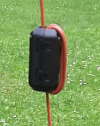
A quick search of the junque drawer revealed no suitable ferrite beads I could use, but there were several snap-on ferrites of the type usually used for EMI suppression. I grabbed a couple of these to see if they would do the required job.
In Peter’s video he quoted the inventor’s suggestion that the FB5’s efficiency could be improved by using multiple ferrite beads at each placement point. With this in mind, I wound 8 turns of wire around each of two snap-on ferrites at one end of a wire, then adjusted the length of the wire to around 17 feet. Without the ferrites 17ft of wire would be close to resonance on 20m (with a counterpoise), so where would the wire be resonant with the ferrites?
My Rig Expert AA55 Zoom antenna analyzer gave me the answer to that question. I tasked the Rig Expert with plotting the SWR from 3-30 MHz and there on the bright color screen was the answer. My 17ft wire was non-resonant throughout the whole amateur HF spectrum!
Doh!
Of course, 16 turns of wire on snap-on ferrites introduces inductance that would not be present if multiple individual ferrite beads had been used.
I gradually reduced the number of turns and monitored the impact at each step with the antenna analyzer. It wasn’t until the experiment progressed to a point at which only a single turn of wire around just one ferrite was reached that hope emerged of finding resonance within a ham band. The target band was 40m.
A 17ft wire is approximately a quarter wavelength long on the 20m band. The current distribution on a quarter wavelength antenna results in maximum current at the feedpoint. So, placing the ferrites there will have the maximum affect on its resonance.
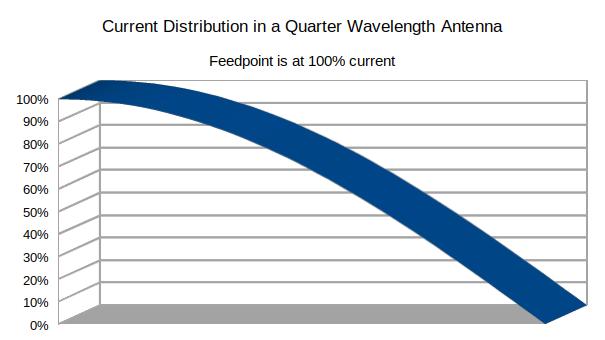
As we have discussed previously on this blog, the current on a quarter wavelength wire declines sinusoidally from the feedpoint towards the far end. Since the experiment thus far yielded resonance below the 40m band, it was decided to try moving the ferrite away from the feedpoint. This was partially successful but it was difficult to find the exact point along the wire where resonance would fall inside the 40m band (7-7.3 MHz in North America).
Perhaps the ferrite I was using was too effective, I thought. Another search of the junque drawer revealed a small type 6 mix of powdered iron toroid. I wound a couple of turns through this toroid but it had far less effect, so it was back to the ferrite. My snap-on ferrites are an unknown mix but are believed to be type 31 or type 43.
With limited choice in ferrite materials to work with, I figured that perhaps the same experiment would have a better chance of success with a longer wire. Small changes in ferrite placement along a half wavelength wire might permit finer tuning adjustment than is the case with a quarter wavelength wire. My guess was right on the money!
One of the most used antennas in my hambag is an End-Fed Half Wave with links for 20m, 30m and 40m. The first section, resonant on 20m, is approximately 31ft long. I separated the wire from the 49:1 impedance matching transformer and proceeded to try out the ferrite trick in a quest for 40m.
A 31ft wire is almost the right length for a quarter wavelength antenna on 40m. It would be a simple matter of adding a couple of feet of wire and Robert would be your father’s brother. Alternatively, almost any tuner would resonate a 31ft wire on 40m. But, the purpose of the experiment was to investigate whether a small ferrite would do the job instead.
Yabba-dabba-doo!
This should be an easy task for the humble little snap-on; 31 feet of wire is very nearly the right length already. To begin, the ferrite was placed at the feedpoint. Conclusion: too much electromagic. Next step: move the ferrite up the wire, away from the maximum current point. Result: better! Further up the wire? Even better. Eventually a point about 2 feet below the center point of the wire (about 13.5 feet above the feedpoint) yielded a nice low SWR at the CW end of the 40 band.
Is this a practical antenna?
I have been trying to reduce the amount of wire I carry to the field for portable operations so, in that sense yes, if it is possible to use the same wire for more than one antenna, then this is a practical idea.
Will I ever use it?
Probably not, but the point of the exercise was to experiment. Isn’t that the finest aspect of our hobby? We are given license to transmit RF for two main reasons: public service and to expand human knowledge of electromagnetrickery. If we were to only use our radios as a social medium we might risk weakening our claim to use of the limited radio spectrum. Well, that’s my 2 cents worth.
Help support HamRadioOutsidetheBox
No “tip-jar”, “buy me a coffee”, Patreon, or Amazon links here. I enjoy my hobby and I enjoy writing about it. If you would like to support this blog please follow/subscribe using the link at the bottom of my home page, or like, comment (links at the bottom of each post), repost or share links to my posts on social media. If you would like to email me directly you will find my email address on my QRZ.com page. Thank you!
The following copyright notice applies to all content on this blog.

This work is licensed under a Creative Commons Attribution-NonCommercial-NoDerivatives 4.0 International License.
Discover more from Ham Radio Outside the Box
Subscribe to get the latest posts sent to your email.
 Ham Radio Outside the Box
Nice experiment OM. I may try to replicate your results with my own 20 meter EFHW.
LikeLiked by 1 person
Yes it was an interesting experiment Matt but not sure if I will use it as a practical antenna. It might make a good magic trick to perform at a club meeting though. Let me know the results if you decide to give it a try.
LikeLike
Matt, just missed you on POTA this morning. You must like to get out early. Just finished working KI5GTR in AR then saw your spot, but you were gone. I’ll put you on Ham Alert.
LikeLike
Now heard you on 15m but v. weak.
LikeLike