
If you happen to live at a latitude within around 45 degrees of either of the Earth’s poles, the word “winter” takes on a whole different meaning. In fact it is more than just latitude that determines climate. Countries such as the UK extend further north than even 55 degrees, but enjoy milder weather due to the warming effects of the Gulf Stream.
Here in North America we occupy a significant land mass that is warm (and often blazingly hot) in the south, but considerably colder in the north. My QTH is in Southern Ontario, Canada which enjoys the unique advantage of extending further south than 30% of the continental United States. This is Great Lakes country and those huge bodies of freshwater contribute to often heavy winter snows despite the apparent advantage of being well south of the fabled “49th parallel”.
To paraphrase a lyric from the Rolling Stones:
“I know it’s only ra-di-o but I like it”
… and I ain’t givin’ it up because of a little bit of seasonal weather.
Adverse winter conditions present an entirely new set of challenges. Operating outdoors in winter is entirely different to operating in a nice warm shack. And, it is absolutely unnecessary to get excessively cold doing so. In fact, the whole point of doing a winter exercise, such as the recent Winter Field Day, is to learn how to overcome those challenges. You simply cannot take the same equipment you would use on a nice warm day in June and expect it to perform exactly the same way in a cold and snowy winter.
- Batteries lose a significant amount of capacity in cold weather and gasoline for generators can freeze
- Radios can fail due to condensation and contraction failure of tiny PCB traces
- Coax cables become very brittle and their connectors can fail
- Telescopic antenna poles freeze up and cannot be collapsed after operating
- Heavy ice can form on antenna wires and cause them to stretch and even break, and wind and snow create static electricity on antennas
- And, most significantly, fingers and toes can develop frostbite; human bodies can suffer from hypothermia
All these challenges can be overcome with the right techniques. For example, there is a way to pass a radio through the dew point without risk of condensation causing problems when it is powered up; there is a way to avoid coax failure etc. Hams who engage in SOTA are experts at this; for example W0RW operates at high mountain altitudes in Colorado – despite the weather. OH8STN operates outdoors above the Arctic Circle in northern Finland.
Operating Outdoors at 74 Degrees North

In 1999 I traveled to Resolute Bay, Nunavut where, as communications consultant for an Arctic expedition, I used commercial satellite radio equipment to send messages to the expedition team at their base in Oslo, Norway. I had to do that outside in order to get a signal from the satellite. Satellite comms are difficult because the geostationary satellites are barely above the horizon at 74 degrees north. In fact there was some doubt as to whether it would work at all. When I sent the first message via the Inmarsat system, which the expedition leader received on his mobile phone while traveling on the Oslo subway, there was significant jubilation among the team on the train.

Nanuk! Nanuk!
My trip took place in late June and summer was just beginning. The Sun shone 24 hours per day and the temperature hovered around freezing during the 3 “days” I spent there. In my spare time I took a walk outside on the permafrost and demonstrated what a naive southerner I was by ignoring the local Inuit childrens’ cries of “Nanuk! Nanuk! (Bear! Bear!). After my safe return I saw “nanuks” in one of the pictures I had taken. There were Canadian Eskimo dogs on the beach which probably discouraged the bears from adding me to their lunch menu.
Later, the expedition leader operated from his destination location even further north in Canada’s High Arctic. He and his team and their boat were deliberately frozen into a bay for a whole year. To send reports to the outside world he had to hike 1km up a hill to his radio hut, often in 24-hour darkness and carrying a rifle in case of polar bear encounters. Inside the hut he had to warm his radio equipment for an hour (it doesn’t work at -43 degC) before he could use it. HF radio works differently in the Arctic so there are special techniques to maintain links.
Meanwhile, 3500 Km Further South …
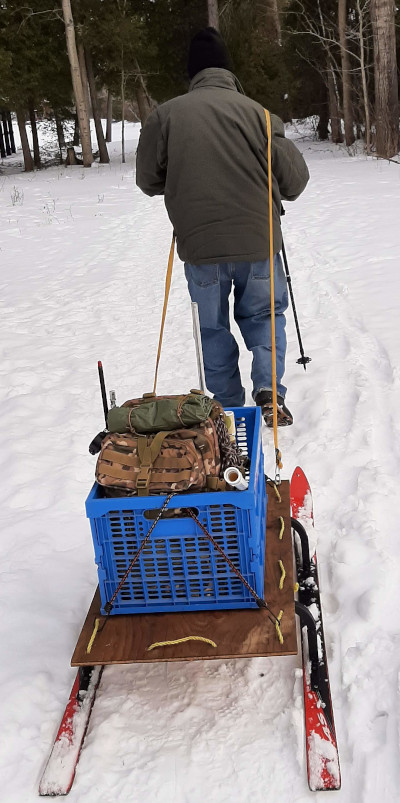
Winter radio operation back home is a little easier but still requires a lot of care and special techniques to be successful. Last winter I hiked into a local conservation area hauling my radio gear on a sled to do a POTA activation. The snow was 2 feet deep on the beach where I setup my antenna. That is when I learned that it is not an easy task to adjust the length of a counterpoise if you have to trudge through deep snow to do so (I use a different technique now). But I did develop some ways to stay tolerably warm while operating outdoors. Through similar exercises while operating Polar Bear QRP Ops events I learned techniques to protect myself and my equipment from the cold.
So here are some tips to help make it through an outdoor operating session when the cold wind blows and the snow is deep and crisp and even.
- Shelter – survival experts teach us the “rule of three”. First: shelter, then hydration, then food. Always carry water; in winter the air is dry and we dehydrate quickly. But first … put up a shelter. A tarp or tent is ideal but it is difficult to drive tent stakes into frozen ground. An alternative is to use “dead man” stakes. These lie horizontally beneath compacted snow. Better still, use a “Bothy Bag”. This device originated in the Scottish highlands and is used by mountain rescue teams. Bothy bags are very light and can be stuffed into a small pouch ready for almost instant deployment. I made my own from an old rain-fly. It has enough room for me to sit inside on my 3-legged stool and operate my manpack radio; radio and operator both sheltered from the elements.
- Batteries – batteries lose a significant amount of capacity in cold weather. It is a good idea to carry a larger amp-hour rating than you would need in summer. I use a 6.5Ah LFP battery in my QRP kit. I could get by with less but if the battery is already partially depleted and it gets cold the juice could run out before an operating session is over.
- Radios – even modern amateur transceivers can withstand quite low temperatures, but they get temperamental if subjected to sudden temperature changes. My Yaesu FT-891 is rated to be operable down to 14F/-10C. It has an internal heater (the PA transistors) that help to keep it warm, so the secret is to transmit, transmit, transmit! I see many hams set up their unprotected radios on a picnic table – not a good idea in winter. I keep my radios inside protective cases (see my previous posts on manpacks). It is a good idea to transition your radio from a warm shack to the cold exterior slowly. When you get home with your cold transceiver and bring it into your warm shack it may develop internal condensation unless you give it time to warm up slowly.
- Coax cables – a coax cable can turn quite ornery when cold. Even if you have remembered to coil it properly using the “over – under” technique, a coax cable becomes very stiff, very quickly. When I have finished operating outdoors in winter I don’t attempt to re-coil my coax until it has been warmed. Also remember that snow can get into your PL259s and SO-239s which is double plus ungood. Consider a directly connected end-fed random wire antenna instead and leave the coax at home.
- Antennas – wire antennas present some interesting challenges since they are very exposed to the elements. At my home QTH I use a 130ft wire antenna – that’s a long span and can be very heavy, especially when covered in ice or snow. I learned the hard way that using thin wire and thin support ropes doesn’t cut it. It’s no fun to re-erect a long wire antenna in the middle of winter. I replaced my antenna the last time it broke with 10ga wire supported by Atwood “Battle Cord” which has a breaking strength of 2650 pounds. It has survived through several winters with no problems. Temporary antennas are a different matter so you can still get away with lighter materials but beware of something like 26ga wire up a tree that is blowing in the wind. Talking of wind – beware of wind-induced static; use bleed resistors. Your first clue is a crackling sound in your receiver.
- Support poles – it happened to me once. I had setup my telescoping fiberglass pole on a cold day outside. Everything worked fine and dandy – until it was time to go home. There I was, with a 30ft pole in my hand, freezing my butt off, trying to collapse the pole to get it into my vehicle. For whatever reason, the pole refused to cooperate. Maybe moisture got into the joints and froze, or maybe the fiberglass material contracted and tightened in the frigid air. Panic set in; was I going to have to abandon my pole? Luck was with me and eventually, after much wrestling with the darn thing I was able to collapse it down to a short enough length to get it into my vehicle. I leave the pole at home in winter since then. Mother Nature has kindly provided 30 billion wooden support poles I can use instead.
What are your experiences with operating outdoors in the winter? Do you have any other tips to offer? Let me know in the comments.
Help support HamRadioOutsidetheBox
No “tip-jar”, “buy me a coffee”, Patreon, or Amazon links here. I enjoy my hobby and I enjoy writing about it. If you would like to support this blog please follow/subscribe using the link at the bottom of my home page, or like, comment (links at the bottom of each post), repost or share links to my posts on social media. If you would like to email me directly you will find my email address on my QRZ.com page. Thank you!
The following copyright notice applies to all content on this blog.

This work is licensed under a Creative Commons Attribution-NonCommercial-NoDerivatives 4.0 International License.
Discover more from Ham Radio Outside the Box
Subscribe to get the latest posts sent to your email.
 Ham Radio Outside the Box