
As in Parts 1 and 2, let me define what I mean by “manpack”. My manpack is a manually transportable, rapidly deployable, field expedient complete radio station for operating while pedestrian mobile or pedestrian stationary.
Why QRO? I have to admit, I love QRP; I started my HF career as a QRP operator and I still enjoy it. I have yet another QRP radio on order – a QRP Labs QMX – but I won’t belabor my frustration at how long I have to wait to take delivery. I started out with the original Yaesu FT-817 and I still own it (although I am considering selling it). But, unlike many others, I am not so committed to QRP that I wouldn’t use a higher powered radio. I also own a couple of 100 watt transceivers, including a Yaesu FT-891 that I use exclusively for outdoor operations.
Back to the question – why QRO? There are several reasons. First, as I have written before, it is usually much faster to get delivery of a QRO radio than many QRP radios. Second, a fully-featured QRO radio often costs less than a QRP radio with similar features – compare the price of, say, an Elecraft KX2 (QRP) with that of a Yaesu FT-891 (QRO) as a case in point.
But are there operational reasons why one might choose QRO over QRP? Certainly there are. A 5 watt CW signal will be received only 2 S-units lower than a 100 watt signal. But what if the conditions are such that the QRP signal is below the noise? And, what if practical considerations dictate that a highly comprised antenna is the only option?
True, a QRP radio with an efficient antenna will get the signal out in almost all conditions. But consider this; sometimes a very compromised antenna is all that is possible. I recall visiting a POTA entity in the middle of a town last summer. It is a historic public building and the only available space to operate was in the very compact grounds outside the building. A short whip and a manpack radio would be the only practical way of activating the site. I moved on to a different park where I could erect a better antenna, but I plan to return.
My QRO rig uses almost as much battery current on receive as my QRP rig uses on transmit.
Another consideration is that the RF power of a QRO radio can be wound down to QRP level when low power is an option. That is not an efficient way to operate for sure. My QRO rig uses almost as much battery current on receive as my QRP rig uses on transmit. I do have the option of operating at 5 watts, but with more power available if necessary. My mantra is: QRP when possible; QRO when necessary.
How often do I operate QRO? Well, if QRO means 100 watts, then almost never. I prefer a mode I like to refer to as QROp. If QRPp means 1 watt or less, I define QROp to mean maybe 20 watts. The battery drain with the FT-891 at 5 watts is already high; increasing power to 20 watts doesn’t increase the battery drain to any significant extent but it might help to overcome any inefficiencies in a field expedient antenna system.
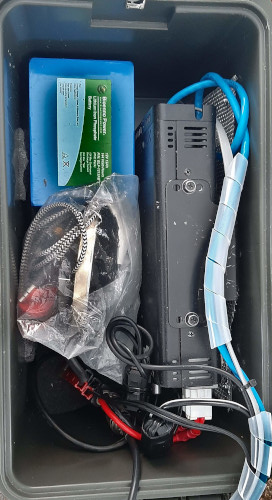
To build the QRO rig, a plastic “50-caliber ammo case” was used, just like the QRP rig. While the QRP rig is entirely self-contained, the QRO rig used to require an external battery. I use a Bioenno 12Ah LFP (Lithium Iron Phosphate) battery that lasts for at least 3 POTA activations at QROp power. I highly recommend Bioenno; their batteries are expensive but very reliable. The battery was too large to fit inside the case, mainly because the body of the FT-891 and an LDG Z11 Pro used up all the space inside.

Note the external battery on the left. Also shown are the CWMorse paddles which have a protective cover (but don’t prevent ingress of bug repellent aerosol spray as I discovered one day last summer!
To fix this problem I decided to eliminate the LDG tuner. It’s a great product that has performed admirably well for a long time, but the physical format doesn’t suit the style of enclosure I have chosen. The tuner is designed to be free standing and has no means to attach a mounting bracket. It had to lay on its side to fit into the ammo case which meant the buttons were inaccessible.
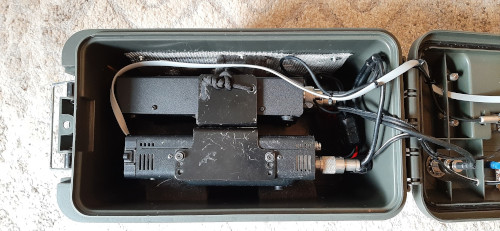
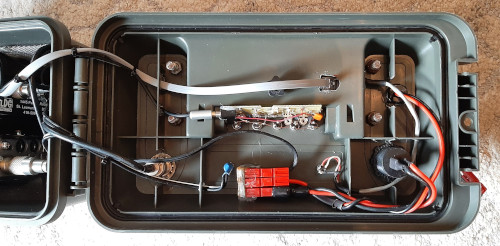
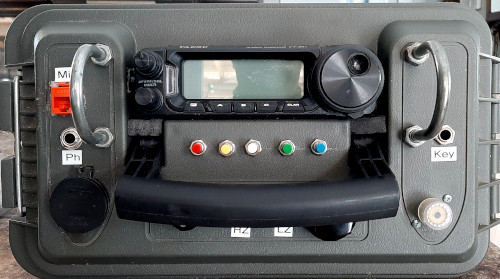
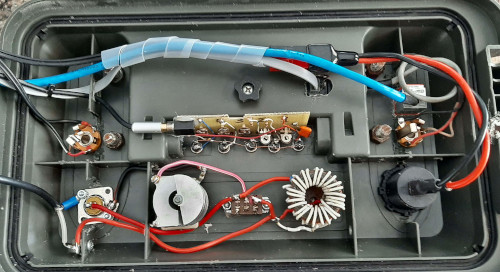
So I decided to replace it with a more compact manual tuner. I have had a lot of success with a home made manual L-match. The LDG autotuner also uses “L” topology and frankly is no faster at finding a match than the new manual L-match. Now the manual tuner AND the battery can be accommodated inside the case and there is also room to store a set of paddles and over-the-ear headphones.

Another difference between the QRP and QRO packaging is that the QRP rig case must be opened when operating. The lid was made to be removable, but when closed, provides a weatherproof seal for protection. The QRO rig does not need to be opened during operation. The FT-891 head is mounted on the case lid, as are the jacks for the CW paddles and headphones, the memory buttons, and now the L-match controls. This arrangement requires additional protection while transporting the rig. The 3.5mm jacks were recently replaced with 1/4-inch jacks for ease of maintenance, but I am considering replacing the 1/4-inch jacks with screw-on aviation style connectors for added reliability during field operations. It is difficult to keep connections clear of sand, soil, bugs and moisture when operating in the field.
Is weight an issue? Yes, the QRO rig weighs more than the QRP rig. I am not a mountain goat; actually the “mountains” in Southern Ontario reach a towering height of no more than about 500 meters (1600 feet) above sea level. The only SOTA summit in my area can be activated from the roadside; you wouldn’t even know you were on a “summit”. So I don’t worry about weight too much. I have a one-wheeled assistant I call my “mule” that can negotiate almost any terrain I am willing to operate in. I am sure a fit young member of the armed forces would laugh at the challenge of carrying my POTA backpack. Although I am reasonably fit “young” is something I remember from a long, long time ago.

This post completes the “manpack” series. I have the option of pairing the antenna described in part 1 with either the QRP rig described in part 2 or the QRO rig described in part 3. Which would you choose; QRP or QRO? Let me know in the comments.
Next up: Operating outdoors … in the winter?
Help support HamRadioOutsidetheBox
No “tip-jar”, “buy me a coffee”, Patreon, or Amazon links here. I enjoy my hobby and I enjoy writing about it. If you would like to support this blog please follow/subscribe using the link at the bottom of my home page, or like, comment (links at the bottom of each post), repost or share links to my posts on social media. If you would like to email me directly you will find my email address on my QRZ.com page. Thank you!
The following copyright notice applies to all content on this blog.

This work is licensed under a Creative Commons Attribution-NonCommercial-NoDerivatives 4.0 International License.
Discover more from Ham Radio Outside the Box
Subscribe to get the latest posts sent to your email.
 Ham Radio Outside the Box
One thought on “Building a Manpack – Part 3, the QRO Rig”