
As in Part 1, let me define what I mean by “manpack”. My manpack is a manually transportable, rapidly deployable, field expedient complete radio station for operating while pedestrian mobile or pedestrian stationary.

The complete station – radio, battery, paddles, phones and antenna fits neatly inside what is commonly called a plastic “50-caliber ammo case“. Frankly I doubt if these boxes have ever been used for storing ammunition, but they make excellent lightweight, waterproof cases for portable ham radio equipment.

I modified the case to make the lid detachable by cutting part of the hinge away with a Weller soldering gun fitted with a plastic cutting tip. The lid has recesses that make good storage compartments for a 20/40m End-Fed Half Wave wire antenna (approx 62 feet long), a short counterpoise wire and my throw line kit.
The throw line kit comprises about 100 feet of “Mason’s Twine” and one of my fameless “Sand Grenades” used as a throwing weight. I described the sand grenades in a previous post so I won’t repeat that here.
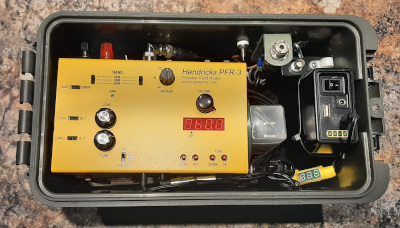
The bottom part of the case contains the radio, a Hendricks PFR3, the battery and – in a recess beneath the radio – connection cables, earbuds, paddles and leg strap.

The battery was recently upgraded from a DIY 3S1P 18650 LiIon unit to a new Talentcell 6.5Ah LiFePO4 (LFP). So far I am very pleased with the Talentcell battery pack, and it was very economically priced too.

I have learned from experience that the Hendricks PFR3 radio has to be powered with a 12 volt supply – NOT 13.8 volts. The Talentcell battery puts out 12.7 volts and like all LFP batteries the voltage remains fairly constant until the battery is nearly depleted. Out of an abundance of caution it was decided to wire a couple of high current diodes from the junk drawer in series with the supply line. The voltage under load dropped to 11.8 volts which is well within the safety zone. I can continuously monitor the voltage on a small digital meter as shown in the picture.
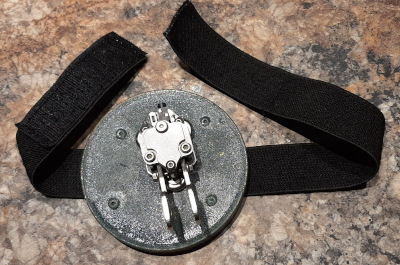
For a CW key I use Putikeeg dual lever paddles from China. I like these paddles; they provide very smooth operation and (unlike other some other manufacturers products) they have very strong magnets that hold them securely in place. I tend to get a bit rough with paddles during the excitement of a POTA activation, but these Putikeeg keys are up to the task.
The paddles are leg-mounted on a homemade device made from an elastic strap and a candy tin lid. Hey, it may not be elegant but it works!

I have a choice of antennas to pair with the QRP rig, but the principal one is an End-Fed Half Wave (EFHW) for 40m. The wire is approximately 62 feet long and is stored in the lid of the ammo case. This antenna works very well on 20m too. The Hendricks PFR3 supports 20m, 30m and 40m. For 30m I can shorten the wire to bring it closer to resonance and the radio’s internal manual tuner can be used to “touch up” the tuning.
A very short piece of coax connects the radio to the SO-239 inside the ammo case. Three clamp-on ferrite chokes help prevent common mode current being fed back to the radio. A short counterpoise (about 6 feet) is connected via a banana jack on the side of the case to deal with the very small ground current inherent with EFHW antennas.

During operation, with the lid of the case removed, a second very short piece of coax connects a 49:1 transformer to the SO-239. In the picture you can see the layout of the transformer with 5 capacitors in series across the input. Why 5? The only suitable high voltage rated capacitors in my component collection were the wrong value; 5 in series gives me (approximately) 100pF as recommended “by experts” to assist matching the higher bands – maybe not strictly necessary with this radio.
An interesting point to note about this rig is the very short transmission line (coax). Quite often, an EFHW antenna uses the coax braid as a counterpoise, but that requires a longer coax. Long coax lengths introduce loss, but a very short coax brings the antenna feedpoint very close to the radio. Is this a problem? Not for an EFHW antenna because the feedpoint is high impedance and therefore low current. There is very little radiation at a low current point (P=i^2*R) and consequently no RF exposure to be concerned about.
When I choose to deploy a different antenna that may have a low impedance feedpoint, a longer coax can be attached to the SO-239 in the case.
The end result is a compact QRP station that fits entirely within a weatherproof, lightweight plastic case with carrying handle. Could it have been made even smaller? Yes, but the design parameters called for a rig that could be set down on the ground (even in snow) and be ready for operation very quickly. I often find myself without the luxury of a picnic table upon which to set up, so this design fits the bill.
Next up: Part 3 – the QRO Rig
Help support HamRadioOutsidetheBox
No “tip-jar”, “buy me a coffee”, Patreon, or Amazon links here. I enjoy my hobby and I enjoy writing about it. If you would like to support this blog please follow/subscribe using the link at the bottom of my home page, or like, comment (links at the bottom of each post), repost or share links to my posts on social media. If you would like to email me directly you will find my email address on my QRZ.com page. Thank you!
The following copyright notice applies to all content on this blog.

This work is licensed under a Creative Commons Attribution-NonCommercial-NoDerivatives 4.0 International License.
Discover more from Ham Radio Outside the Box
Subscribe to get the latest posts sent to your email.
 Ham Radio Outside the Box