
I have two main rigs for operating outdoors, mainly for Parks on the Air (POTA) activations. I dream that one day I will have three, but my order for a QRP Labs QMX is on a never-never delivery list – well maybe one day! Rig number 1 is a Yaesu FT-891 which, although capable of delivering 100 watts, is usually set around 20 watts. It could be turned down all the way to 5 watts, but the difference in current consumption is minimal.
Rig number 2 is “Ye Olde FT-817”. I pulled the trigger on that purchase as soon as the original model was introduced while the Sun was still rising on the new millenium. Consequently it is the disappointingly basic pre-ND model. Ye Olde FT-817 is still useful for CW operations but since it has no filters and no message memories, it requires external circuitry to provide those functions.

When the FT-891 is used out in the Big Blue Sky Shack, I have 5 CW memories available to use. Each memory is accessed via my DIY FH2 buttons on the front panel of my custom go-box (the Yaesu FH2 is a handheld remote control). The buttons are programmed to send the following messages:
- 1. CQ CQ POTA de VA3KOT VA3KOT k
- 2. TU UR 599 599 ON k
- 3. VA3KOT
- 4. [Park reference number]
- 5. tnx es 73 de VA3KOT dit dit
You may think it might be a little bit lazy to use memory keying instead of sending by hand, but there are three good reasons why this is an indispensable convenience. First, POTA QSOs are very repetitive and pile-ups can be intense. Memory keying helps avoid keying errors and fatigue. Second, I log with pencil and paper; memory keying gives me a chance to ensure log entries are legible and accurate while maintaining the momentum of the contact. Third, I am often operating in less than ideal conditions; I may be sharing my operating position with a swarm of mosquitoes and other voracious man-eating insects. I may also be in the back-country in bear territory and need to stay aware of what is around me. Since I also operate in winter, my fingers can get too cold to accurately operate the paddles.
After many successful POTA activations I have discovered that I often only use the first CW memory – the CQ message. Everything else is hand keyed. So when I decided to build a memory keyer for Ye Olde FT-817 it was a simple decision to limit the design to just a single memory which would be programmed with a CQ message.
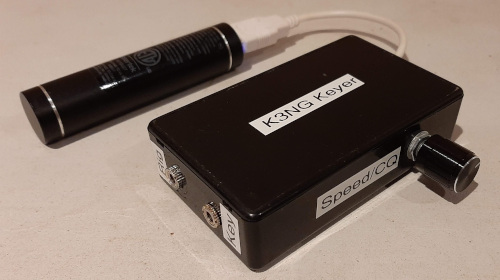
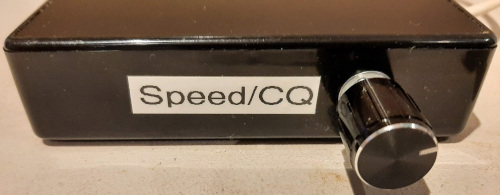
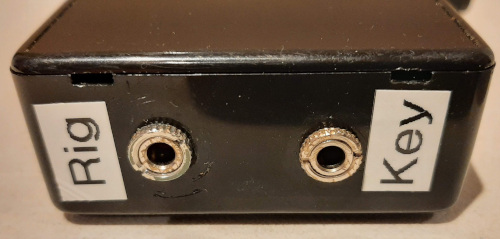
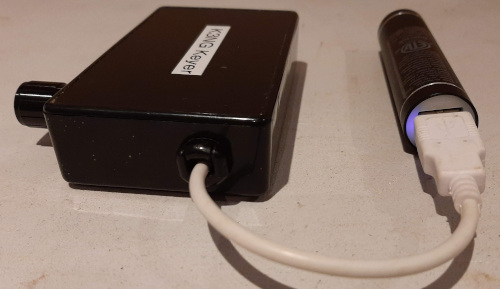
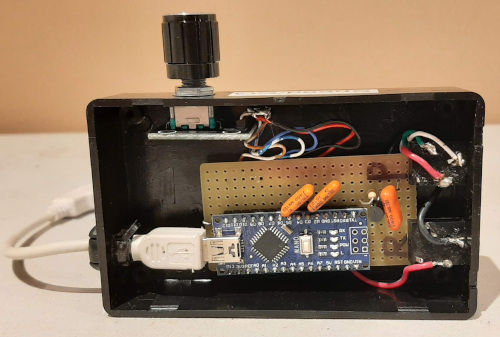

I have to give a huge amount of credit to Anthony (“Goody”) Good K3NG who wrote the rather complex Arduino sketch for this keyer.
I made one simple hardware modification for my “Unikeyer” build. Since the Unikeyer employs a rotary encoder for adjusting the code speed and rotary encoders have a built-in pushbutton switch, it was decided to use the switch to trigger the sending of a CQ message.
The hardware design employs a voltage divider resistor chain to differentiate between up to 12 available memories. The first resistor in the chain is 10 kilohms and, when grounded by the rotary encoder’s pushbutton switch, usually sets the keyer into “command mode” for changing its settings via the paddles. Message memories are selected by a daisy chain of 1 kilohm resistors in series with the 10 kilohm resistor. This was a problem! I needed to avoid additional pushbutton switches.
The solution was to remove the surface mount 10K resistor on the rotary encoder’s circuit board and replace it with an external component. Now, when the rotary encoder’s pushbutton switch is pressed, both the 10k resistor and a series 1k resistor are grounded to trigger sending a CQ message. It works very well and has prolonged the life of Ye Olde FT-817. Hopefully I can keep the old girl alive long enough into the future until, if I live that long, my QRP Labs QMX will replace it. One lives in hope.
Help support HamRadioOutsidetheBox
No “tip-jar”, “buy me a coffee”, Patreon, or Amazon links here. I enjoy my hobby and I enjoy writing about it. If you would like to support this blog please follow/subscribe using the link at the bottom of my home page, or like, comment (links at the bottom of each post), repost or share links to my posts on social media. If you would like to email me directly you will find my email address on my QRZ.com page. Thank you!
The following copyright notice applies to all content on this blog.

This work is licensed under a Creative Commons Attribution-NonCommercial-NoDerivatives 4.0 International License.
Discover more from Ham Radio Outside the Box
Subscribe to get the latest posts sent to your email.
 Ham Radio Outside the Box