
What is a “Radio Camp”? Put simply, a Radio Camp is a rapidly deployable temporary setup established for the primary purpose of operating ham radio outdoors. It is not quite the same as a traditional vacation or RV camp. A Radio Camp might be setup for a very short period (e.g. for the duration of a POTA activation) and probably doesn’t include sleeping equipment.
Where to set up a Radio Camp? A Radio Camp might be set up in a remote bush location accessible only by hiking along a trail or canoeing from lake to lake. It might also be set up in a home’s backyard! There is a lot of enjoyment to be had traveling from lake to lake by canoe with portages to traverse along the way. I have done that several times. The nearest road might be several miles and multiple lakes away. And then add the fun of operating HF radio from a small clearing at the side of a lake – magic!
What is the purpose of a Radio Camp? Its purpose is to provide a comfortable environment to shelter operator and equipment from the weather, insects etc during a radio operation. A Radio Camp is self-contained and does not rely on any buildings, benches or picnic tables. The radio operator will carry in all equipment and everything needed for comfort.
Above all, the entire Radio Camp must be rapidly deployable so that it may be set up and torn down as quickly as possible. This is essential for activities such as POTA’s Rover award or the RaDAR Rally.
When to deploy a Radio Camp? Heck, why not just operate from the comfort of a vehicle, or at a table inside a park picnic shelter? Picnic tables and shelters aren’t always available in the back country; in fact they are rare. If the weather is mild and the bugs are not too bad you can get away without setting up a shelter if you have limited time available. But why rush? Enjoy the experience!
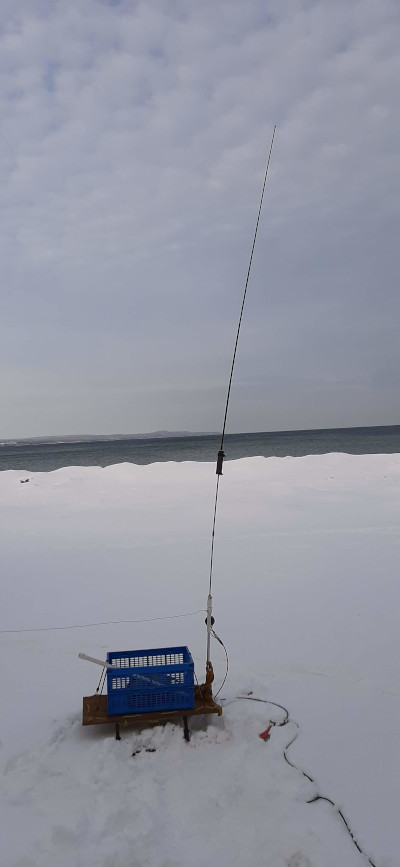
But let’s say the weather is inclement; maybe it is cold and snow is falling. Then it becomes necessary to protect operator and equipment from the elements. Who in their right mind would go outside to operate in those conditions anyway? The Polar Bear QRP group would! In fact we bears exist to go outdoors and play radio throughout the winter in an activity called the Polar Bear Moonlight Madness Event. It is held on the closest Saturday to a full moon each month.
OK, so what are the essentials for prepping a Radio Camp? There are four essentials.
- Shelter – first get some protection from the weather
- Water – important in any season; stay hydrated
- Food – keep your strength up, replace the calories you burned getting to camp
- Radio – well, that’s the reason for being there after all!
What kind of shelter is best? If you are setting up Radio Camp in your backyard a pop-up tent might be a good choice. Modern small tents can often be erected in as little as one minute. But, the downside is they can be a little heavy – too heavy to carry a long way down a rough trail along with your radio gear.
I recommend a tarp shelter. If you search online you can find many resources providing detailed instructions on how to build a tarp shelter. The following images illustrate some of the different tarp shelters I have built and used.


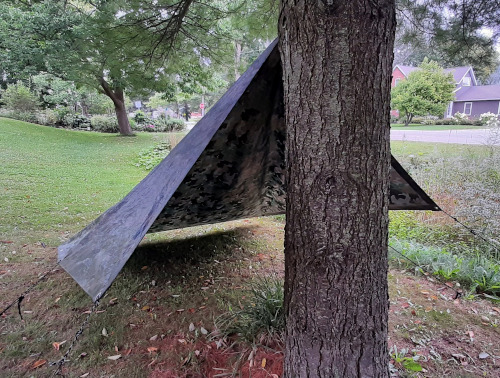
Some tarp shelters require trees for support. One technique involves tying a ridge line between two trees and throwing a tarp over the line in an A-frame design. There are many different ways of setting up a ridge line but my favorite requires no knots to tie in the field. Instead, the line is prepared in advance by tying a series of simple overhand knots, every 4 inches, in a folded length of cordage. The technique, pioneered by the British military, is called “Jungle Knots”. A Jungle Knot ridge line can be set up and torn down in mere seconds.

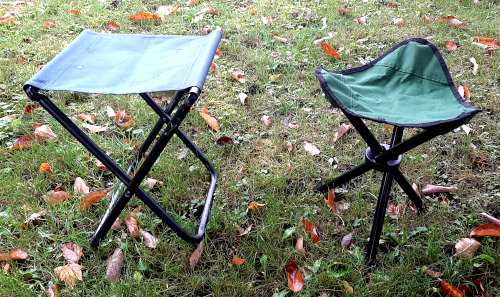
How to comfortably furnish your shelter? Maybe it’s my age but I cannot sit comfortably on the ground while operating my radio; I need a chair! Some of the camping chairs I own sink into the ground when I sit on them. I also find the common folding lawn chairs with nice comfy arm rests unsuitable. They restrict my right arm movement and make my CW keying even more erratic than it normally is. The stool on the left in the picture below is one I use frequently. The 3-legged stool on the right packs up nice and small, but it’s a sinker!
Now that we are sitting comfortably inside our cosy shelter, how about a nice table on which to place our radio equipment? A suitable table should have a nice flat, firm surface and strong legs. The perfect solution is a clipboard; legal size is best but letter size works. And legs? Yes, I have two of them. The clipboard sits on my lap and accommodates a Rite in the Rain logbook and pencil, paddles and a phone for checking the UTC time for the log.
Camper’s creature comforts? There are a couple of other considerations to take care of – maybe even before calling CQ. If the weather is cold a source of heat is needed. A simple candle heater can provide enough heat to warm up fingers and prevent frostbite. Other alternatives are a folding stove with “chafing fuel” intended for keeping food warm in restaurants, or an alcohol stove made from a soda pop can.

Food glorious food? I always seem to get very hungry after completing a POTA activation. Maybe the excitement of battling pileups and receiving responses to my CQs from remote DX stations burns a lot of calories. Maybe it’s just my mind playing tricks. Or maybe I got so caught up in the fun of playing radio out in the Big Blue Sky Shack that I failed to notice that it’s meal time!
The simplest way to prepare a quick hot drink or meal is to boil some water on a tiny camping stove. If you like tea, grab a teabag and some powdered milk and you’re good to go. If you prefer coffee, tie some ground coffee inside a small piece of cheese cloth and drop it in boiling water in a camp cup – it’s good!
If you need a meal, try a pack of dried Ramen noodles; they cook really fast in boiling water on the camp stove. Alternatively make your own MREs in freezer bags; freezer bags can also be safely boiled in water to reheat a pre-cooked meal.
That sounds like a lot of gear to carry! Yes, it sounds like a lot of gear, but everything can be rolled or folded flat and stuffed into a backpack. But what can you do if your pack is a little too heavy? Let’s say you have some difficult terrain to traverse. A heavy backpack moves your center of gravity higher up your body and that can lead to balance problems on difficult terrain. You may need transport. Experience has taught me that a single wheeled pull cart works best on many of the rocky, uneven trails encountered in my region.
I built one from pieces of tubing scrounged from various sources (a golf cart, a children’s stroller and a kid’s bicycle). The “mule”, as I call it, carries all my radio gear inside a canvas NATO style rucksack. Everything else packs into a backpack that I wear. The backpack attaches to the “mule” handles with small loops of webbing leaving my hands free to use trekking poles to maintain my balance. In winter the “mule” is replaced with a DIY “Radio Sled”.

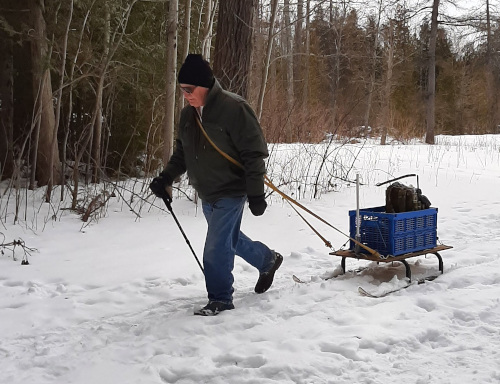
How to modify trekking poles for ham radio use
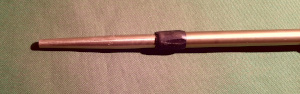
Trekking poles for ham radio use need a couple of small modifications. With these mods completed, the poles have multiple uses in amateur radio. Step One: remove the plastic molded tips at the bottom of the poles. These tips are usually glued onto the poles so I found a little less-than-gentle persuasion was required to remove them. First, I warmed the plastic tips with a heat gun to soften them. Then, I held the tips in a bench vise and, using a pair of vise grips on the metal pole just above the tips, I twisted the pole until the glue surrendered to superior force. The bottom end of the trekking poles are tapered to a point about a quarter of an inch diameter.
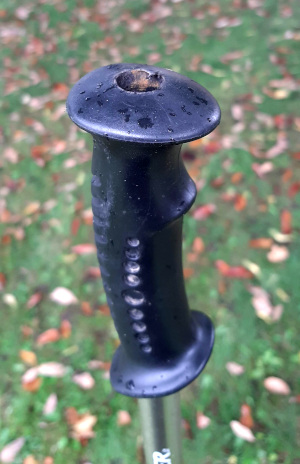
Step Two: drill a hole in the top of the plastic handles. The hole should be sufficiently large to allow two poles to be nested vertically by inserting the tip of one pole into the handle of the other pole.
The modified trekking poles can still be used for their intended purpose, but now they can also be used to support the ends of antenna wires – the pointed end of the pole can be pushed into soft ground allowing the pole to be free standing.
If the two poles are nested vertically they can also be used to support a tarp shelter high enough to allow a radio operator to stand up inside.
Radio Camping is a Whole Lot of Fun!
Yes, you can pull into a parking lot, turn on your radio, transmit into a mag-mount antenna on your vehicle roof, make your contacts and drive on. Or you can immerse yourself in the beauty of nature, harmonize with the wind in the trees, listen to the waves breaking on the shore of a back country lake and hear the loons calling up the wind out on the water. Sip on a fresh-brewed camp coffee and take your radio activity slowly. What’s the rush?
Help support HamRadioOutsidetheBox
No “tip-jar”, “buy me a coffee”, Patreon, or Amazon links here. I enjoy my hobby and I enjoy writing about it. If you would like to support this blog please follow/subscribe using the link at the bottom of my home page, or like, comment (links at the bottom of each post), repost or share links to my posts on social media. If you would like to email me directly you will find my email address on my QRZ.com page. Thank you!
The following copyright notice applies to all content on this blog.

This work is licensed under a Creative Commons Attribution-NonCommercial-NoDerivatives 4.0 International License.
Discover more from Ham Radio Outside the Box
Subscribe to get the latest posts sent to your email.
 Ham Radio Outside the Box