
Whenever I venture out into the Big Blue Sky Shack – which is often (even in winter) – my entire station has to fit into a backpack. Radio, Bioenno LFP battery, paddles, headphones, logbook, pencils, lapdesk, antennas, stool and all the other bits and pieces necessary to operate out in the bush. Everything has to be carried on my back, so weight and bulk are a major consideration when deciding what gear makes the trip.
Wherever possible each item has to have more than one function. For example, trekking poles have a primary function of helping me maintain balance while negotiating rocky terrain with a heavy pack on my back. But trekking poles can also be used in other ways such as supporting a tarp shelter, holding up the ends of wire antennas and even as a mechanical aid in launching a line into a tree.
As a side note I should add that I have been practicing launching lines into trees using the arborist technique of swinging a weight (my “sand grenades”) and throwing the line up and over a branch. I have to credit Don WB0ISG for some helpful tips on throwing technique (it’s working Don).
My primary field rig for outdoor operations is a Yaesu FT891 with an LDG Z-11 Pro automatic tuner. I typically use either a vertical whip or an End-Fed Random Wire (EFRW) antenna. Where there is a suitable tree available the EFRW antenna is the preferred choice.
In a previous post I discussed whether to use a 9:1, 4:1 or 1:1 transformer to match the relatively high impedance of a random wire. Since the impedance of a random wire will be “all over the Smith Chart” depending on which band is chosen, it makes sense to use a 1:1 unun and let the ATU take care of the matching. An external ATU has an impedance matching range of 10:1 so it can find a match for antenna impedances in the range of 5-500 ohms.


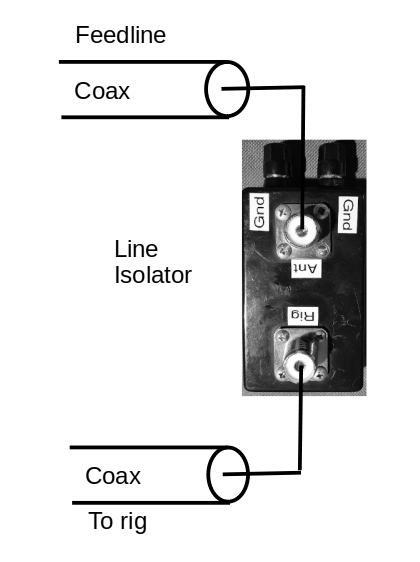
A 1:1 unun can be as simple as a few turns of coax on a ferrite core. But, just a minute, that also describes a Common Mode Current Choke (CMCC) or a Line Isolator. So one piece of equipment can serve in a number of different ways to support various antennas. Some examples are provided here:
Use as a 1:1 unun replacing 9:1 or 4:1 transformer with a random wire antenna
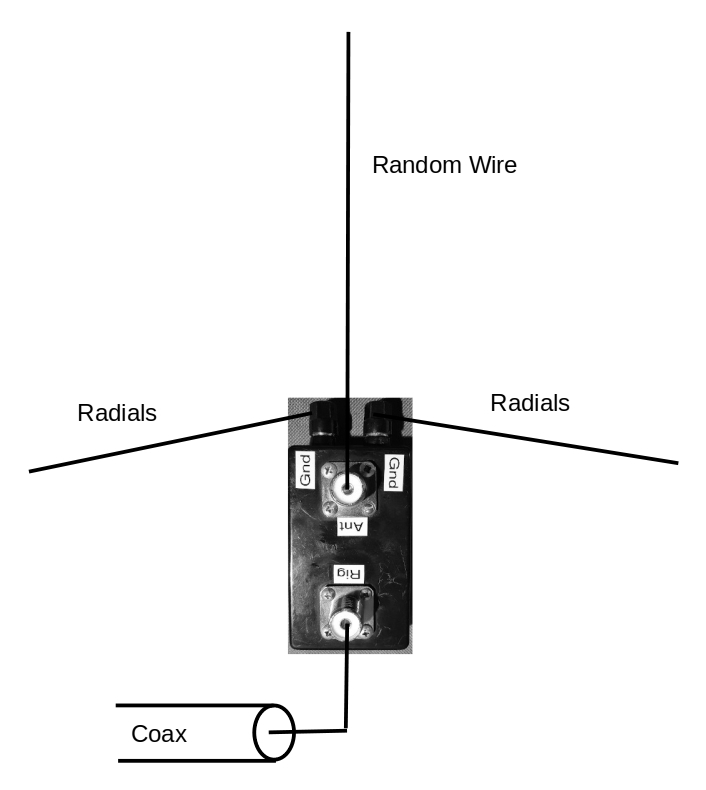
Use as a 1:1 unun with a quarter wave whip antenna

Use as a Line Isolator to block induced RF on the feedline – commonly used with an End-Fed Half Wave (EFHW) antenna where the feedline acts as a counterpoise. The Line Isolator is located at the rig end of the feedline, or sometimes at some point along the feedline in the case of an EFHW.
Help support HamRadioOutsidetheBox
No “tip-jar”, “buy me a coffee”, Patreon, or Amazon links here. I enjoy my hobby and I enjoy writing about it. If you would like to support this blog please follow/subscribe using the link at the bottom of my home page, or like, comment (links at the bottom of each post), repost or share links to my posts on social media. If you would like to email me directly you will find my email address on my QRZ.com page. Thank you!
The following copyright notice applies to all content on this blog.

This work is licensed under a Creative Commons Attribution-NonCommercial-NoDerivatives 4.0 International License.
Discover more from Ham Radio Outside the Box
Subscribe to get the latest posts sent to your email.
 Ham Radio Outside the Box