
I have a real problem with using vertical antennas when operating field portable. And I mean quarter-wave vertical antennas. You see they need “the other half”; a ground plane, radials, or counterpoise and without “the other half” they just aren’t going to work.
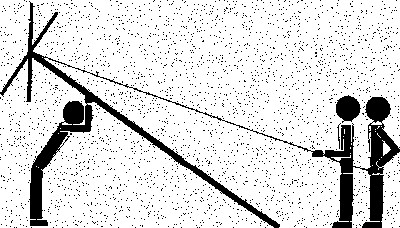
So here’s the rub (as Shakespeare would undoubtedly have commented had he not been born four centuries before the invention of radio). A quarter-wave vertical occupies a very small footprint. A radial field or even just a single counterpoise wire requires a much larger footprint. So, if we have sufficient room in the great outdoors to put up a 33ft long raised counterpoise for the 40-meter band, why not just use a wire antenna anyway?
And here’s another “rub”. A quarter-wave vertical antenna can be mounted on a backpack for pedestrian mobile operation. The “other half” then becomes a drag wire which makes intermittent and constantly variable capacitive connection to ground.
So can we get rid of “the other half” of the antenna to make pedestrian mobile or field portable operation less awkward? No. But we can make it less inconvenient and this contrarian tinkerer is on a quest to explore strange new worlds and boldly go where no ham has gone before to discover all the ways to make it so.
So far I have come up with five alternatives:
- A Ground Tuning Unit with a capacitive ground connection
- A tuned counterpoise to resonate a short conductor
- A full-length quarter-wave spiral counterpoise
- A ground rod, 8-feet long pounded into the ground
- A saltwater ground plane such as an ocean
Option 4 can be summarily discarded. Pounding copper-plated steel rods into the ground isn’t terribly convenient for temporary field portable operations. Option 5 has been successfully demonstrated by well-known YouTuber Peter Parker VK3YE who paddled in shark-infested Australian waters wearing a conductive ankle bracelet. Personally I have three options for saltwater. I can travel hundreds of miles east or southeast to the Atlantic coast. I can travel way up north to Hudson’s Bay or, I can arrange to flood the world’s largest underwater salt mine on Lake Huron. None of those options is likely so Option 5 goes in the bin too.
That leaves three practical options that we’ll explore in separate posts:
– A Ground Tuning Unit (a.k.a. Artificial Ground)
– A Tuned Short Counterpoise
– A Spiral Counterpoise
Dare I say “Stay Tuned” …
Discover more from Ham Radio Outside the Box
Subscribe to get the latest posts sent to your email.
 Ham Radio Outside the Box
Very interesting site!
On the issue of verticals, I’ve played with antennas for nearly 50-years, with quarter-wave verticals being my favorite. I’ve found that the bane of vertical antennas is the counterpoise… or as you call it, the “other half.”
I’ve visited ham stations that used quarter-wavers. These are very popular antennas – who doesn’t love an antenna that can be quickly installed and easily maintained at ground level, often by one person? Unfortunately I’ve seen enough quarter wave vertical stations to understand why such antennas have less than a sterling reputation. It’s the counterpoise thing.
I’ve seen few quarter-wavers that were properly counterpoised. At least one manufacturer of a popular multi-band trap design instructs to install just two counterpoise wires per band cut to resonant length for each band the trap antenna is designed for. Well, cutting counterpoise wires to length but then laying them on top or under the ground detunes the intended resonance… at least that’s what an antenna analyzer tells me when I’ve checked such as arrangement.
I understand that the industry standard for commercial broadcast vertical towers is 120 counterpoise radials which I’ve always presumed to be the standard for such antennas. But how much time, effort and expense is required to lay such a counterpoise?
But what antenna manufacturer is going to suggest such a thing in order to get maximum performance from their product? So, over the decades I’ve come up with two very effective alternatives. The first is this… do you have a tin-roof on the house, car port, barn, etc.? If so mount the quarter-wave antenna on top – it can be in the center, or a corner.
Now, elevating the antenna above ground will cause the resonance to go haywire, but this can be remedied by winding the coax at both ends into an RF choke…. simply make a 6″ loop of 10 turns no further than 8-feet from the antenna feed point, and an identical loop no further than the same distance from the transmitter. That will cure the mismatch created by elevating the vertical above ground (some hams claim this should be done regardless of how the antenna the mounted).
The next step is is labor intensive, but very effective… chicken coop wire; using the tallest wire you can find. Unroll the wire outward from the antenna base in at least four directions, and for the heck of it make the length of the wire 1/4 wavelength at the lowest band the vertical will be operated on whether it’s a multi-band trap, or a monoband design. The last time I did this it took three full days of labor – something I can no long do in my old age. Make a 360-deg circle of bare, heavy gauge copper around around the base of the mounted antenna, and solder each protrusion of the chicken wire to this circle.
Now for more fun – everywhere there is a twist in the chicken wire, solder those twists together.. All this soldering will require a propane torch and you will deplete several bottles of propane and a lot of solder to get the job done.
The next consideration how to bury the chicken wire counterpoise. Well, you do NOT. You tack the wire down using whatever you can come up with for the job. I used metal coat hangers cut to several inches in length and bent into a U-shape staple (a LOT of coat hangars). Once you have all the chicken wire tacked down as closely to the ground as you can, you will mow the grass quite high for a couple of seasons. The cut grass will pile atop the chicken wire and effectively burry it in two or three seasons of mowing.
Sure, it’s a lot of work, but far less than burying 120 radials. And for what it’s worth it has my guarantee that you can’t come by a more effective “other half” counterpoise. I got this idea from a fellow ham back in the 1970’s who laid out a patch of chicken wire to counterpoise a copper tube cut for 15-meters only. He was a DX buff and was working the world with what he called his “chicken coop vertical.”
LikeLike
Interesting ideas Tom, but an even simpler idea is to raise the base of the vertical above ground. Then as few as 2 raised radials will be effective. For portable Ops like myself even 1 raised counterpoise is enough to get the QSOs in the log. I appreciate you sharing your 50 years of experience, thank you!
LikeLike